




-
6

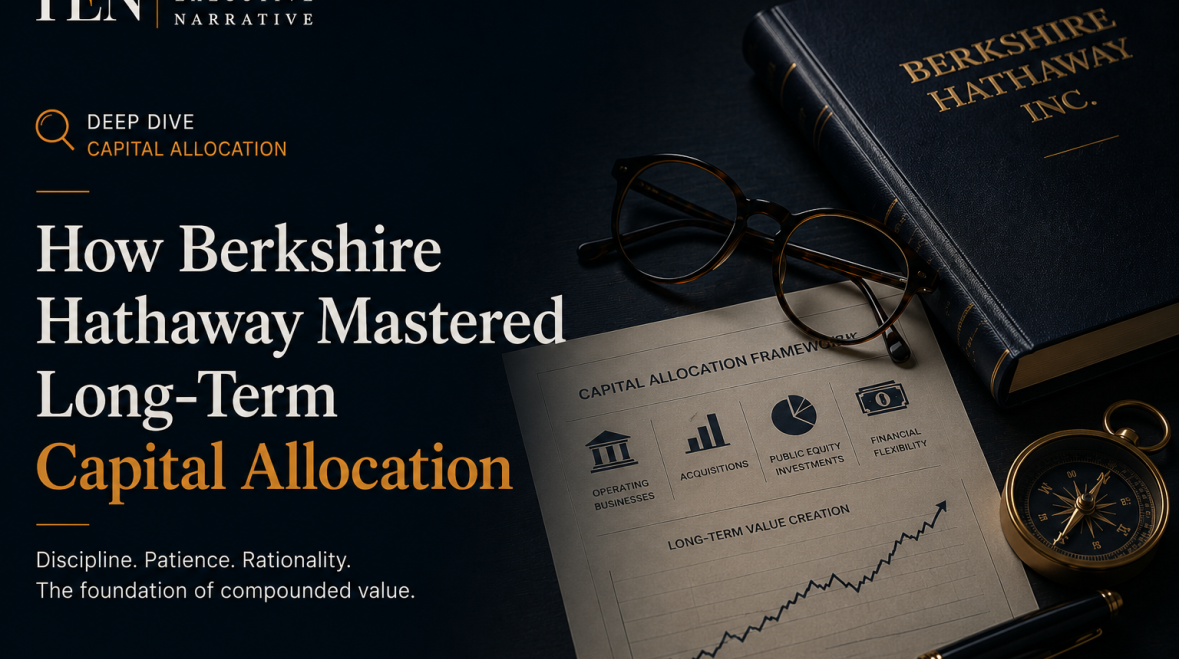
How Berkshire Hathaway Built the Greatest Capital
Allocation Machine in Modern Business
Executive Summary
Most companies compete by building better
products, expanding into new markets, or acquiring competitors. Berkshire
Hathaway's capital allocation strategy followed a fundamentally different path.
Rather than treating capital as a financial resource, Berkshire Hathaway
transformed capital allocation into its primary competitive advantage. Every
dollar generated by its businesses is viewed as an opportunity to create
greater long-term value through disciplined reinvestment.
Over six decades, Berkshire Hathaway evolved from a struggling textile
manufacturer into one of the world's most valuable conglomerates by applying a
consistent decision framework centered on patience, rationality, and long-term
value creation. Instead of maximizing quarterly earnings, management focused on
allocating capital where it could generate the highest risk-adjusted returns
over decades.
This Deep Dive explores the governance principles, operating model, and
investment discipline behind Berkshire Hathaway's capital allocation framework,
revealing why it remains one of the most successful long-term investment
strategies in modern business.
The Strategic Challenge
Every mature organization faces a
fundamental strategic question: Where should the next dollar of capital be
deployed? Many companies pursue acquisitions, share buybacks, or expansion
initiatives without a consistent framework, resulting in fragmented investments
and declining returns.
Berkshire Hathaway approached this challenge differently. Rather than measuring
success by growth alone, the company evaluated every capital allocation
decision against its long term ability to compound shareholder value. The
objective was not simply to invest more capital but to allocate capital more
intelligently than competitors, reinforcing a disciplined capital allocation
strategy.
Strategic Decisions
Berkshire Hathaway's capital allocation
strategy is built on three defining decisions.
First, the company centralized capital allocation while decentralizing business
operations. Subsidiary leaders retained complete operational autonomy, while
major investment decisions remained disciplined at the corporate level. This
structure enabled entrepreneurial execution without compromising financial
discipline.
Second, management consistently invested in businesses possessing durable
competitive advantages, predictable cash flows, and capable leadership teams.
Rather than pursuing speculative growth, Berkshire Hathaway emphasized
businesses capable of compounding value over extended periods.
Third, Berkshire maintained significant financial flexibility by preserving
substantial cash reserves. Instead of viewing idle cash as inefficient, management
considered liquidity a strategic asset that enabled decisive investments during
periods of market uncertainty.
Operating Model
Berkshire Hathaway functions as a capital
allocation platform rather than a traditional holding company. Operating
businesses generate substantial cash flows that are continuously evaluated for
reinvestment across acquisitions, public equity investments, business
expansion, or retained liquidity.
This operating model is reinforced through decentralized management, disciplined
governance, conservative leverage, and long-term ownership. Together, these
elements create a self reinforcing system where capital generated by existing
businesses funds future growth opportunities, allowing the organization to
compound value over multiple economic cycles.
Strategic Trade-offs
Every strategy requires deliberate
sacrifice. Berkshire Hathaway willingly forgoes short term growth opportunities
that fail to meet its long-term investment criteria. The company also accepts
periods of underperformance during speculative market environments rather than
compromising its investment discipline.
This conservative approach may limit rapid expansion, but it protects capital
from permanent impairment and preserves the organization's ability to capitalize
on future opportunities. The result is a long term capital allocation strategy
designed to maximize sustainable value rather than short-term performance.
Executive Lessons
Berkshire Hathaway demonstrates that
sustainable competitive advantage is determined not only by operational
excellence but by disciplined capital allocation.
Questions Every Executive Should Ask
• Does every investment support our long-term strategy?
• Are we allocating capital based on opportunity or external pressure?
• Does our governance encourage rational decision-making?
• Are we maximizing long-term value rather than short-term activity?
Organizations that consistently allocate capital with discipline are more
likely to create enduring competitive advantage and stronger shareholder value.
TEN Perspective
Berkshire Hathaway's greatest achievement
is not simply owning exceptional businesses. Its true advantage lies in
institutionalizing Berkshire Hathaway's capital allocation framework as a core
organizational capability.
Many organizations view capital as a resource to be deployed. Berkshire
Hathaway views capital as an asset to be compounded through patience,
governance, and rational decision making. The broader management lesson is
clear: enduring organizations are built not by making more investments, but by
making better investment decisions consistently over time. Effective capital
allocation is not merely a financial discipline it is the foundation of
long-term competitive advantage.
Share:
Weekly trending

Stay Informed with Global Headlines
16 Jul, 2025
- 6 mins read

The Rise of Mindful Living in a Digital World
16 Jul, 2025
- 6 mins read

The Quiet Power of Present Living
16 Jul, 2025
- 6 mins read

Minimalism in Design: Why Less is Still More
16 Jul, 2025
- 6 mins read






Recommended for you
Breaking Down the Elements of a Masterpiece Painting
The Revival of Classical Art in a Digital Age
Must-See Art Exhibitions Around the World This Year
The Revival of Classical Art in a Digital Age