




-
6

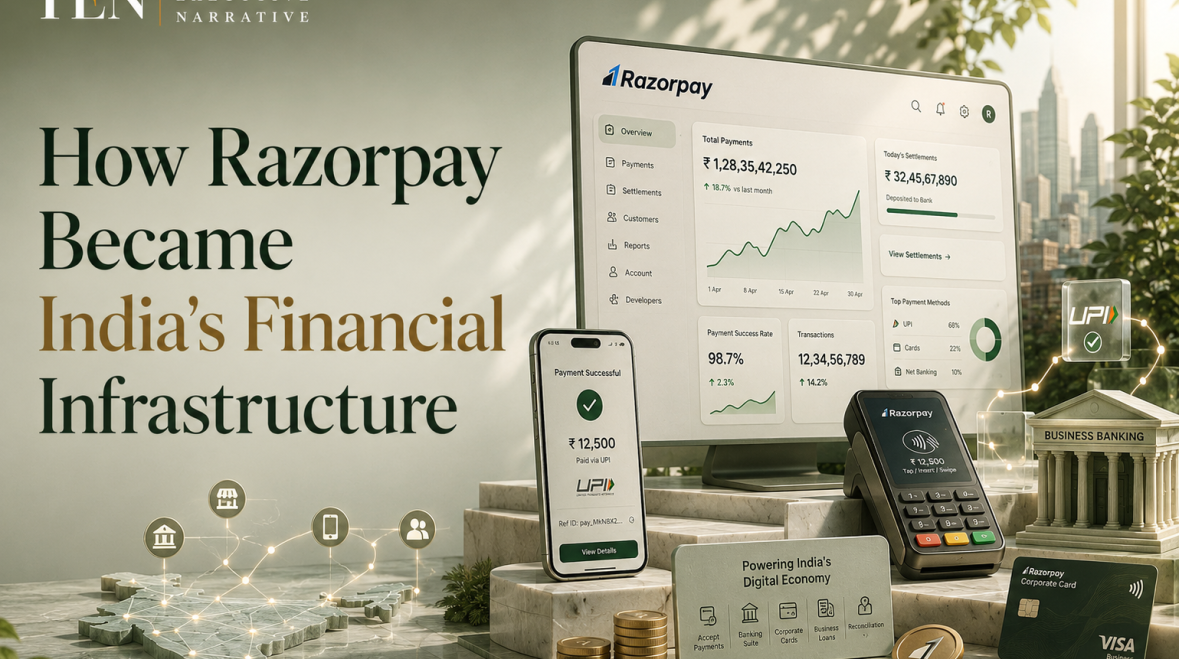
India's fintech boom created hundreds of payment companies, yet only a handful evolved into strategic infrastructure. Razorpay's defining advantage was not building a superior payment gateway, but recognizing that payments were merely the first interaction in a business's financial workflow. Instead of optimizing transactions, the company embedded itself into the operating system of modern businesses by integrating banking, payouts, lending, payroll, and financial automation into a single platform.
This strategic shift transformed Razorpay from a service provider into financial infrastructure. The deeper its products became embedded in day-to-day operations, the harder it became for customers to replace the platform without disrupting critical business processes. This Deep Dive argues that Razorpay's enduring advantage lies not in payments, but in controlling the financial workflows that surround them.
The Strategic Challenge
For years, digital payments in India were treated as an isolated problem. Payment gateways competed on transaction success rates, pricing, and ease of integration, while businesses continued to rely on separate providers for banking, payroll, vendor payouts, reconciliation, and financing. The industry assumed that improving individual financial products would be sufficient to serve growing enterprises.
That assumption proved incomplete. As businesses digitized, operational complexity shifted from processing payments to managing the movement of money across multiple systems. The challenge was no longer enabling transactions; it was orchestrating the entire financial lifecycle of a business.
The Strategic Insight
Razorpay recognized that payments generate valuable context rather than lasting differentiation. Every transaction reveals information about cash flow, customer behavior, vendor relationships, and business health. By positioning payments as the entry point instead of the final product, Razorpay gained visibility into the financial workflows of its customers.
This insight fundamentally changed the company's strategic direction. Rather than expanding horizontally into unrelated services, Razorpay expanded vertically across interconnected financial workflows. Each new capability strengthened the value of the existing platform, increasing customer dependence while creating opportunities for deeper integration.
The Competitive Mechanism
Razorpay's competitive advantage is reinforced through a self-reinforcing ecosystem. Payment processing attracts businesses to the platform. Those businesses adopt payout automation to simplify vendor payments, payroll tools to streamline employee compensation, and banking solutions to centralize financial operations. As adoption grows, Razorpay gains richer operational data that improves underwriting, risk management, and financial automation.
This creates a reinforcing loop. Every additional product increases switching costs because customers are no longer replacing a payment gateway; they are replacing an integrated financial operating system. Competitors can replicate individual features, but recreating the relationships between those products requires years of integration, customer trust, regulatory partnerships, and operational execution.
Operating Model
Razorpay deliberately chose to build software around the banking system rather than becoming a bank itself. This allowed the company to innovate rapidly while leveraging regulated banking partners for compliance and financial services. Instead of owning every financial asset, Razorpay focused on owning the customer experience and workflow orchestration layer.
Internally, the company follows a platform philosophy where every new product must strengthen the broader ecosystem rather than operate independently. Product teams are incentivized to deepen customer engagement across multiple financial workflows, reinforcing the platform's long-term strategic position.
Strategic Trade offs
Expanding beyond payments required significant investment in technology, compliance, partnerships, and product development. Razorpay accepted higher complexity instead of pursuing the simplicity of remaining a payment gateway.
The company also chose platform depth over rapid international expansion. Concentrating on solving India's unique financial infrastructure challenges allowed Razorpay to build capabilities tailored to local regulatory frameworks, banking relationships, and business needs rather than pursuing global scale prematurely.
Why Competitors Struggle
Competing with Razorpay requires far more than matching payment features. Established banks often possess the financial products but lack the speed and developer-first experience expected by digital businesses. Standalone fintech companies can innovate quickly but frequently lack the breadth of services and ecosystem integration that Razorpay has assembled.
The company's advantage lies in the combination of technology, banking partnerships, operational data, and customer workflows. Replicating one component does little to weaken the broader system because the competitive advantage emerges from how those components reinforce one another.
Executive Lessons
Organizations rarely create enduring competitive advantage by optimizing individual products. They create it by identifying adjacent workflows that customers struggle to manage and integrating them into a coherent system.
Razorpay demonstrates that infrastructure is not defined by scale alone. It is defined by indispensability. Businesses become difficult to replace when they evolve from solving isolated problems to orchestrating critical workflows that customers rely on every day.
Questions Every Executive Should Ask
• Are we solving a customer task or becoming part of the customer's operating system?
• Which adjacent workflows strengthen the value of our existing platform?
• What operational data can create new strategic capabilities over time?
• Does every new product reinforce the competitive position of the entire ecosystem?
TEN Perspective
The future of fintech will not be determined by who processes the most payments. It will belong to the companies that become the invisible operating layer through which businesses manage money. Razorpay's greatest achievement is not that it made payments easier. It recognized that controlling the flow of money creates the opportunity to shape how businesses operate. In the long run, infrastructure companies do not win because they process more transactions. They win because they become impossible to operate without.
Share:
Weekly trending

Stay Informed with Global Headlines
16 Jul, 2025
- 6 mins read

The Rise of Mindful Living in a Digital World
16 Jul, 2025
- 6 mins read

The Quiet Power of Present Living
16 Jul, 2025
- 6 mins read

Minimalism in Design: Why Less is Still More
16 Jul, 2025
- 6 mins read






Recommended for you
Breaking Down the Elements of a Masterpiece Painting
The Revival of Classical Art in a Digital Age
Must-See Art Exhibitions Around the World This Year
The Revival of Classical Art in a Digital Age