




-
4

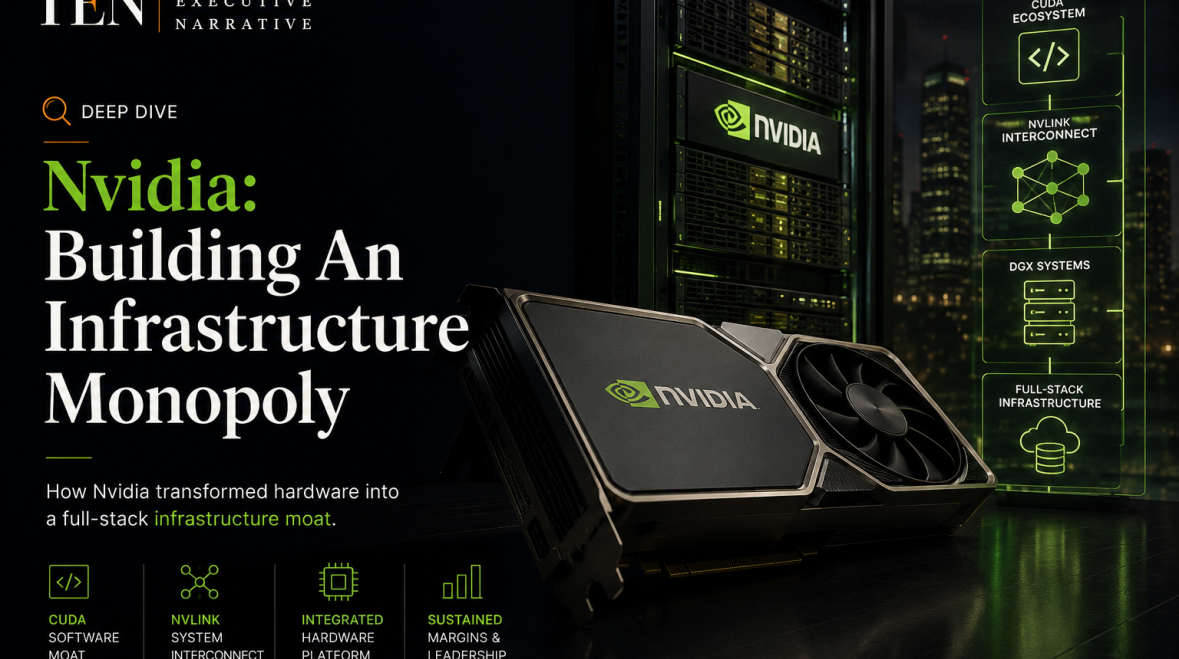
Nvidia: Building An Infrastructure Monopoly
Executive Summary
Hardware businesses usually face a brutal reality:
point-solution components eventually get commoditized, and profit margins get
crushed. Nvidia completely broke this economic law.
By reaching multi-trillion-dollar valuations while
maintaining 70%+ gross margins, it transformed into the foundational compute
engine of modern enterprise intelligence.
It achieved this not through raw chip speed alone, but by
turning a physical microchip into a tightly coupled software, networking, and
hardware system. This analysis breaks down the strategic decisions that turned
a hardware maker into an infrastructure monopoly—and extracts universal
principles for executive teams building enduring moats.
The Strategic Challenge
In the hardware industry, buyers hold all the leverage when
components are easily replaceable, triggering zero-sum price wars that destroy
gross margins. For high-performance computing, connecting thousands of GPUs
created severe communication latency and bandwidth deadlocks across distributed
data centers. The standard industry assumption was to specialize purely in
silicon and outsource networking and software to third parties.
Nvidia challenged this premise by asking a radical question:
What if hardware is simply the monetization vehicle for an un-copyable software
and networking ecosystem?

Share:
Weekly trending

Stay Informed with Global Headlines
16 Jul, 2025
- 6 mins read

The Rise of Mindful Living in a Digital World
16 Jul, 2025
- 6 mins read

The Quiet Power of Present Living
16 Jul, 2025
- 6 mins read

Minimalism in Design: Why Less is Still More
16 Jul, 2025
- 6 mins read






Recommended for you
Breaking Down the Elements of a Masterpiece Painting
The Revival of Classical Art in a Digital Age
Must-See Art Exhibitions Around the World This Year
The Revival of Classical Art in a Digital Age