




-
5

Executive Summary
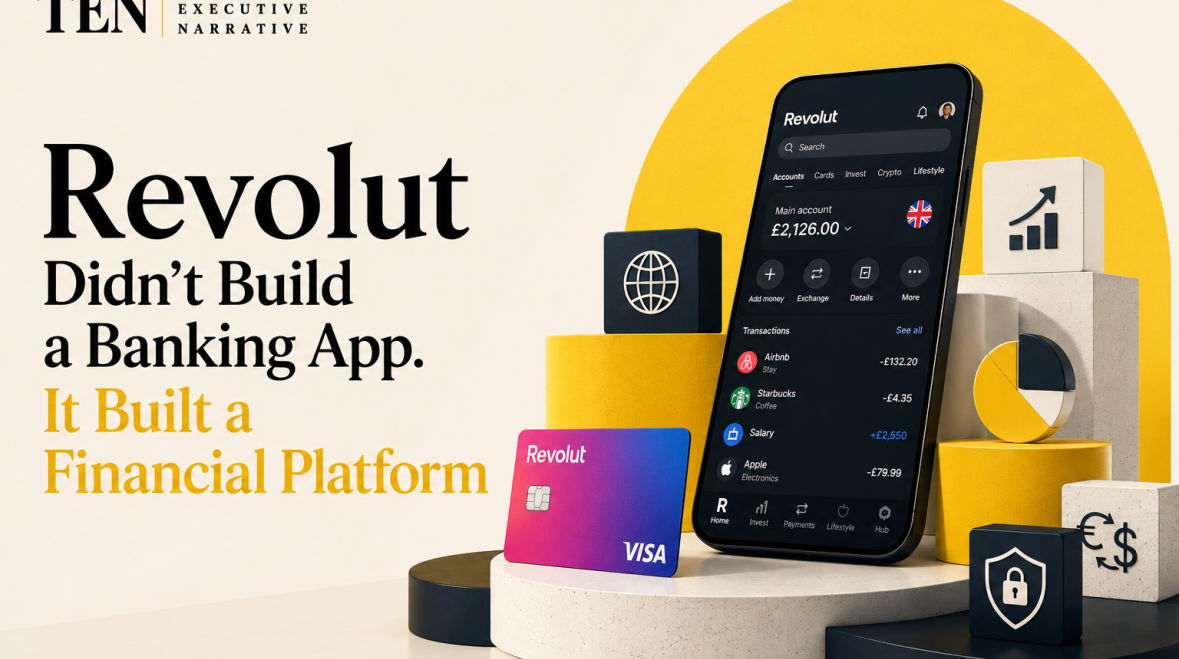
For decades, financial services have been organized around individual products. Customers opened one account for banking, another for investing, another for insurance, and yet another for international payments. Every financial need required a separate provider, creating fragmented experiences and weak customer relationships. Revolut recognized that the future of finance would not belong to the company offering the best individual product. It would belong to the company offering the most complete financial ecosystem. Starting with low cost foreign exchange and digital banking, Revolut steadily expanded into investing, savings, insurance, business banking, cryptocurrency, budgeting, subscriptions, and wealth management. Every new service increased the value of the platform while strengthening customer loyalty. Today, Revolut is no longer competing as a digital bank. It is building the operating system for personal finance. This Deep Dive explores how ecosystem expansion became Revolut's strongest competitive advantage.
________________________________________
The Strategic Challenge
Financial services have traditionally been fragmented across multiple institutions. Consumers often relied on different providers for banking, investing, insurance, foreign exchange, budgeting, and international payments.
This fragmentation created friction. Customers managed multiple accounts, navigated inconsistent user experiences, and repeatedly transferred money between platforms.
The challenge was not building another financial product.
It was simplifying financial life by bringing everything together.
________________________________________
The Strategic Insight
Revolut realized that acquiring a customer is only the beginning of the relationship.
Most financial institutions optimize for transactions. Revolut optimized for engagement.
Customers initially joined for one feature, often international payments or fee free currency exchange. Instead of stopping there, the company continuously introduced complementary services that solved additional financial needs within the same application.
Every new product increased customer convenience while reducing the need to leave the platform.
The objective was not simply to increase revenue.
It was to increase customer lifetime value.
________________________________________
The Competitive Mechanism
Revolut's competitive advantage is created through three reinforcing mechanisms.
The first is continuous product expansion. Banking, investing, savings, insurance, cryptocurrency, budgeting, subscriptions, travel services, and business banking operate within one ecosystem. Customers gain more reasons to remain on the platform as new services are introduced.
The second is efficient customer acquisition. A strong digital experience and word of mouth referrals reduce dependence on expensive marketing campaigns. Satisfied customers become advocates, lowering acquisition costs while strengthening brand trust.
The third is ecosystem reinforcement. Every additional service increases engagement. Greater engagement produces richer customer insights. Better insights enable more personalized experiences, encouraging customers to adopt even more services. Each product strengthens the value of every other product.
________________________________________
Operating Model
Revolut operates as a technology driven financial platform rather than a traditional bank.
Its revenue is diversified across subscriptions, interchange fees, foreign exchange, premium memberships, investing, cryptocurrency, business banking, and financial services.
Instead of relying primarily on interest income like conventional banks, Revolut generates value from multiple customer interactions across a growing ecosystem.
This diversified model increases resilience while reducing dependence on any single product.
________________________________________
Strategic Trade Offs
Revolut deliberately chose breadth over specialization.
Rather than becoming the best provider in one financial category, it invested heavily in expanding its ecosystem across multiple services.
This required significant investment in engineering, compliance, cybersecurity, regulatory licensing, and product development across different markets.
Although operational complexity increased, so did customer engagement and platform value.
________________________________________
Why Competitors Struggle
Launching a digital banking application is relatively straightforward.
Building an integrated financial ecosystem is considerably more difficult.
Revolut has spent years developing global payment infrastructure, regulatory approvals, product integrations, and a unified customer experience across multiple financial services.
Each new capability increases switching costs while making the platform more valuable to existing customers.
Its competitive advantage compounds through ecosystem depth rather than individual product excellence.
________________________________________
Executive Lessons
Revolut demonstrates that sustainable platform businesses grow by expanding customer relationships instead of constantly pursuing new customers.
Business leaders should ask themselves:
• Can one successful product become the gateway to a broader ecosystem?
• Are we maximizing customer lifetime value or individual transactions?
• Does every new product increase the value of the platform?
• Are we building standalone services or interconnected experiences?
Organizations that solve more customer problems within one platform often build stronger competitive advantages than those offering isolated products.
________________________________________
TEN Perspective
Revolut is frequently described as a digital banking app. That description understates its strategic ambition.
Its real innovation lies in transforming financial services into a connected platform where every new capability strengthens the customer relationship. Instead of competing product by product, Revolut competes through ecosystem value.
The broader lesson extends beyond banking. Modern platform companies succeed not by offering one exceptional service but by becoming the place where customers solve multiple related problems. Revolut did not build a better banking application. It built a financial platform that becomes more valuable every time a customer uses another part of its ecosystem.
Share:
Weekly trending

Stay Informed with Global Headlines
16 Jul, 2025
- 6 mins read

The Rise of Mindful Living in a Digital World
16 Jul, 2025
- 6 mins read

The Quiet Power of Present Living
16 Jul, 2025
- 6 mins read

Minimalism in Design: Why Less is Still More
16 Jul, 2025
- 6 mins read






Recommended for you
Breaking Down the Elements of a Masterpiece Painting
The Revival of Classical Art in a Digital Age
Must-See Art Exhibitions Around the World This Year
The Revival of Classical Art in a Digital Age