




-
3

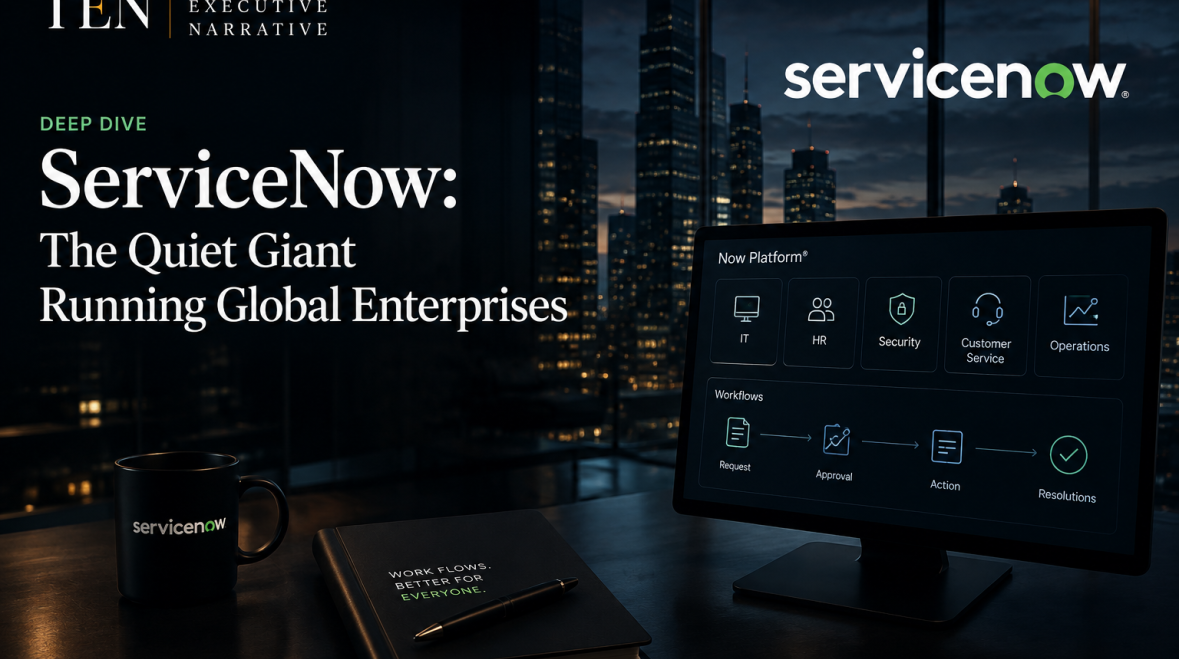
Legacy enterprises operated on fragmented SaaS point solutions and legacy ERPs that failed to communicate effectively. ServiceNow recognized that enterprise productivity was fundamentally an orchestration problem rather than a database storage issue. By positioning itself as a single System of Action running above legacy systems, ServiceNow transformed workflow automation into an unbreakable enterprise stickiness moat.
The Strategic Challenge
Large enterprises struggle with disjointed departmental processes spanning IT, HR, customer service, and security operations. Disconnected tools created massive productivity bottlenecks, manual approval delays, and severe operational visibility gaps. The fundamental challenge was orchestrating complex cross-departmental workflows without requiring enterprises to rip and replace their core systems of record.
The Strategic Insight
ServiceNow understood that modern enterprises did not need another database of record, but a unified layer to automate work across existing systems. By building a single cloud platform with a unified data model, the company enabled seamless workflow routing across legacy infrastructure. Treating workflow automation as an overarching orchestration layer converted departmental task management into a company-wide operational engine.
The Competitive Mechanism
ServiceNow's competitive advantage operates through a deeply embedded enterprise flywheel:
• Initial IT Service Management (ITSM) adoption establishes the platform as the core IT operating hub.
• Standardized workflow data enables frictionless expansion into HR Service Delivery, Security, and Customer Workflows.
• Deep cross-departmental integration creates astronomical switching costs and industry-leading net expansion.
Operating Model
ServiceNow operates on a single cloud platform architecture with a unified relational database schema. Unlike competitors that offer stitched-together acquisitions with separate logins, every ServiceNow application runs natively on the same codebase. This allows IT, HR, and ops teams to automate cross-functional requests within a single, highly configurable enterprise interface.
Strategic Trade-offs
Building a complex, enterprise-wide orchestration platform required accepting lengthy implementation cycles and high initial deployment costs. ServiceNow deliberately resisted targeting small-and-medium businesses, focusing exclusively on Global 2000 enterprises. This intentional strategic choice sacrificed quick transactional SMB revenue to capture massive, high-margin enterprise accounts.
Why Competitors Struggle
Point-solution vendors and legacy ERP giants struggle because their architectures are fragmented across siloed databases and acquired software products. Replicating ServiceNow's single-platform data model and multi-departmental workflow integration requires rebuilding software from scratch. Once an enterprise automates its core operational processes on ServiceNow, replacing the platform introduces catastrophic business disruption risks.
Executive Lessons
Durable enterprise stickiness stems from orchestrating cross-functional workflows rather than storing static data. Leaders must evaluate:
• Are we building isolated departmental tools or orchestrating cross-functional systems of action?
• Does our platform architecture lower customer expansion friction or create new operational silos?
TEN Perspective
ServiceNow proves that the quietest platforms often possess the most unassailable business moats. By sitting above legacy systems of record to automate enterprise work, the company built an indispensable operational nervous system. Its enduring achievement is demonstrating that true enterprise stickiness comes from becoming the software that runs how work flows.
Share:
Weekly trending

Stay Informed with Global Headlines
16 Jul, 2025
- 6 mins read

The Rise of Mindful Living in a Digital World
16 Jul, 2025
- 6 mins read

The Quiet Power of Present Living
16 Jul, 2025
- 6 mins read

Minimalism in Design: Why Less is Still More
16 Jul, 2025
- 6 mins read






Recommended for you
Breaking Down the Elements of a Masterpiece Painting
The Revival of Classical Art in a Digital Age
Must-See Art Exhibitions Around the World This Year
The Revival of Classical Art in a Digital Age