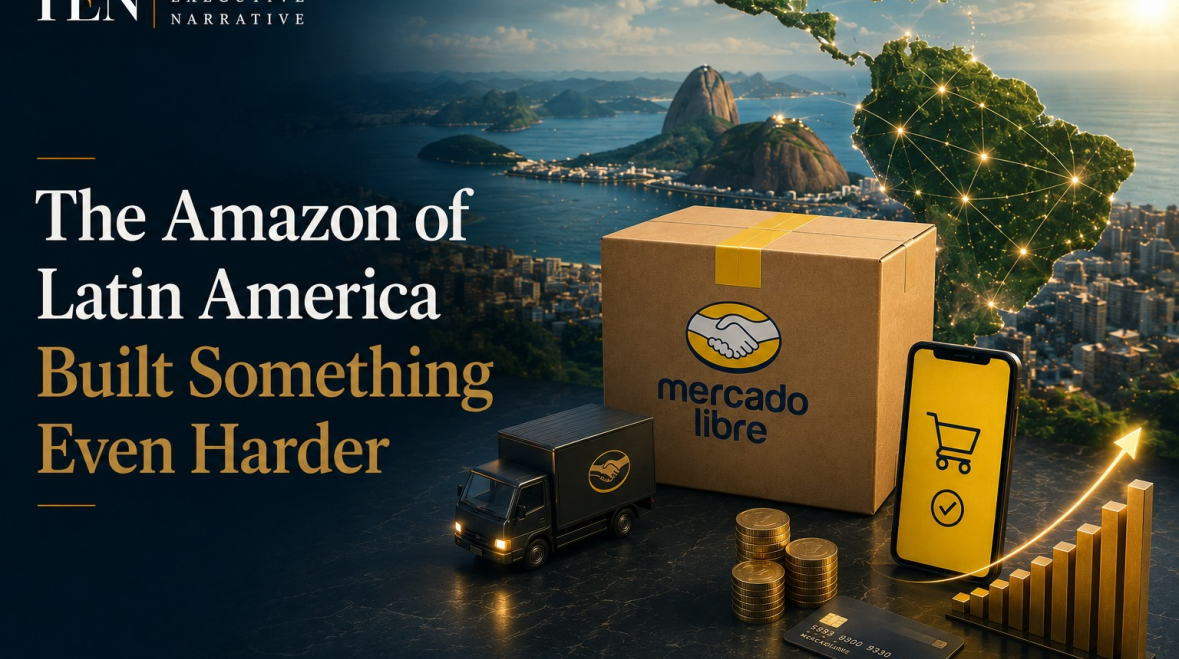
Many companies build successful ecommerce platforms, but few succeed in creating the infrastructure that enables digital commerce at scale. Mercado Libre recognized that online retail in Latin America was constrained not by consumer demand, but by fragmented logistics networks, limited digital payments, and low financial inclusion. Rather than solving one problem, the company built an integrated ecosystem that addressed them simultaneously.
Today, Mercado Libre is more than an online marketplace. Its competitive advantage comes from combining ecommerce, logistics, fintech, and digital services into a single operating system for commerce. Each business strengthens the others, creating network effects that become increasingly difficult for competitors to replicate.
This Deep Dive examines how Mercado Libre expanded beyond retail to build one of Latin America's most resilient digital ecosystems, offering valuable lessons in platform strategy, ecosystem expansion, and long term competitive advantage.
The Strategic Challenge
Building an online marketplace is challenging under any circumstances. In Latin America, the obstacles were even greater. Limited banking access, unreliable logistics infrastructure, fragmented delivery networks, and low consumer trust made large scale ecommerce difficult to sustain.
Instead of treating these barriers as external constraints, Mercado Libre viewed them as strategic opportunities. Management recognized that solving infrastructure problems would create a stronger competitive position than simply competing on product assortment or pricing.
Strategic Decisions
Mercado Libre's transformation was driven by three critical strategic decisions.
First, the company invested heavily in proprietary logistics capabilities through Mercado Envíos. Rather than depending entirely on third party carriers, Mercado Libre built fulfillment centers, delivery partnerships, and logistics technology to improve delivery speed and reliability across the region.
Second, management expanded into financial services through Mercado Pago. By offering digital payments, merchant financing, and consumer financial products, the company reduced friction across its marketplace while creating an independent growth engine beyond ecommerce.
Third, Mercado Libre continuously expanded its ecosystem by introducing complementary services that increased customer engagement and merchant dependence. Instead of operating separate businesses, every new service reinforced the value of the broader platform.
Operating Model
Mercado Libre operates as an integrated digital ecosystem rather than a standalone marketplace. Its marketplace attracts buyers and sellers, logistics infrastructure improves fulfillment, digital payments simplify transactions, and financial services deepen customer relationships. Each component generates data that strengthens the performance of the others.
This interconnected operating model creates powerful network effects. As more consumers join the platform, more merchants participate. Increased transaction volume strengthens logistics efficiency, expands payment adoption, and generates additional financial services opportunities. The ecosystem becomes increasingly valuable as it grows.
Strategic Trade offs
Building proprietary infrastructure required significant long term investment and lower short term profitability. Mercado Libre deliberately accepted higher operating costs to strengthen customer experience and platform reliability.
The company also chose operational complexity over asset light expansion. Managing logistics, payments, lending, and marketplace operations simultaneously increases execution risk but creates competitive advantages that are significantly harder for competitors to replicate.
Executive Lessons
Mercado Libre demonstrates that sustainable competitive advantage often comes from solving industry constraints rather than competing within existing ones.
#### Questions Every Executive Should Ask
Which industry friction points create the greatest customer pain?
Should we build complementary capabilities instead of relying entirely on partners?
Does each new product strengthen our existing business?
Are we creating network effects that become stronger over time?
Organizations that build interconnected systems rather than isolated products are better positioned to sustain long term competitive advantage.
TEN Perspective
Mercado Libre's success is not simply the result of becoming Latin America's largest ecommerce company. Its enduring advantage comes from recognizing that digital commerce depends on infrastructure, not marketplaces alone.
The broader management lesson extends beyond retail. Competitive advantage increasingly belongs to organizations that build ecosystems where logistics, technology, payments, and customer relationships continuously reinforce one another. The strongest platforms do not compete through individual products. They compete through integrated systems that become more valuable with every participant.



















Recommended for you
Breaking Down the Elements of a Masterpiece Painting
The Revival of Classical Art in a Digital Age
Must-See Art Exhibitions Around the World This Year
The Revival of Classical Art in a Digital Age