




-
5

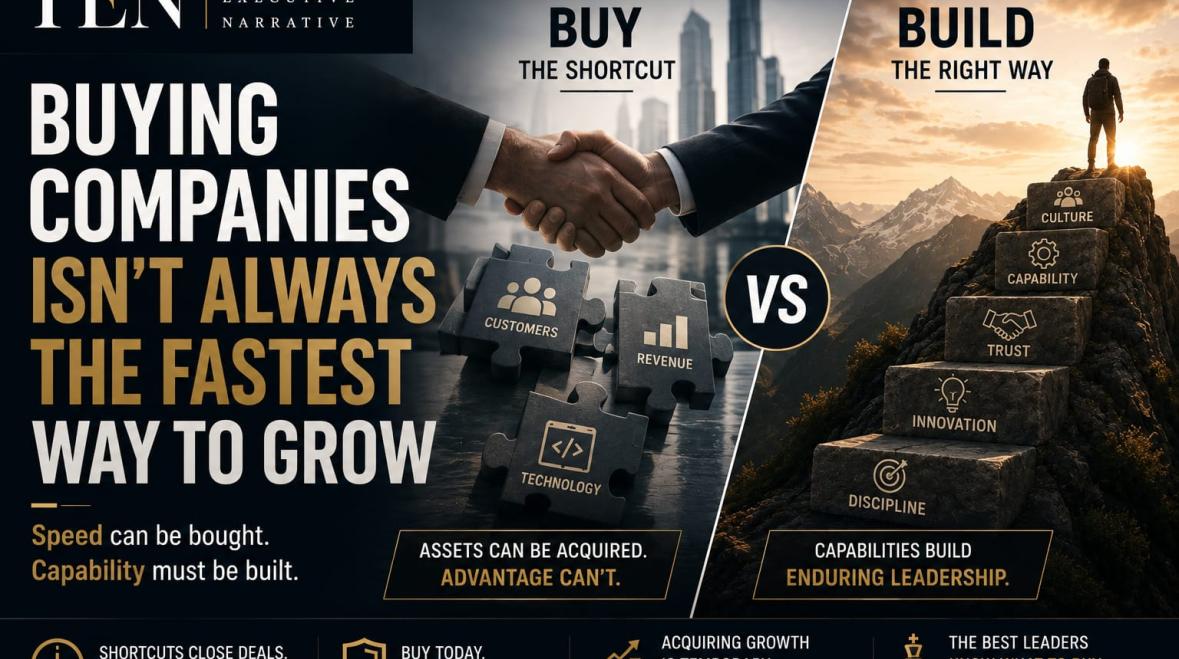
Every board eventually faces the same temptation.
A competitor has built the product you wish you had. A startup has entered a market you want to own. Advisors begin calculating synergies, investment bankers prepare presentations, and suddenly the fastest path to growth seems obvious.
"Why spend years building it when we can buy it next quarter?"
It's an attractive argument.
Until someone asks a different question.
"Are we buying a business—or avoiding the hard work of building one?"
That question changes the conversation.Because the real decision is rarely about acquisitions. It is about where competitive advantage actually comes from.
Speed Is Easy to Buy. Capability Isn't.
Acquisitions promise something every executive values: time. Instead of spending years developing a product, entering a market, or acquiring customers, one transaction can deliver all three. On paper, it looks like acceleration.But businesses are not built on assets alone.
Technology can be purchased. Customers can be acquired. Revenue can appear almost overnight. Yet the capabilities that made those assets valuable—leadership, culture, operational discipline, and customer trust—do not automatically transfer with the deal.
Growth may be immediate.Capability rarely is.
The Real Work Begins After the Signature
Most acquisitions are judged by the deal itself. The better question is what happens six months later.
Integration demands leadership attention. Systems need to be aligned. Cultures begin colliding. Decision-making slows while two organisations learn how to become one. During that time, competitors are not standing still. They are improving products, strengthening customer relationships, and executing with the clarity that comes from being one company not two. The acquisition may have been completed in a day.The business still has to be built.
The Best Companies Know What Should Never Be Bought
The world's strongest companies don't reject acquisitions.They simply understand their limits.
Apple has acquired dozens of businesses, yet the capabilities that define Apple—product design, ecosystem integration, and customer experience—were developed internally over decades. Microsoft acquires strategically, but it continues investing heavily in the engineering and platforms that shape its future. Their acquisitions strengthen the business.
They don't replace the business.That's the distinction many organisations miss.Acquisitions should accelerate an existing advantage—not become a substitute for creating one.
The Better Boardroom Question
Perhaps executives are asking the wrong question.
Not,
"Should we build or acquire?"
But,
"Is this capability so important that someone else should never own the expertise behind it?"
That single question changes the discussion.Some opportunities deserve acquisition because speed creates value. Others demand patience because the capability itself will become the company's competitive advantage for years to come.
Leadership is knowing the difference.
TEN Perspective
Buying a company can shorten a journey.
It cannot replace one.
Every enduring business eventually discovers that its greatest strengths cannot be purchased from another balance sheet. They are built through thousands of decisions, years of refinement, and an operating culture competitors struggle to imitate.
The companies that outperform are not those that complete the most acquisitions.
Share:
Weekly trending

Stay Informed with Global Headlines
16 Jul, 2025
- 6 mins read

The Rise of Mindful Living in a Digital World
16 Jul, 2025
- 6 mins read

The Quiet Power of Present Living
16 Jul, 2025
- 6 mins read

Minimalism in Design: Why Less is Still More
16 Jul, 2025
- 6 mins read






Recommended for you
Breaking Down the Elements of a Masterpiece Painting
The Revival of Classical Art in a Digital Age
Must-See Art Exhibitions Around the World This Year
The Revival of Classical Art in a Digital Age