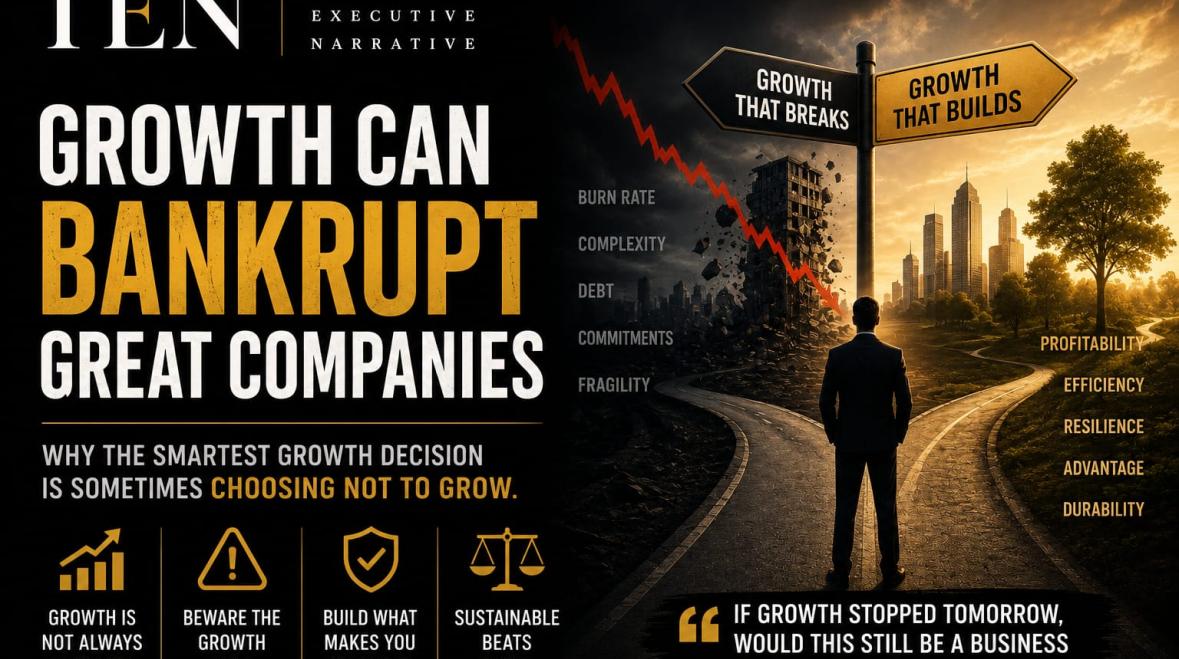
Growth Can Bankrupt Great Companies
Why the smartest growth decision is sometimes choosing not to grow
The Boardroom Moment
The quarterly board meeting begins with optimism.Revenue has grown by 43%. Customer numbers are rising. Market share is expanding. Every chart on the presentation suggests progress. The room is confident. Then one director asks a question: "If external funding disappeared tomorrow, would this business still become stronger?" The discussion changes instantly. Because the question is no longer about growth. It is about economics.That distinction separates companies that scale a business from companies that simply scale complexity.
The Growth Trap
Most companies treat growth as proof of success.More customers. More markets. More revenue. More attention. The assumption is simple: if the company is growing, value is being created. But growth can hide weaknesses just as easily as it can reveal strengths. Expansion requires more employees, larger infrastructure, higher commitments, and greater operational pressure. A company can become bigger while becoming less efficient, less profitable, and less resilient. Size is not the same as strength.
When Growth Creates Value
Growth itself is not the problem. The question is what growth improves. Some companies use expansion to build stronger economics. Every new customer improves efficiency. Every investment strengthens capabilities. Every step forward creates a deeper competitive advantage. Amazon's journey reflects this approach. For years, the company invested heavily instead of prioritising short-term profits. But those investments were not simply buying growth. They were building logistics, customer loyalty, technology infrastructure, and operational advantages that became difficult for competitors to replicate. Growth strengthened the business.
When Growth Becomes Expensive
Other companies grow differently. Expansion becomes the goal rather than the outcome. We Work became one of the clearest examples. The company expanded rapidly, opened locations worldwide, and achieved enormous valuation growth.But every stage of expansion also increased long-term commitments without creating stronger underlying economics. The company became larger. The business did not become stronger. Growth does not fix weak foundations. It amplifies them.
The Question Boards Should Ask Most boards ask:
"How fast should we grow?" A more important question is: "What becomes stronger every time we grow?" The difference is significant. One measures speed. The other measures quality. Growth deserves investment when it improves the capabilities that make the company harder to replace. If expansion only increases revenue without improving the business itself, growth becomes an expensive illusion.
The Decision Behind Growth
The companies that endure rarely view growth as the final objective.They view it as a test. Does every step forward create a stronger company? Does expansion increase advantage or simply increase size? Does the organisation become more valuable because it grows, or does it only become more complicated? These questions reveal what revenue numbers often hide.
TEN Perspective
Businesses rarely fail because they grow too slowly.They fail because they confuse growth with proof. Revenue becomes proof. Market share becomes proof. Valuation becomes proof. Until the market asks a different question:
"What did growth actually build?" History does not reward the companies that expanded the fastest.It rewards the companies that created something competitors could not easily reproduce.
Perhaps the most important growth question is not: "How do we grow faster?" But: "If growth stopped tomorrow, would this still be a business worth owning? "Because growth can always be financed.A durable business must be built.

















Recommended for you
Breaking Down the Elements of a Masterpiece Painting
The Revival of Classical Art in a Digital Age
Must-See Art Exhibitions Around the World This Year
The Revival of Classical Art in a Digital Age