




-
5

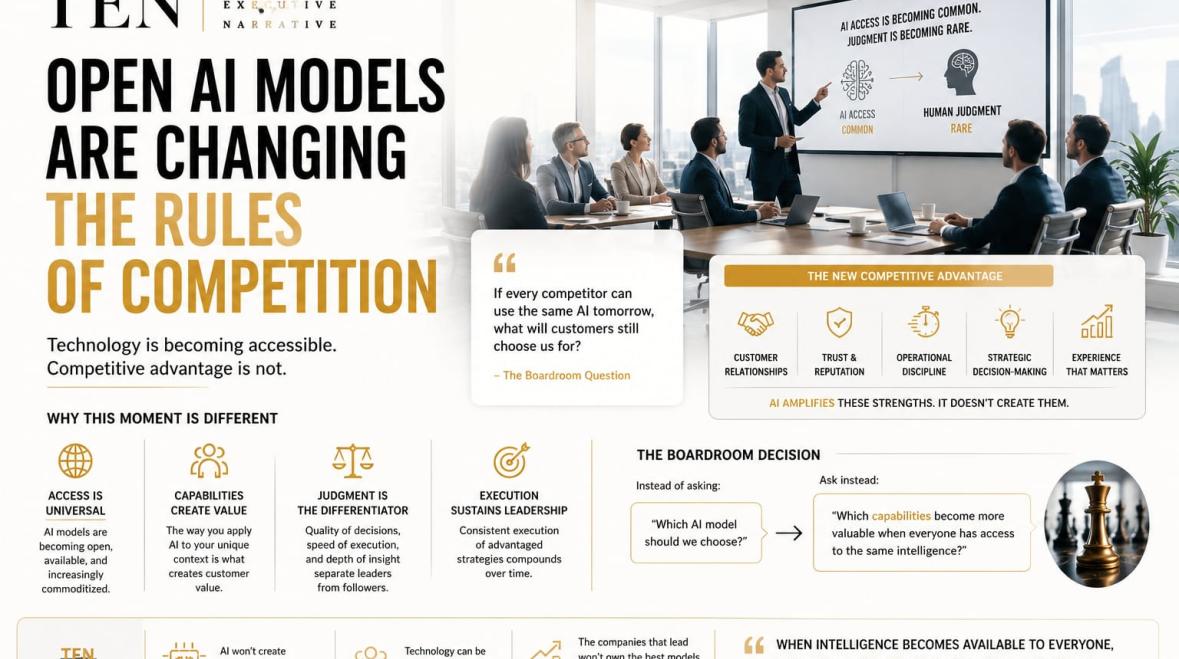
Every technology revolution begins with the same race.Companies compete to gain access before everyone else does. Today, that race is centered on AI. Leadership teams debate proprietary models, open-source alternatives, infrastructure investments, and vendor partnerships as though choosing the right model will determine the next decade of growth.
Then an experienced board member asks a different question.
"If every competitor can use the same AI tomorrow, what will customers still choose us for?"
The room falls silent.
Because the real decision was never about AI. It was about competitive advantage.
The Wrong Question Is Driving the Right Investment
The discussion around AI is dominated by access. Which model is more powerful? Which platform is more secure? Which ecosystem offers the greatest flexibility? These are important operational questions, but they rarely determine long-term market leadership.
History tells a different story.Cloud computing became accessible. Enterprise software became standard. Digital infrastructure became available to everyone. The companies that won weren't the ones with exclusive technology. They were the ones that used common technology to strengthen uncommon capabilities.AI is following the same path.
When Intelligence Becomes Common, Judgment Becomes Rare
Imagine two banks implementing the same open AI model.One automates reports, customer support, and internal workflows. The other redesigns how it evaluates risk, personalizes financial advice, and allocates capital. Both have access to identical intelligence, yet one transforms its business while the other simply becomes more efficient.
The technology didn't create the difference.Leadership did.Open AI changes the rules because it shifts competition away from who owns intelligence and toward who applies it with greater judgment.
The New Competitive Advantage
Executives often assume proprietary technology creates defensibility.
In reality, customers rarely reward technology itself. They reward trust, consistency, speed, experience, and decisions that competitors struggle to replicate.
Apple's strength isn't just its technology; it's the ecosystem surrounding it. Costco's advantage isn't software; it's an operating model competitors have struggled to imitate for decades. Bloomberg's value isn't information alone; it's the way information becomes indispensable to financial decision-making.
Technology supports these advantages.It doesn't define them.The same will be true for AI.
The Decision Every Board Should Be Discussing
Perhaps the real question isn't whether to choose open-source or proprietary AI.
Perhaps it is this:
Which capabilities become more valuable when everyone has access to the same intelligence?
That single question changes the conversation completely.
Instead of comparing models, leadership begins identifying what truly differentiates the business—customer relationships, proprietary knowledge, operational discipline, brand trust, and strategic decision-making. AI becomes an amplifier of those strengths rather than a substitute for them.
That's where lasting competitive advantage is built.
TEN Perspective
Every technology eventually becomes accessible.Very few competitive advantages survive that transition.Open AI models are not reducing competitive advantage—they are exposing it. They reveal which organisations built their success on exclusive tools and which built it on capabilities competitors cannot easily copy.
The companies that lead the AI era won't necessarily own the smartest models.
They will be the ones that answer one uncomfortable boardroom question before everyone else:
When intelligence becomes available to everyone, what part of our business remains impossible to commoditize?
Share:
Weekly trending

Stay Informed with Global Headlines
16 Jul, 2025
- 6 mins read

The Rise of Mindful Living in a Digital World
16 Jul, 2025
- 6 mins read

The Quiet Power of Present Living
16 Jul, 2025
- 6 mins read

Minimalism in Design: Why Less is Still More
16 Jul, 2025
- 6 mins read






Recommended for you
Breaking Down the Elements of a Masterpiece Painting
The Revival of Classical Art in a Digital Age
Must-See Art Exhibitions Around the World This Year
The Revival of Classical Art in a Digital Age