

Should Every Country Get the Same Strategy?
August 09, 2026
- 5 mins read

2026 Copyright @ TEN.
All Rights Reserved
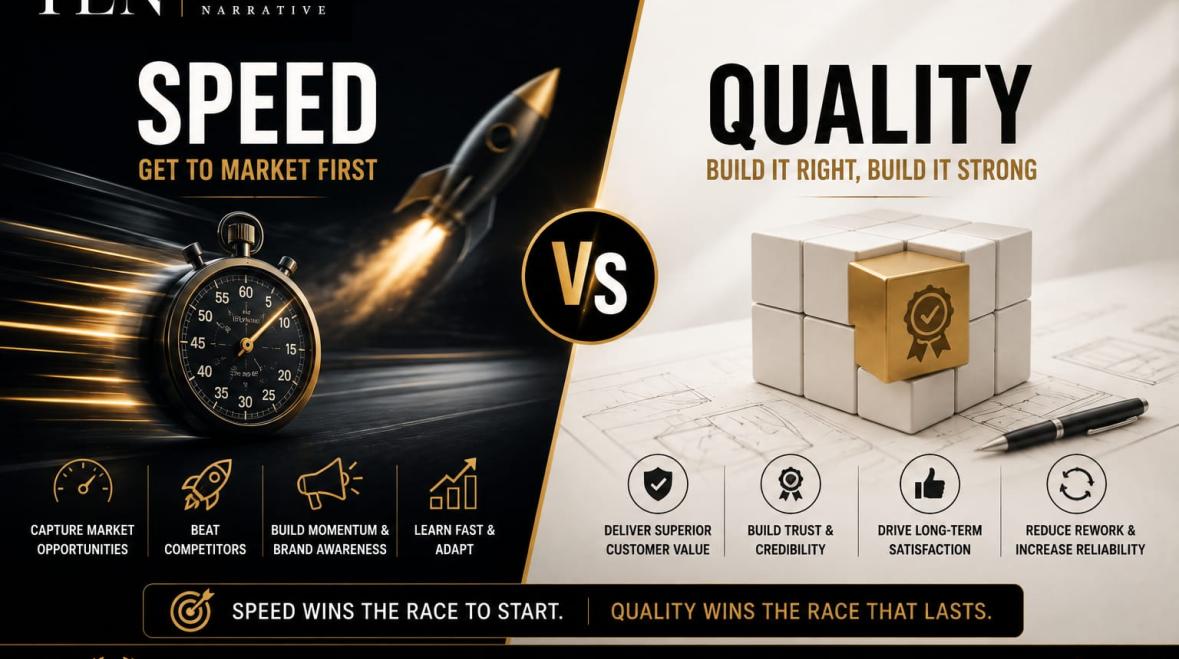
Markets reward speed, but they remember quality. Leadership teams often feel pressure to launch products before competitors, believing that first-mover advantage guarantees long-term success. Yet speed creates value only when it strengthens customer trust. Releasing products faster while compromising quality may accelerate growth today but weaken the confidence that drives tomorrow's business.
The Strategic Challenge
Organizations frequently face a difficult choice. Delay a launch to improve the product, or release early to capture market momentum. Waiting risks losing attention and competitive positioning. Launching too soon risks disappointing customers whose first impression may define the product's reputation. The challenge is determining whether speed creates an advantage or simply exposes unfinished work to the market.
The Strategic Insight
Speed wins attention.
Quality wins loyalty.
A product launched ahead of competitors gains visibility, but sustained success depends on consistently meeting customer expectations. Businesses rarely lose because they launched second. They lose when customers stop believing the next release will solve their problems better than the last.
The Competitive Mechanism
Organizations that outperform understand that speed and quality are not opposing goals—they are strategic priorities managed differently.
•Speed captures emerging opportunities before competitors.
•Quality strengthens customer confidence and reduces long-term churn.
•Sustainable advantage comes from releasing products that customers continue to recommend after the initial excitement fades.
Execution becomes a balance between momentum and reliability.
Operating Model
Leading organizations build development systems that improve speed without sacrificing product excellence. Customer feedback, iterative releases, strong quality assurance, and disciplined engineering allow teams to move quickly while protecting user experience. The objective is not simply to launch faster, but to learn faster without eroding trust.
Strategic Trade-offs
Prioritizing speed can secure early market share and valuable customer feedback, but repeated quality issues increase support costs, damage reputation, and reduce customer loyalty. Prioritizing quality creates stronger products but may delay revenue opportunities and invite faster competitors into the market. The decision is not between speed and excellence. It is deciding which compromise creates the greater long-term advantage.
Why Competitors Struggle
Many organizations confuse product launches with product success. They measure release dates instead of customer outcomes, celebrating faster delivery while overlooking declining satisfaction and trust. Competitors can often match product features within months. Rebuilding customer confidence after a disappointing launch takes far longer.
Executive Lessons
Executives should ask:
•Are we accelerating customer value or simply accelerating release schedules?
•Will customers remember that we launched first, or that we delivered best?
•Does every faster launch strengthen trust or slowly reduce it?
TEN Perspective
Every company wants to move faster.
Very few ask whether customers want them to.
Markets reward companies that create confidence, not just excitement.
The real competitive advantage isn't being first to launch. It's becoming the company customers trust enough to wait for.














Recommended for you
Breaking Down the Elements of a Masterpiece Painting
The Revival of Classical Art in a Digital Age
Must-See Art Exhibitions Around the World This Year
The Revival of Classical Art in a Digital Age