




-
5

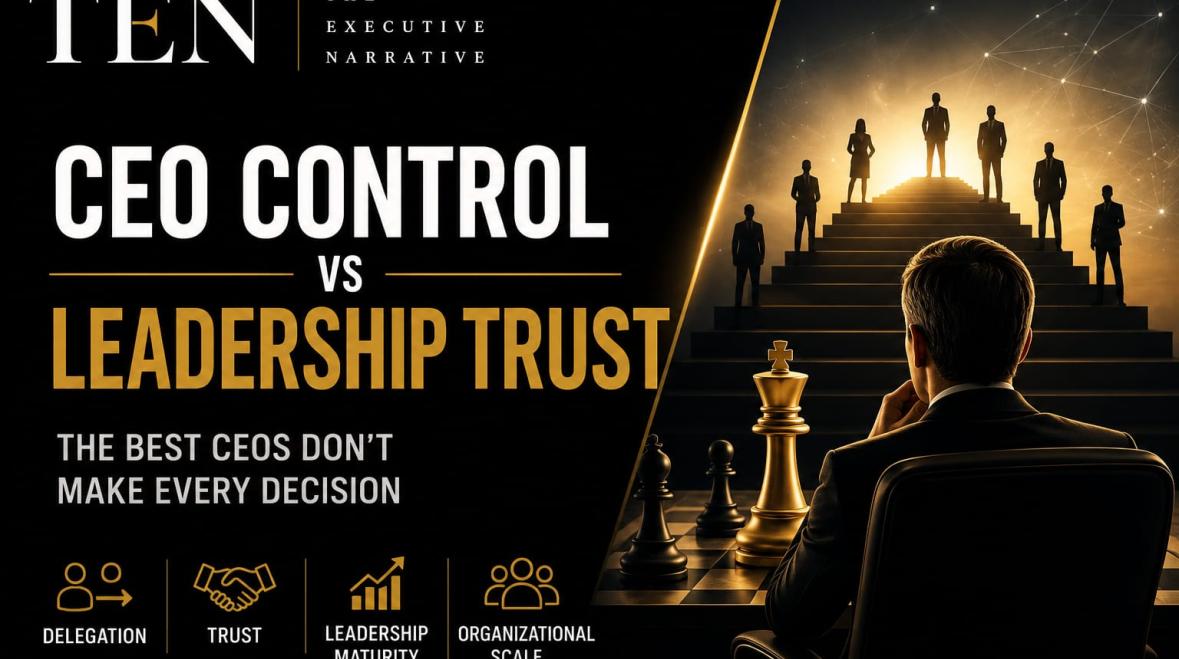
The strongest CEOs are not the people with answers to every question.They are the people who build organizations capable of finding the right answers without them.In the early stages of a company, centralized decision-making can feel necessary. The CEO knows the customers, understands the product, and often sits close to every important decision.But as the organization grows, the same behavior can become a constraint.More employees. More markets. More customers. More decisions.Eventually, one person cannot be the operating system for the entire company.
Control Has a Limit
A CEO who wants visibility into every decision may believe they are protecting quality.
In reality, they may be creating dependency.
When every significant decision requires executive approval, teams wait. Managers hesitate. Opportunities move more slowly. Employees learn to optimize for what the CEO wants rather than what the business needs.
Control can create consistency.But too much control can eliminate ownership.
The goal of leadership is not to make every decision correctly.It is to build a system where good decisions can happen without constant intervention.
Delegation Is Not Abdication
Delegation is sometimes misunderstood as simply handing work to someone else.Real delegation is different.It means giving people responsibility along with the authority required to exercise it.
A CEO cannot say, “You own this,” and then question every decision that follows.
Trust requires space.
That does not mean leaders stop monitoring performance. It means they establish clear expectations, define boundaries, provide context, and allow capable people to operate within them.The best leaders do not remove accountability.
They move accountability closer to the decision.
Trust Is a Leadership Capability
Trust is not built through motivational speeches.It is built through repeated evidence.A manager makes a decision. It produces a result. The organization learns. The manager makes a better decision next time.Over time, this creates leadership capacity.
A CEO who trusts capable leaders creates more leaders.A CEO who constantly overrides them creates more dependence.This is why trust is not simply a cultural value.It is an organizational capability.
Leadership Maturity Means Knowing When to Step Back
Early-stage leadership often rewards involvement.
Scale rewards judgment.As companies grow, CEOs must learn to distinguish between decisions that require their attention and decisions that should remain with the people closest to the problemNot every decision deserves the CEO's time.Some decisions are strategic.Some are operational.Some should never reach the executive level at all.Leadership maturity is knowing the difference.
Scale Requires Distributed Leadership
A company cannot scale faster than its decision-making capacity.If every major decision travels upward, organizational growth eventually creates a bottleneck at the top.But when decision-making is distributed across strong leaders, the organization can move faster without losing alignment.
The CEO's role changes.Instead of answering every question, they establish the principles that help others answer questions consistently.Instead of controlling every function, they build leaders who can control their own functions.Instead of becoming more necessary as the company grows, the best CEOs make themselves less necessary for day-to-day decisions.
The Real Test of a CEO
A CEO should not measure leadership by how many decisions they make.
They should ask:
“Can my organization make good decisions without me?”
If the answer is yes, leadership has created leverage.
If the answer is no, the company may still be dependent on one person.
The strongest CEOs do not build organizations around their personal judgment.They build organizations capable of exercising judgment at scale.
TEN Perspective
Leadership is not about having control over everything.
It is about creating enough clarity and trust that control does not have to sit with one person.
Delegation creates capacity.Trust creates ownership.Strong leadership creates independent decision-makers.And scale requires all three.
The best CEOs understand that their greatest contribution is not making every decision.
It is building an organization where the right people can make the right decisions without waiting for the CEO.
Share:
Weekly trending

Stay Informed with Global Headlines
16 Jul, 2025
- 6 mins read

The Rise of Mindful Living in a Digital World
16 Jul, 2025
- 6 mins read

The Quiet Power of Present Living
16 Jul, 2025
- 6 mins read

Minimalism in Design: Why Less is Still More
16 Jul, 2025
- 6 mins read






Recommended for you
Breaking Down the Elements of a Masterpiece Painting
The Revival of Classical Art in a Digital Age
Must-See Art Exhibitions Around the World This Year
The Revival of Classical Art in a Digital Age