





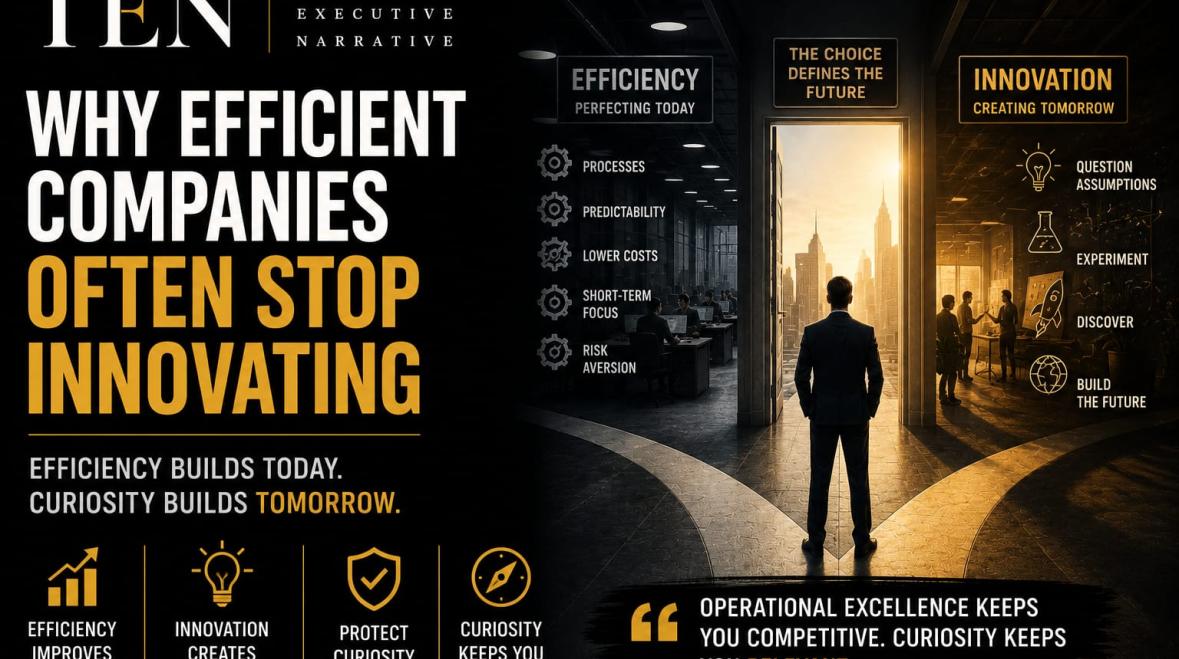
The companies that master efficiency often become prisoners of it. Every successful company begins with curiosity.
In the early days, teams move fast, challenge assumptions, and experiment constantly. Decisions are made with imperfect information because discovering what works matters more than following perfect processes. That willingness to learn becomes the company's greatest competitive advantage.Success changes that.As organisations grow, they introduce structure. Processes become standardised, performance becomes measurable, and efficiency becomes the priority. Costs fall, margins improve, and execution becomes predictable. Everything looks stronger.
Yet beneath those improvements, something quietly disappears.The organisation stops questioning itself.The company doesn't lose its ability to execute.It loses its willingness to explore.That is the paradox many leadership teams fail to recognise.
The Boardroom Moment
The quarterly review is impressive.
Revenue is growing. Costs are falling. Every performance metric is ahead of target.
Then an independent director asks a simple question.
"What did we learn this quarter that we didn't already know?"
The room falls silent.
There were countless reports and operational improvements—but very little genuine discovery. The company had become exceptional at improving its existing business while slowly forgetting how to build its future.
When Efficiency Becomes the Strategy
Efficiency and innovation are often treated as partners.They're not.Efficiency improves what already exists. Innovation creates what doesn't. Efficiency rewards certainty. Innovation depends on uncertainty.The problem begins when organisations manage both with the same mindset. Every project is expected to deliver immediate returns, every idea must justify itself through efficiency, and every experiment is judged by short-term performance.
Eventually, employees stop taking intelligent risks—not because they lack ideas, but because the system rewards predictability.
The Companies That Understood the Difference
Amazon built one of the world's most efficient businesses, yet Jeff Bezos insisted it should remain "the best place in the world to fail." Leadership understood that operational excellence could scale today's business, but only experimentation could create the next one.
Toyota became famous for efficiency because it never stopped questioning its own processes. Continuous improvement wasn't about protecting the system—it was about constantly improving it.
Kodak chose another path.It perfected film manufacturing while competitors reinvented photography itself.Kodak didn't fail because it lacked operational excellence.It failed because operational excellence became more valuable than curiosity.
The Leadership Decision
Every CEO eventually faces the same question.Should every part of the organisation become more efficient?
Or should some parts remain intentionally free to experiment?
The best organisations understand that these are not competing priorities.Operational teams should optimise.Innovation teams should explore.Managing both with the same logic weakens both.
TEN Perspective
Every successful company eventually becomes efficient.That isn't the difficult part.The difficult part is remaining curious after success makes curiosity feel unnecessary.
History rarely rewards companies that simply execute yesterday's business better than everyone else.It rewards the companies willing to challenge yesterday's assumptions before someone else does.
Perhaps boards have been asking the wrong question.
Instead of asking,
"How do we become more efficient?"
they should ask,
"Where must we deliberately protect curiosity?"
Because every breakthrough begins as an inefficient idea.
Every industry leader was once an experiment that couldn't be justified on an operational dashboard.Efficiency keeps a company competitive.Curiosity keeps it relevant.And in the long run, relevance is what determines who leads—and who gets left behind.
Share:
Weekly trending

Stay Informed with Global Headlines
16 Jul, 2025
- 6 mins read

The Rise of Mindful Living in a Digital World
16 Jul, 2025
- 6 mins read

The Quiet Power of Present Living
16 Jul, 2025
- 6 mins read

Minimalism in Design: Why Less is Still More
16 Jul, 2025
- 6 mins read






Recommended for you
Breaking Down the Elements of a Masterpiece Painting
The Revival of Classical Art in a Digital Age
Must-See Art Exhibitions Around the World This Year
The Revival of Classical Art in a Digital Age