




-
5

Executive Snapshot
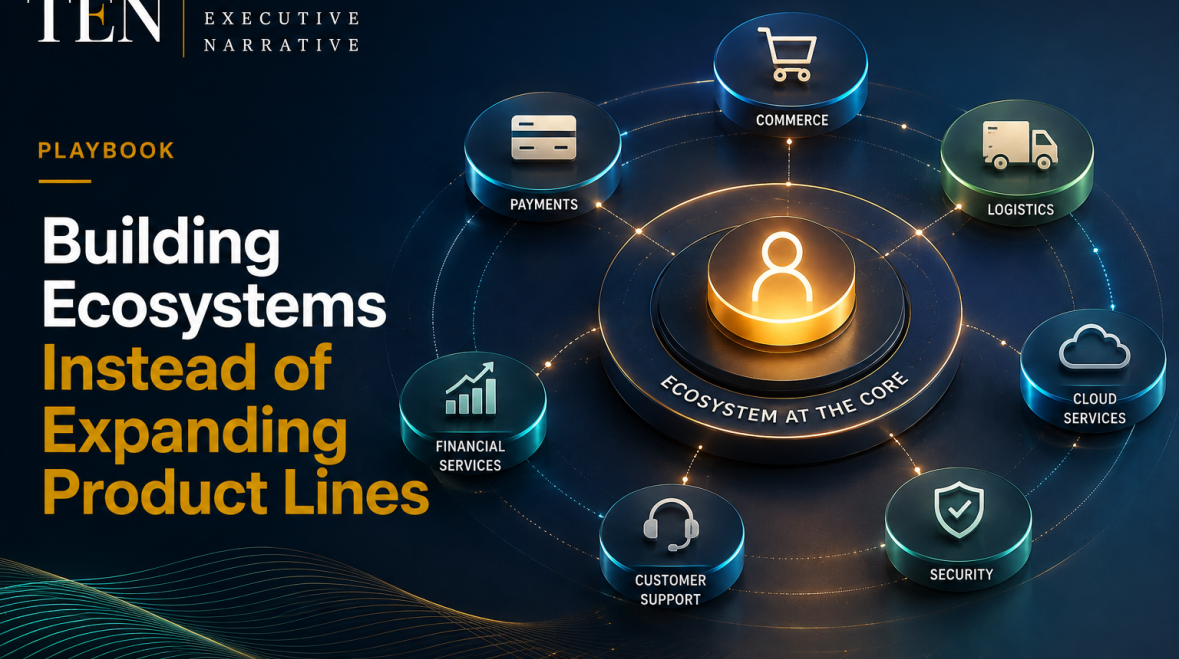
• Objective: Build an interconnected product and service ecosystem that creates self-reinforcing network effects and high customer switching costs.
• Best Fit: Platform Businesses, Tech Multinationals, FinTech Leaders, E-Commerce Operators, Multi-Product Enterprises.
• Avoid If: Single-product niche businesses without horizontal integration opportunities or underlying platform architecture.
• Research Base: Synthesizes core ecosystem strategies from Apple, Tencent, Mercado Libre, Amazon, and Razorpay.
• Executive Takeaway: Learn five actionable plays to integrate disparate products into compounding, self-reinforcing business ecosystems.
Why This Strategy Exists
Most companies attempt to grow by linearly expanding their product catalog.
When facing revenue targets, leadership teams add new features, launch adjacent products, or enter unrelated categories. Yet, standalone products compete in isolation. Every new release requires independent customer acquisition, separate marketing spend, and individual customer retention efforts.
Standalone products generate linear revenue; ecosystems compound exponential value.
When products are built as isolated offerings, adding a second product does not make the first product more valuable. However, in a true ecosystem, every new product, service, or feature enhances the utility of existing components, creating sticky lock-in and compounding customer lifetime value.
Exceptional organizations do not build bigger product catalogs. They design integrated ecosystems where payments, logistics, software, and hardware reinforce each other, making the overall platform increasingly indispensable.
THE PLAYBOOK
PLAY ONE: Anchor the Ecosystem Around a High-Frequency Anchor Capability
Objective: Establish a essential, daily-use anchor capability that serves as the gateway for adjacent ecosystem services.
Executive Problem: Launching secondary services without a high-frequency anchor requires expensive, continuous customer acquisition for every individual offering.
Why It Works: High-frequency interaction creates organic customer engagement, lowering acquisition costs for all attached ecosystem products.
How Exceptional Organizations Execute It:
• Apple anchors its hardware ecosystem around the iPhone, using daily device usage to drive adoption of Services, iCloud, and Apple Pay.
• Tencent built WeChat around high-frequency messaging, turning daily communication into an operating system for gaming, payments, and commerce.
• Mercado Libre anchored its e-commerce ecosystem around marketplace transactions, using high transaction volume to drive Mercado Pago adoption.
Implementation: Identify your highest-frequency customer touchpoint. Restructure product strategy to use this anchor as the primary distribution channel for adjacent offerings.
Success Indicators:
• Customer engagement frequency on the core anchor capability increases.
• Customer acquisition cost (CAC) for secondary offerings decreases significantly.
• Cross-sell attachment rates from anchor to adjacent products grow steadily.
PLAY TWO: Build Shared Infrastructure that Eliminates Cross-Product Friction
Objective: Unify identity, data, payment, and security layers across all products to create a frictionless user experience.
Executive Problem: Operating adjacent products as siloed entities with separate logins, billing, and data stores fragments the user journey and destroys cross-product synergy.
Why It Works: A single unified identity and data layer enables effortless cross-product adoption, turning user friction into competitive advantage.
How Exceptional Organizations Execute It:
• Amazon unifies identity, payment, and logistics through Amazon Prime, granting seamless access across retail, streaming, and delivery.
• Razorpay expanded from payment gateway integration into payroll, banking, and credit using a single merchant account and unified API dashboard.
• Mercado Libre integrated Mercado Pago and Mercado Envíos seamlessly into its marketplace, eliminating payment and shipping friction.
Implementation: Consolidate user identity, authentication, and payment infrastructure into a single shared service layer across all current and future products.
Success Indicators:
• 100% of ecosystem products utilize unified login and billing architecture.
• User drop-off during cross-product onboarding approaches zero.
• Customer profile data enriches cross-sell intelligence enterprise-wide.
PLAY THREE: Design Flywheels Where Each Product Magnifies the Value of Others
Objective: Structure product linkages so that adoption of one service automatically increases the utility and retention of connected services.
Executive Problem: Adding unrelated products creates operational bloat without increasing customer switching costs or overall platform defensibility.
Why It Works: Interlocking product flywheels create exponential switching costs, making it irrational for users to leave for a single-point competitor.
How Exceptional Organizations Execute It:
• Apple connects Apple Watch, AirPods, and iPhone via proprietary features like auto-pairing and Handoff, where each device boosts the value of the others.
• Tencent links WeChat Pay directly into mini-programs and social feeds, accelerating merchant adoption and user retention simultaneously.
• Amazon uses Prime Video to drive Prime membership retention, which directly increases e-commerce purchase frequency.
Implementation: Map your product portfolio to identify network dependencies. Design explicit integration features that require or benefit from multi-product usage.
Success Indicators:
• Multi-product users exhibit significantly higher retention rates than single-product users.
• Customer lifetime value (LTV) expands exponentially with each added service.
• Churn rate drops sharply as users adopt two or more ecosystem components.
PLAY FOUR: Convert Internal Operational Capabilities into Commercial Platforms
Objective: Externalize core internal infrastructure to third parties, transforming cost centers into high-margin ecosystem revenue engines.
Executive Problem: Building expensive internal operational infrastructure increases fixed overhead without contributing directly to top-line growth.
Why It Works: Opening internal tools to third-party developers and merchants amortizes infrastructure costs and expands ecosystem network effects.
How Exceptional Organizations Execute It:
• Amazon converted its internal IT infrastructure into AWS and its internal logistics network into Fulfillment by Amazon (FBA).
• Razorpay externalized its internal merchant risk, payout, and treasury tools into RazorpayX enterprise banking solutions.
• Mercado Libre opened Mercado Pago and Mercado Envíos to third-party offline merchants and independent e-commerce stores.
Implementation: Audit internal operating infrastructure (logistics, data pipelines, risk tools). Identify capabilities that can be packaged as external B2B APIs.
Success Indicators:
• Third-party revenue from externalized infrastructure grows as a percentage of total income.
• Unit cost of internal infrastructure decreases through scale efficiencies.
• Third-party developer/merchant ecosystem expands independently.
PLAY FIVE: Subsidize Gateway Products to Capture High-Margin Adjacent Monetization
Objective: Use low-margin or free gateway products to acquire user volume, monetizing through high-margin financial or data services.
Executive Problem: Demanding immediate profitability on entry-level products restricts market penetration and limits ecosystem expansion opportunities.
Why It Works: Optimizing for total ecosystem economics rather than standalone product margins maximizes market share and long-term enterprise value.
How Exceptional Organizations Execute It:
• Razorpay offers payment acceptance to acquire merchants, monetizing through high-margin business lending, corporate cards, and payroll software.
• Mercado Libre subsidizes buyer shipping and seller tools to capture high-margin payment processing fees and credit interest via Mercado Pago.
• Tencent offers free messaging and social services, monetizing through high-margin digital gaming, advertising, and financial distribution.
Implementation: Re-evaluate product pricing strategies across the portfolio. Identify entry products that can be priced at cost to drive high-margin monetization downstream.
Success Indicators:
• User acquisition velocity accelerates on subsidized gateway products.
• Overall ecosystem gross margin expands due to attached financial/software services.
• Total revenue per user (ARPU) expands across multi-product journeys.
Common Implementation Mistakes
• Building Disconnected Product Catalogues: Launching adjacent products that lack shared identity, unified data, or technical integration.
• Evaluating Products in Isolation: Demanding standalone profitability on gateway products rather than measuring total ecosystem lifetime value.
• Failing to Establish a High-Frequency Anchor: Expanding into secondary services without a daily-use core product to drive organic adoption.
• Creating Friction Across Product Boundaries: Forcing users through separate logins, billing systems, and onboarding flows for each service.
• Hoarding Internal Infrastructure: Treating core operational tools as cost centers instead of packaging them for external monetization.
Executive Scorecard
Evaluate your leadership team against these 5 diagnostic questions:
1. Anchor Frequency: Is your primary product anchor used with sufficient frequency to organically drive adjacent service adoption?
2. Shared Infrastructure: Do all products in your portfolio share a single, frictionless identity, billing, and data layer?
3. Flywheel Mechanics: Does adoption of a second product automatically increase the utility and retention of the core anchor?
4. Externalized Capabilities: Are you packaging proprietary internal tools (logistics, risk, payments) into B2B commercial platforms?
5. Ecosystem Economics: Are you evaluating business performance based on multi-product customer LTV rather than isolated product margins?
TEN Principle
Exceptional organizations do not scale by simply adding items to a product catalog. They win by designing integrated ecosystem architectures where every product strengthens the overall network, drives cross-product retention, and deepens customer lock-in.
Products compete on features; ecosystems compete on network effects. When an enterprise anchors on high-frequency usage, unifies core infrastructure, designs interlocking product flywheels, externalizes operating capabilities, and optimizes for total ecosystem economics, individual products cease to be vulnerable targets and become an insurmountable enterprise moat.
Share:
Weekly trending

Stay Informed with Global Headlines
16 Jul, 2025
- 6 mins read

The Rise of Mindful Living in a Digital World
16 Jul, 2025
- 6 mins read

The Quiet Power of Present Living
16 Jul, 2025
- 6 mins read

Minimalism in Design: Why Less is Still More
16 Jul, 2025
- 6 mins read






Recommended for you
Breaking Down the Elements of a Masterpiece Painting
The Revival of Classical Art in a Digital Age
Must-See Art Exhibitions Around the World This Year
The Revival of Classical Art in a Digital Age