




-
5

Executive Snapshot
• Objective: Build institutional leadership systems, governance structures, and decision frameworks that outlast founding leaders and ensure multi-generational operational excellence.
• Best Fit: Founder-Led Scale-Ups, Rapidly Growing Enterprises, Family-Owned Conglomerates, Transitioning Tech Platforms.
• Avoid If: Early pre-product/market fit startups where founder central control and rapid pivoting are still required.
• Research Base: Synthesizes core leadership transition frameworks from Microsoft, Amazon, Infosys, Apple, and Tata Group.
• Executive Takeaway: Learn five actionable plays to codify founder judgment, institutionalize leadership pipelines, decouple governance, and embed culture into scalable organizational mechanisms.
Why This Strategy Exists
Most founder-led organizations face a existential crisis when scaling beyond their original leadership.
In the early years, founder instinct, personal charisma, and direct oversight drive product decisions, culture, and strategy. However, as the organization grows in headcount, geographical spread, and business complexity, founder-centric decision-making becomes a severe operational bottleneck. Decisions slow down, middle managers wait for executive blessing, and cultural alignment degrades into imitation.
Great founders build products; iconic founders build leadership systems that outlast them.
When leadership development, cultural preservation, and strategic governance remain tied to an individual founder, the enterprise remains inherently fragile. Founder departure, burnout, or transition triggers strategy drift, executive conflict, or loss of market dominance.
Exceptional organizations solve this by institutionalizing founder judgment into explicit operating mechanisms. They build repeatable leadership pipelines, independent governance architectures, and educational systems that allow the enterprise to innovate and execute seamlessly across generations of leadership.
THE PLAYBOOK
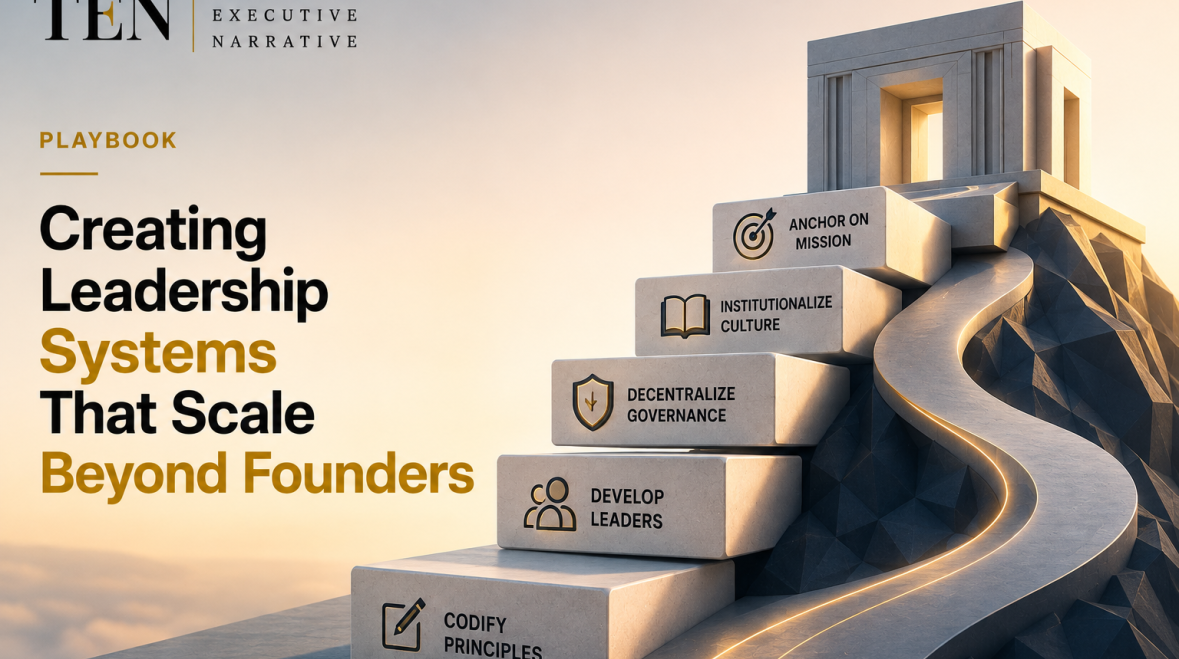
PLAY ONE: Codify Implicit Founder Judgment into Explicit Operating Principles
Objective: Transform intuitive founder decision-making into written, repeatable operational mechanisms for decentralized execution.
Executive Problem: Early founder decisions rely on unwritten intuition. As the company scales, new managers lack those mental models, causing decision latency or constant escalation back to the executive office.
Why It Works: Writing explicit decision frameworks empowers decentralized leaders to make high-quality, aligned decisions at velocity without executive intervention.
How Exceptional Organizations Execute It:
• Amazon codified Jeff Bezos's decision-making philosophy into 16 explicit Leadership Principles (e.g., 'Customer Obsession', 'Have Backbone; Disagree and Commit') used daily across all levels.
• Microsoft codified Satya Nadella's cultural leadership shift into explicit operating tenets focused on a 'Growth Mindset' and customer empathy.
• Tata Group institutionalized founding principles into the Tata Code of Conduct and Tata Business Excellence Model, unifying hundreds of operating companies.
Implementation: Document the top 10 recurring strategic trade-offs faced by leadership. Convert them into explicit, written operating principles enforced during weekly business reviews.
Success Indicators:
• 100% of strategic proposals reference codified operating principles.
• Decision escalation back to senior founders decreases by >50%.
• Decentralized team decision speed and quality increase across divisions.
PLAY TWO: Build Institutionalized Leadership Pipelines Over Charismatic Selection
Objective: Systematize talent identification, cross-functional rotation, and leadership development to ensure seamless succession.
Executive Problem: Relying on informal, charismatic selection or panic external hiring for executive roles creates cultural instability and strategic fragmentation.
Why It Works: Structured internal pipelines groom culture-aligned leaders who possess deep operational context, preserving enterprise continuity.
How Exceptional Organizations Execute It:
• Tata Group established the Tata Administrative Services (TAS) in 1956, creating a permanent institutional pipeline for cross-group executive leadership.
• Infosys built the Infosys Leadership Institute and structured executive succession protocols to ensure smooth transitions beyond its founding team.
• Microsoft developed deep internal bench strength, enabling seamless succession from Bill Gates to Steve Ballmer, and subsequently Satya Nadella.
Implementation: Institute an annual executive bench review. Require every key leadership role to identify and actively develop at least two internal successors.
Success Indicators:
• Internal promotion rate for VP-level roles and above exceeds 75%.
• Succession coverage identified for 100% of critical leadership positions.
• Leadership transition cycle time and disruption drop significantly.
PLAY THREE: Decouple Enterprise Governance from Individual Founders
Objective: Transition corporate oversight from founder-centric approvals to structured, independent board and committee governance.
Executive Problem: When strategic governance rests solely on founder presence, approval bottlenecks choke operational speed and leave the firm vulnerable to founder absence.
Why It Works: Independent governance committees and clear delegation-of-authority matrices protect enterprise integrity and long-term strategy independent of any single individual.
How Exceptional Organizations Execute It:
• Tata Group anchored enterprise ownership under philanthropic trusts (Tata Trusts) overseen by an independent board of Tata Sons, insulating governance from individual personalities.
• Infosys pioneered independent board governance in emerging markets, separating founder management from board oversight early in its growth trajectory.
• Apple structured executive committee governance and operational delegation, allowing Tim Cook and executive leadership to run operations seamlessly after Steve Jobs.
Implementation: Establish a formal Delegation of Authority (DOA) matrix detailing clear capital and operational decision limits for non-founder executives.
Success Indicators:
• Operational decisions below defined threshold require zero founder pre-approval.
• Board committees operate with independent non-executive leadership.
• Enterprise strategy continues execution without disruption during founder absences.
PLAY FOUR: Institutionalize Cultural Training via Dedicated Learning Mechanisms
Objective: Embed core operating principles into daily rituals, onboarding frameworks, and executive education.
Executive Problem: Cultural values fade into superficial slogans during rapid hiring unless actively taught and tested through structured institutional mechanisms.
Why It Works: Dedicated educational mechanisms transform abstract founder values into repeatable operational habits across thousands of employees.
How Exceptional Organizations Execute It:
• Apple established Apple University, created by Steve Jobs and Joel Podolny, to teach executives how Apple thinks using historical product case studies.
• Infosys constructed the world's largest corporate training center in Mysore, immersing tens of thousands of recruits annually in technical and cultural excellence.
• Amazon instituted the 'Bar Raiser' program in hiring, ensuring every new hire meets or exceeds the cultural bar set by leadership principles.
Implementation: Create a mandatory leadership academy and onboarding curriculum that uses actual company case studies to teach operational decision-making.
Success Indicators:
• 100% of new managers complete institutional leadership decision-making training.
• Cultural alignment metrics remain consistent across geographically distributed offices.
• Internal case studies are used as primary training materials for executive development.
PLAY FIVE: Anchor Organizational Identity Around a Enduring Customer Mission
Objective: Align corporate purpose around a timeless customer-centric mission rather than the founder's personal persona.
Executive Problem: When employees and customers identify the enterprise solely with the founder's personal brand, founder transition triggers identity crises and strategic disorientation.
Why It Works: Anchoring the firm around an enduring customer mission allows successor leaders to adapt strategy and products while preserving core organizational identity.
How Exceptional Organizations Execute It:
• Microsoft evolved its mission from 'a computer on every desk' (Gates era) to 'empower every person and organization on the planet to achieve more' (Nadella era), enabling massive cloud growth.
• Apple anchored its post-Jobs identity on core enduring values—product excellence, user privacy, and intuitive design—enabling record growth under Tim Cook.
• Tata Group anchored its multi-century identity on nation-building and community stewardship, outlasting multiple generations of leadership.
Implementation: Reframe corporate vision documentation to focus on the customer problem the enterprise exists to solve, rather than founder historical narratives.
Success Indicators:
• Customer brand sentiment remains stable or improves during leadership transitions.
• Employee engagement scores remain high following founder departure or role shifts.
• Successor leaders successfully launch new growth strategies aligned with the core mission.
Common Implementation Mistakes
• Keeping Decision Models Implicit in Founder Heads: Failing to write down decision principles, forcing teams to constantly seek founder approval.
• Panic External Hiring for Executive Roles: Ignoring internal succession pipelines and bringing in external executives who clash with core culture.
• Concentrating Governance on Personal Authority: Resisting delegation of authority matrices and keeping board governance subordinated to founder whims.
• Treating Culture as Slogans Instead of Training: Printing values on posters without building internal universities or hiring mechanisms to enforce them.
• Tying Company Identity Exclusively to Founder Persona: Positioning the company around the founder's celebrity rather than an enduring customer mission.
Executive Scorecard
Evaluate your leadership team against these 5 diagnostic questions:
1. Codified Decision Principles: Are your founder's core decision-making mental models written into explicit operating principles used daily?
2. Succession Pipeline: Does every key leadership role have at least two identified internal successors undergoing active development?
3. Governance Autonomy: Is there an active Delegation of Authority matrix that allows non-founders to execute major investments without founder approval?
4. Institutional Learning: Does your company operate a structured leadership academy or case-study training program for new managers?
5. Enduring Purpose: Is your corporate identity anchored around an enduring customer mission rather than individual founder personality?
TEN Principle
Exceptional organizations do not rely on the perpetual presence of brilliant founding leaders. They win by building operating systems that codify founder judgment, institutionalize leadership pipelines, decouple governance, and embed culture into scalable mechanisms.
Founders launch companies; institutional systems build institutions. When an enterprise codifies decision principles, systematically grooms internal talent, decouples governance, institutionalizes cultural education, and anchors on an enduring mission, leadership ceases to be a fragile single point of failure and becomes a multi-generational competitive moat.
Share:
Weekly trending

Stay Informed with Global Headlines
16 Jul, 2025
- 6 mins read

The Rise of Mindful Living in a Digital World
16 Jul, 2025
- 6 mins read

The Quiet Power of Present Living
16 Jul, 2025
- 6 mins read

Minimalism in Design: Why Less is Still More
16 Jul, 2025
- 6 mins read






Recommended for you
Breaking Down the Elements of a Masterpiece Painting
The Revival of Classical Art in a Digital Age
Must-See Art Exhibitions Around the World This Year
The Revival of Classical Art in a Digital Age