




-
5

Executive Snapshot
• Objective: Build an organizational operating system that embeds culture into daily behaviors, governance mechanisms, and performance incentives.
• Best Fit: Scaling Enterprises, Multi-Location Businesses, High-Growth Tech Companies, Re-organizing Corporations.
• Avoid If: Early-stage startups under 10 employees where culture is purely organic, or pure holding companies with disconnected portfolio entities.
• Research Base: Synthesizes operating principles from Netflix, Southwest Airlines, Costco, HubSpot, and Patagonia.
• Executive Takeaway: Learn five actionable plays to shift culture from inspirational wall posters to hard operational systems that drive execution.
Why This Strategy Exists
Most corporate culture initiatives produce inspiring words rather than operational change.
Leadership teams spend millions defining corporate values like 'Integrity', 'Innovation', and 'Excellence'. These values are printed on office walls, recited in town halls, and listed on corporate websites. Yet, daily employee behavior remains dictated by actual incentives, promotion metrics, and manager tolerance.
Culture is not what leaders say; culture is what leaders tolerate and reward.
When a top-performing sales representative abuses team members but receives a promotion, that performance review defines the actual culture. When an engineer is praised for shipping buggy features to meet an arbitrary deadline, speed over quality becomes the true operational standard.
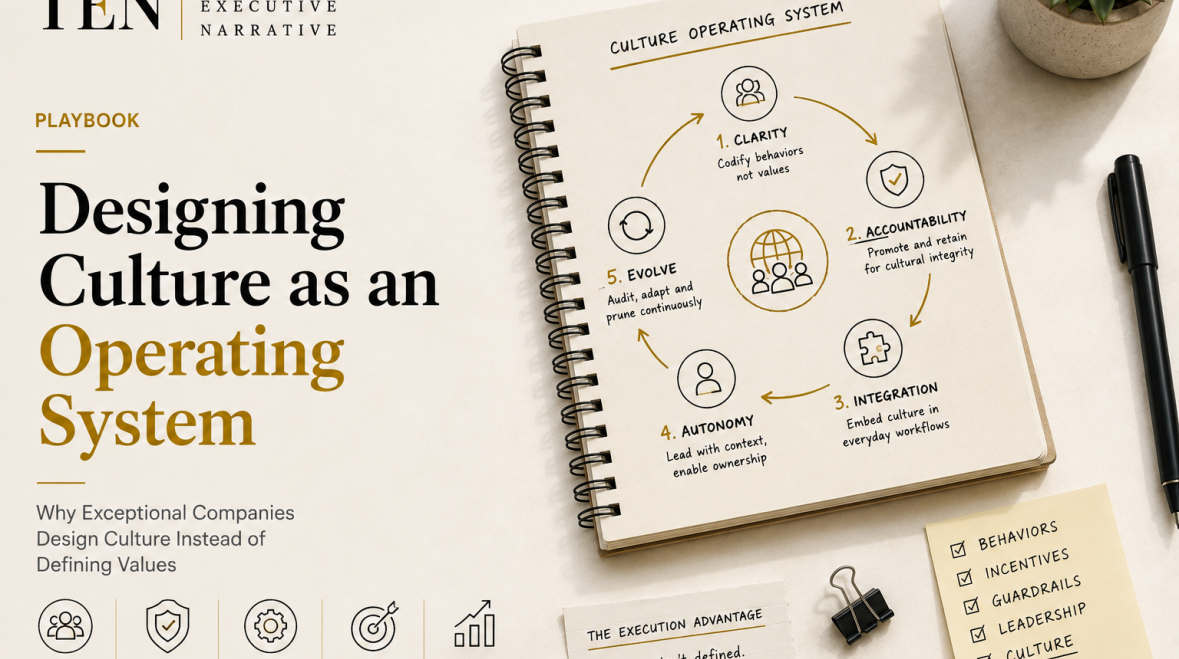
Exceptional organizations treat culture as an operating system. Rather than attempting to control behavior through platitudes, they build mechanisms that make desired behaviors mandatory, observable, and systematically rewarded.
THE PLAYBOOK
PLAY ONE: Codify Observable Behaviors Over Abstract Values
Objective: Replace vague value statements with explicit, observable operating behaviors.
Executive Problem: Abstract values like 'Respect' or 'Customer Focus' are open to individual interpretation. Without clear behavioral standards, employees define those values according to personal preference, leading to inconsistent cultural execution.
Why It Works: Specific, observable behaviors create unambiguous standards that can be evaluated during daily operations, performance reviews, and promotions.
How Exceptional Organizations Execute It:
• Netflix codified culture into its famous Culture Deck, defining 'Freedom and Responsibility' through specific behaviors like the 'Keeper Test' rather than generic values.
• HubSpot published the HubSpot Culture Code, defining culture as a product that is designed, bug-tested, and updated based on operational data.
• Southwest Airlines translates 'Warrior Spirit' into specific front-line actions, such as empowering crew members to resolve customer delays instantly.
Implementation: Audit existing corporate values. Replace every abstract noun with two specific, observable behaviors that managers can evaluate on a weekly basis.
Success Indicators:
• 100% of cultural values are translated into observable behaviors.
• Performance reviews evaluate specific behaviors alongside output targets.
• Employees cite behavioral expectations during decision-making.
PLAY TWO: Align Promotion and Retention to Cultural Integrity
Objective: Enforce cultural standards by tying advancement and exit decisions directly to behavior.
Executive Problem: Organizations often tolerate high performers who violate cultural standards. Retaining culturally toxic high producers signals to the organization that output matters more than operational principles.
Why It Works: People watch who gets promoted, rewarded, or fired. Removing high-performing cultural misfits demonstrates that cultural alignment is non-negotiable.
How Exceptional Organizations Execute It:
• Netflix utilizes the 'Keeper Test' ('If this person wanted to leave, would I fight to keep them?'), actively parting ways with adequate performers or toxic high achievers.
• Costco promotes over 98% of store managers from within, ensuring leaders have spent years practicing the company's core operating principles.
• Patagonia hires and retains employees based on demonstrated alignment with environmental responsibility, prioritizing cultural stewardship in career progression.
Implementation: Institute a mandatory cultural evaluation matrix in all performance reviews. Exclude any employee who scores below cultural standards from promotion or bonus eligibility regardless of financial output.
Success Indicators:
• Promotion candidates undergo formal behavioral/cultural review.
• Cultural misfits are actively transitioned out regardless of revenue contribution.
• Employee retention is correlated with cultural alignment.
PLAY THREE: Embed Cultural Guardrails in Operational Artifacts
Objective: Integrate cultural expectations directly into daily tools, hiring frameworks, and meeting cadences.
Executive Problem: Culture degrades when it remains separate from operational routines. If cultural reviews occur only annually, daily decisions naturally default to immediate operational ease.
Why It Works: Operational artifacts (hiring rubrics, meeting formats, decision memos) embed culture into daily work, ensuring principles are reinforced without executive intervention.
How Exceptional Organizations Execute It:
• Southwest Airlines uses peer-driven hiring rubrics that test candidate humor and selflessness before assessing technical skill.
• Patagonia implements 'Let My People Go Surfing' flex-time policies enforced through peer trust rather than managerial approval systems.
• HubSpot embeds 'Use Good Judgment' as its total expense and policy guideline, replacing bureaucratic manuals with trust-based artifacts.
Implementation: Audit key operational artifacts—hiring rubrics, onboarding decks, and meeting templates. Insert explicit behavioral checks into each artifact.
Success Indicators:
• Hiring rubrics explicitly filter for cultural behaviors.
• Daily operational meetings include behavioral retrospectives.
• Bureaucratic policy manuals are replaced by principle-driven guidelines.
PLAY FOUR: Grant Context-Based Autonomy Within Clear Guardrails
Objective: Empower employees to make decisions by replacing approval hierarchies with clear operational context.
Executive Problem: Over-regulating employee decisions through heavy approval chains creates bureaucracy, slows execution, and communicates distrust, eroding high-performance culture.
Why It Works: Providing high context and broad autonomy enables fast, decentralized decision-making while maintaining alignment with corporate goals.
How Exceptional Organizations Execute It:
• Netflix operates on 'Lead with Context, Not Control,' expecting managers to provide strategic context while empowering individual contributors to execute.
• Costco empowers floor managers to make real-time inventory and pricing adjustments to protect customer value without corporate pre-approval.
• Patagonia grants employees autonomy to make operational decisions that favor environmental sustainability without complex approval chains.
Implementation: Identify top 5 approval processes that delay execution. Replace explicit approval steps with contextual guidelines and post-decision reviews.
Success Indicators:
• Decision cycle times decrease significantly across departments.
• Approval layers are reduced across core operational workflows.
• Employees cite operational context rather than manager approval when making decisions.
PLAY FIVE: Audit and Prune Cultural Drift Continuously
Objective: Systematically identify and eliminate operational habits that diverge from intended culture.
Executive Problem: As organizations scale, legacy habits, middle-management additions, and rapid hiring introduce subtle cultural drift that erodes core operating principles.
Why It Works: Treating culture as a dynamic system requiring continuous tuning prevents gradual degradation and preserves operational excellence.
How Exceptional Organizations Execute It:
• HubSpot treats its Culture Code as an open-source document, updating it through employee feedback and version iterations.
• Netflix continually updates its culture documentation as the company expands globally to ensure principles adapt to new market realities.
• Southwest Airlines conducts continuous culture audits across stations to ensure ground crews maintain core operational principles.
Implementation: Conduct bi-annual culture audits measuring behavioral compliance and management tolerance. Prune policies and behaviors that conflict with core principles.
Success Indicators:
• Bi-annual cultural audits identify operational drift early.
• Outdated policies that conflict with culture are actively retired.
• Culture documentation is updated regularly based on operational learnings.
Common Implementation Mistakes
• Confusing Slogans with Culture: Focusing on inspirational posters and perks rather than operational incentives and governance.
• Tolerating Toxic High Performers: Allowing top revenue drivers to violate behavioral norms, signaling that principles are optional.
• Over-Regulating with Rules Instead of Context: Creating bureaucratic rulebooks when execution strays instead of providing clear strategic context.
• Failing to Involve Middle Management: Designing culture at the executive level without building behavioral alignment into line-manager routines.
• Treating Culture as Static: Failing to update and prune cultural practices as the business scales and enters new markets.
Executive Scorecard
Evaluate your leadership team against these 5 diagnostic questions:
1. Behavioral Clarity: Are corporate values translated into specific, observable behaviors that managers evaluate weekly?
2. Accountability: Has your organization exited a high performer in the past 12 months strictly due to cultural misalignment?
3. Artifact Integration: Are cultural standards embedded directly into hiring rubrics, performance reviews, and meeting formats?
4. Context vs Control: Do leaders provide clear context and autonomy rather than enforcing multi-layered approval chains?
5. Continuous Pruning: Do you actively audit and retire operational policies that conflict with your intended culture?
TEN Principle
Exceptional organizations do not build enduring cultures by writing inspiring vision statements. They build them by designing operating systems where culture is enforced by incentives, hiring filters, governance artifacts, and leadership behavior.
Values define what you believe; operating systems determine how you behave. When an enterprise replaces abstract values with observable behaviors, promotes for cultural integrity, embeds guardrails in daily workflows, and leads with context, culture transforms from an inspirational poster into an insurmountable competitive advantage.
Share:
Weekly trending

Stay Informed with Global Headlines
16 Jul, 2025
- 6 mins read

The Rise of Mindful Living in a Digital World
16 Jul, 2025
- 6 mins read

The Quiet Power of Present Living
16 Jul, 2025
- 6 mins read

Minimalism in Design: Why Less is Still More
16 Jul, 2025
- 6 mins read






Recommended for you
Breaking Down the Elements of a Masterpiece Painting
The Revival of Classical Art in a Digital Age
Must-See Art Exhibitions Around the World This Year
The Revival of Classical Art in a Digital Age