




-
6
Playbook

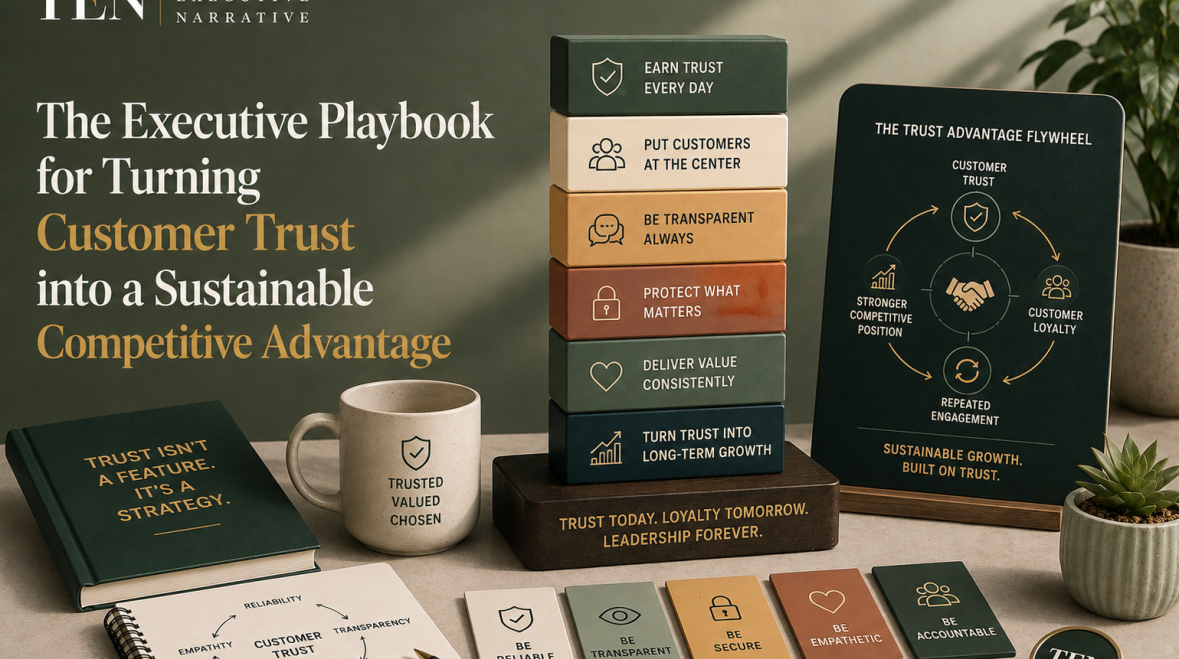
Customer trust is often treated as a brand outcome.
Exceptional organizations treat it as an operating capability.
Companies such as Costco, Amazon, Apple, Stripe and Nubank have built strong customer relationships by making reliability, transparency, simplicity and customer protection part of how their businesses operate.
The lesson is not to copy their customer experience.
It is to understand the systems behind it.
This Playbook identifies five operating principles leadership teams can use to turn customer trust from an intangible reputation into a sustainable competitive advantage.
Why This Strategy Exists
Customers make decisions under uncertainty.
They ask whether a company will deliver what it promised, protect their information, resolve problems fairly and continue providing value after the transaction is complete.
As businesses scale, maintaining that confidence becomes harder.
More products create more complexity. More customers create more interactions. More markets create more operational challenges. More employees create more opportunities for inconsistency.
The result is a fundamental leadership challenge:
How do you make trust repeatable at scale?
Trust cannot be created through advertising alone.
It is created when customers repeatedly experience a company behaving in ways that confirm their expectations.
The strongest organizations therefore do not simply communicate trust.
They design systems that produce it.
PLAY ONE — Make the Customer Promise Operational
Objective
Turn the company's customer promise into measurable operating standards.
Why This Play Exists
Many companies promise simplicity, reliability or customer-centricity while managing the organization around completely different internal priorities.
A company can promise a simple experience while adding unnecessary complexity.
It can promise reliability while tolerating recurring service failures.
It can claim to put customers first while rewarding teams primarily for reducing costs.
The gap between what a company promises and what customers experience is where trust begins to erode.
Why It Works
Trust strengthens when customers repeatedly receive what they were promised.
The customer promise therefore needs to exist inside the operating model—not just inside the brand strategy.
Implementation
Identify three to five promises that matter most to customers.
Then translate each promise into an operational measure.
For example:
"Fast" → response and resolution time.
"Secure" → security and incident performance.
"Simple" → number of steps required to complete important tasks.
"Fair" → complaint resolution and exception rates.
The objective is to make trust measurable.
PLAY TWO — Design Trust Into the Product
Objective
Make trustworthy behaviour part of the customer experience itself.
Why This Play Exists
Customers rarely experience a company's values directly.
They experience its products.
They see how information is collected, how prices are presented, how transactions work and how much control they have.
Every one of these interactions communicates whether the company deserves their confidence.
Why It Works
Trust is stronger when customers do not have to constantly think about whether they can trust the system.
Apple provides an example of this principle through its approach to privacy, where privacy considerations are incorporated into product and service design.
The broader lesson applies across industries:
Trust should be designed into the experience rather than added through communication afterward.
Implementation
Map the moments where customers are most dependent on your company.
Ask:
What information are customers giving us?
Where are they exposed to risk?
What happens when something goes wrong?
How much control do they have?
Where could the experience feel unclear or opaque?
Redesign these moments around transparency, control and predictability.
PLAY THREE — Build Reliability Before Loyalty
Objective
Create consistent customer experiences before attempting to create emotional loyalty.
Why This Play Exists
Organizations often try to increase loyalty through rewards, memberships and promotional programs.
But loyalty is difficult to sustain when the underlying experience is unreliable.
Customers cannot develop lasting confidence in a company that repeatedly disappoints them.
Why It Works
Reliability creates the foundation for loyalty.
Amazon's customer-centric operating model demonstrates the importance of making convenience and dependable customer experience central to the business.
Stripe illustrates the same principle from a different angle. When businesses depend on financial infrastructure to operate, reliability becomes part of the value proposition itself.
The principle is transferable:
Before asking customers to become loyal, give them a reason to feel confident.
Implementation
Identify the five customer interactions that matter most.
Measure:
Failure rates
Resolution times
Customer complaints
Service interruptions
Promise-versus-delivery gaps
Repeat usage
Reliability should be reviewed at the executive level—not treated solely as an operational issue.
PLAY FOUR — Make Transparency a Competitive Capability
Objective
Reduce customer uncertainty by making important information clear and accessible.
Why This Play Exists
Trust declines when customers feel information is being hidden from them.
Unexpected charges.
Unclear policies.
Complicated cancellation processes.
Opaque data practices.
Unexplained service failures.
These experiences force customers to assume the worst.
Why It Works
Transparency reduces perceived risk.
It gives customers enough information to make decisions with confidence.
But transparency is not simply about publishing more information.
It is about providing the information customers actually need at the moment they need it.
Implementation
Audit customer-facing information.
Look for areas where the company knows significantly more than the customer.
Then ask:
What would the customer want to know before making this decision?
What information could prevent future disappointment?
Where are we technically transparent but practically unclear?
The goal is not to reveal everything.
It is to remove avoidable uncertainty.
PLAY FIVE — Treat Trust as a Long-Term Economic Asset
Objective
Make customer trust part of strategic and financial decision-making.
Why This Play Exists
Trust rarely appears directly on a quarterly income statement.
Its economic impact appears through retention, referrals, repeat purchases, adoption and lower customer acquisition friction.
That makes trust vulnerable to short-term decision-making.
A company may increase immediate revenue by introducing confusing pricing, reducing service quality or aggressively monetizing customer relationships.
But those decisions can weaken the relationship that creates future value.
Why It Works
Trust compounds.
A customer who has repeatedly experienced reliable service becomes more willing to try another product.
A customer who believes a company will resolve problems fairly becomes more comfortable committing further.
A business that trusts its technology provider becomes more willing to build additional operations on that infrastructure.
This creates a reinforcing cycle:
Trust → Adoption → Positive Experience → Retention → Advocacy → Lower Acquisition Friction → Greater Trust
Implementation
Add trust-related indicators to executive dashboards.
Track:
Customer retention
Repeat purchase
Referral behaviour
Complaint frequency
Resolution satisfaction
Customer effort
Product adoption
Customer confidence
Then connect these indicators to financial outcomes.
The objective is not another dashboard.
It is to make the economic value of trust visible to leadership.
Common Implementation Mistakes
Organizations rarely lose customer trust because of one dramatic decision.
It usually happens through repeated small inconsistencies.
Common mistakes include:
• Treating trust as a marketing problem.
• Making promises operations cannot consistently deliver.
• Measuring satisfaction without measuring reliability.
• Building loyalty programs before fixing customer experience.
• Treating transparency as merely a legal requirement.
• Optimizing short-term revenue at the expense of long-term confidence.
• Treating customer complaints as isolated incidents instead of systemic signals.
The most dangerous mistake is assuming that trust belongs to one department.
It does not.
Every function that influences the customer experience influences trust.
Executive Scorecard
Leadership teams should ask:
Does our operating model actually deliver what our brand promises?
Where in the customer journey are we asking customers to trust us?
How reliable are our most important customer interactions?
Where could greater transparency reduce customer uncertainty?
Are we measuring customer confidence alongside customer satisfaction?
Do our short-term decisions strengthen or weaken long-term trust?
If leadership cannot answer these questions, customer trust is probably being managed as a communications issue rather than an organizational capability.
TEN Principle
Customer trust is not created by saying the right things.
It is created by repeatedly doing the right things.
The strongest organizations make their promises measurable, design trust into their products, protect reliability, communicate transparently and make long-term customer confidence part of strategic decision-making.
Competitors can copy a feature.
They can copy a pricing model.
They can copy a marketing campaign.
They cannot easily copy years of accumulated customer confidence.
That is why trust, when deliberately designed and consistently delivered, becomes more than reputation.
It becomes a competitive moat.
Share:
Weekly trending

Stay Informed with Global Headlines
16 Jul, 2025
- 6 mins read

The Rise of Mindful Living in a Digital World
16 Jul, 2025
- 6 mins read

The Quiet Power of Present Living
16 Jul, 2025
- 6 mins read

Minimalism in Design: Why Less is Still More
16 Jul, 2025
- 6 mins read






Recommended for you
Breaking Down the Elements of a Masterpiece Painting
The Revival of Classical Art in a Digital Age
Must-See Art Exhibitions Around the World This Year
The Revival of Classical Art in a Digital Age