




-
6

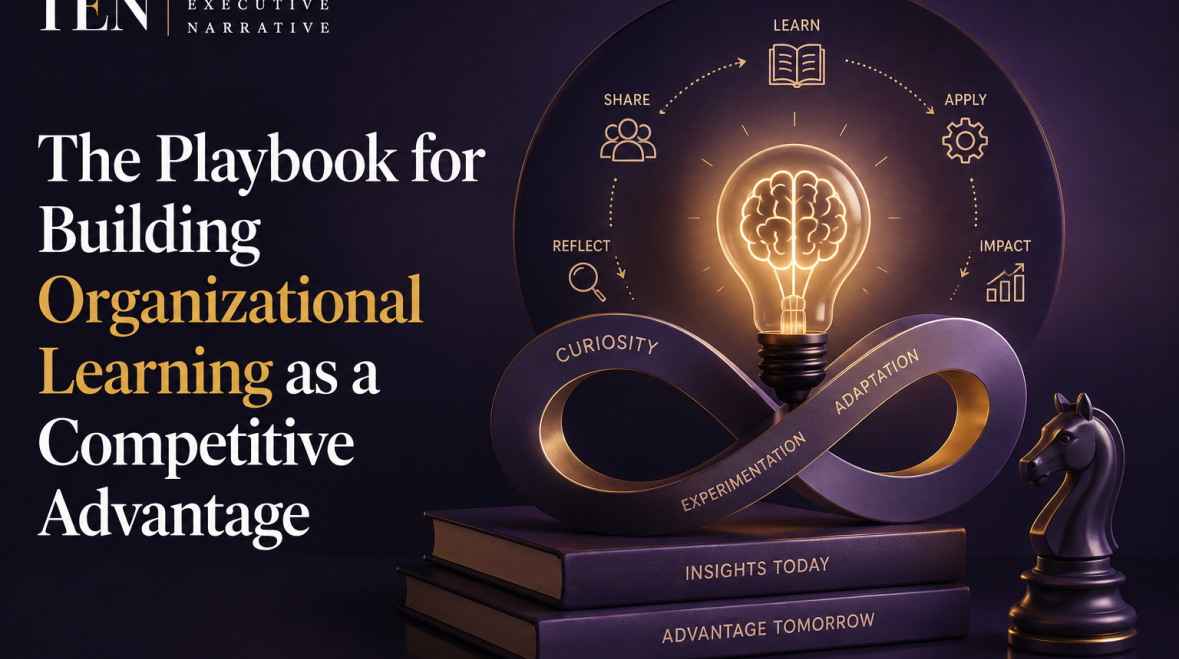
Most organizations learn.
Few learn systematically.
Companies collect customer feedback, conduct postmortems, review performance and hold strategy meetings. Yet many of these activities disappear into presentations, documents and individual experience without changing how the organization operates.
Exceptional organizations treat learning differently.
Amazon, Toyota, Netflix, Stripe and Microsoft have developed mechanisms that turn experience into better decisions, faster execution and stronger capabilities.
Their advantage is not simply having more information.
It is learning faster from the information they already have.
This Playbook identifies five operating principles leadership teams can use to make organizational learning a repeatable competitive capability.
The Executive Problem
As organizations grow, experience increases but learning can slow down.
More teams create more information.
More markets create more feedback.
More decisions create more outcomes to analyze.
Yet organizational knowledge often becomes fragmented across departments.
One team discovers something important, but another team repeats the same mistake months later.
The problem is not a lack of intelligence.
It is the absence of mechanisms that convert individual experience into organizational knowledge.
A learning organization closes this gap.
PLAY ONE
Turn Experience Into Institutional Knowledge
Organizations generate valuable lessons every day.
The problem is that those lessons often remain with the people who experienced them.
Toyota's continuous improvement philosophy demonstrates the importance of capturing lessons from operational experience and using them to improve future processes.
The principle is simple:
A lesson has little organizational value until the organization can reuse it.
Implementation
After significant projects, failures and operational events, document:
What happened?
Why did it happen?
What did we learn?
What should change?
Who else should know?
Store these lessons where future teams can actually access them.
Success Indicator
Teams increasingly reuse previous lessons instead of repeatedly solving the same problems.
PLAY TWO
Create Fast Feedback Loops
Learning speed depends heavily on how quickly an organization receives useful feedback.
Amazon's customer centric operating model places significant emphasis on understanding customer behaviour and using that information to influence decisions.
Stripe similarly operates in an environment where developer and customer feedback can rapidly influence product development.
The shorter the distance between action and feedback, the faster the organization can adapt.
Implementation
For every major initiative, define the signals that will indicate whether the strategy is working.
Do not wait for annual reviews.
Monitor customer behaviour, operational performance and business outcomes continuously.
Success Indicator
Teams identify problems and opportunities earlier, allowing decisions to change before small issues become large ones.
PLAY THREE
Make Experimentation Safer Than Guessing
Organizations that punish every failed experiment eventually stop experimenting.
Netflix demonstrates the value of testing assumptions and using evidence to improve decisions.
The objective is not to eliminate failure.
It is to make intelligent experimentation cheaper than making large decisions based entirely on assumptions.
Implementation
For uncertain decisions, begin with controlled experiments where possible.
Define the hypothesis before the experiment begins.
Establish what evidence would confirm or challenge the assumption.
Afterward, record the result and the lesson.
Success Indicator
More strategic decisions are informed by evidence generated through experimentation rather than hierarchy or intuition alone.
PLAY FOUR
Separate Learning From Blame
Organizations cannot learn honestly when employees are afraid of the consequences of admitting mistakes.
When something goes wrong, leadership should distinguish between poor decision making and reasonable decisions that produced unexpected outcomes.
Microsoft's transformation under Satya Nadella illustrates the broader importance of creating a culture centered on learning, adaptability and continuous improvement rather than defending established assumptions.
The objective is accountability without creating an environment where people hide problems.
Implementation
When reviewing failures, ask:
What did we believe at the time?
What information did we have?
Which assumption proved incorrect?
What could the system have detected earlier?
What should change as a result?
Focus the review on improving future decisions.
Success Indicator
Problems surface earlier because employees are more willing to report risks, failures and contradictory information.
PLAY FIVE
Turn Learning Into Better Decisions
Learning has no strategic value if it does not change behaviour.
This is where many organizations fail.
They conduct reviews.
They create reports.
They identify lessons.
Then they continue operating exactly as before.
Exceptional organizations connect learning directly to decision making.
A lesson should change a process, assumption, investment decision, product direction or operating practice.
Implementation
After every major learning exercise, require one explicit question:
What will we do differently because of what we learned?
Assign an owner and a deadline for implementing the change.
Review later whether the change actually improved the outcome.
Success Indicator
Organizational learning produces measurable changes in decisions, processes and outcomes.
THE COMMON IMPLEMENTATION MISTAKES
The first mistake is confusing information with learning.
More dashboards, reports and meetings do not necessarily create a smarter organization.
The second is documenting everything.
Excessive documentation can bury important lessons under irrelevant information.
The objective is not to record every experience.
It is to capture lessons that can improve future decisions.
The third mistake is treating learning as an HR or training initiative.
Organizational learning belongs inside operations, product development, strategy and leadership decisions.
The final mistake is rewarding certainty.
If leaders consistently reward people who appear confident and punish people who change their minds, employees will defend existing assumptions instead of updating them.
EXECUTIVE SCORECARD
Ask your leadership team:
How does the organization capture lessons from major decisions?
How quickly does customer feedback influence strategic decisions?
How frequently do teams run controlled experiments?
What happens after a significant failure?
Can employees challenge established assumptions safely?
How many important processes changed because of something the organization learned?
If the answers are unclear, the organization may be collecting information without actually learning from it.
TEN PRINCIPLE
The strongest organizations are not necessarily those that make the fewest mistakes.
They are the organizations that extract more value from every experience.
Amazon, Toyota, Netflix, Stripe and Microsoft demonstrate different approaches to institutionalizing learning, but the underlying principle is consistent:
Competitive advantage increasingly belongs to organizations that can convert experience into better decisions faster than competitors.
Technology changes.
Markets change.
Customer expectations change.
The ability to learn faster allows an organization to change with them.
Share:
Weekly trending

Stay Informed with Global Headlines
16 Jul, 2025
- 6 mins read

The Rise of Mindful Living in a Digital World
16 Jul, 2025
- 6 mins read

The Quiet Power of Present Living
16 Jul, 2025
- 6 mins read

Minimalism in Design: Why Less is Still More
16 Jul, 2025
- 6 mins read






Recommended for you
Breaking Down the Elements of a Masterpiece Painting
The Revival of Classical Art in a Digital Age
Must-See Art Exhibitions Around the World This Year
The Revival of Classical Art in a Digital Age