





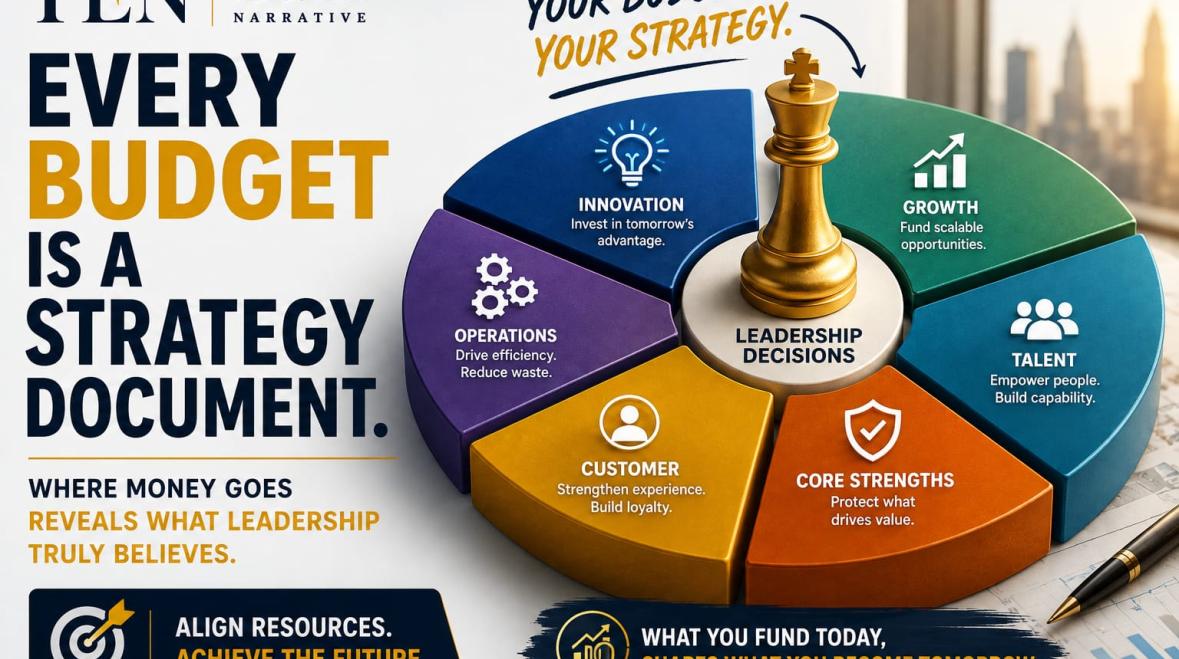
Where Money Goes Reveals What Leadership Believes
Every company has a strategy document. It may describe growth, innovation, customer experience, technology, talent or expansion as strategic priorities. But there is another document that often reveals the truth more clearly. The budget. A company can say that innovation is a priority while cutting its product investment. It can call customer experience critical while underfunding support. It can talk about long-term growth while directing most available capital toward short-term performance. The contradiction is rarely in the strategy presentation. It is in the allocation of resources.
What a company funds, protects and continues to invest in tells you what leadership truly considers important. Strategy Becomes Real When Resources Move
Strategic priorities compete for limited resources.
There is only so much capital, executive attention, talent and management capacity available. Choosing to invest more heavily in one area inevitably means investing less in another. That makes capital allocation more than a financial exercise. It is a leadership decision about the future. A company deciding to invest heavily in automation is making a different strategic bet from one investing the same capital in geographic expansion. A business increasing spending on customer retention is expressing a different belief from one prioritizing aggressive acquisition.
The budget turns these beliefs into commitments.
The Difference Between Funding and Prioritizing
Leadership teams often have long lists of priorities. The problem is that everything cannot be a priority at the same level. When resources are distributed evenly across dozens of initiatives, the organization receives a confusing message. Teams understand what has been mentioned, but not necessarily what matters most.
Real prioritization requires disproportionate commitment. That may mean:
• Giving the most important initiatives stronger funding.
• Protecting investment in capabilities that will matter several years from now.
• Reducing spending on activities that no longer create strategic value.
• Moving talent toward the opportunities with the greatest potential.
• Continuing to fund important bets even when their immediate returns are difficult to measure.
The uncomfortable part is that strategic allocation requires saying no.
The Cost of Protecting the Past
One of the most common capital allocation problems is not excessive spending. It is spending that continues simply because it has always existed. Established products receive resources because they already generate revenue. Existing processes remain funded because removing them creates disruption. Mature business units continue receiving management attention because they are familiar. Meanwhile, emerging opportunities compete for whatever remains.
This can create a subtle strategic problem: the company becomes increasingly efficient at funding yesterday while underinvesting in tomorrow.
Good capital allocation therefore requires asking not only what is performing today, but what deserves resources for the future the company is trying to build.
Capital Allocation Is a Portfolio of Bets
No strategic investment comes with certainty. Some initiatives will exceed expectations. Others will fail. A few may become transformational. The objective is not to predict every outcome correctly. It is to build a portfolio of investments where the potential upside justifies the resources committed and where leadership is willing to adjust when evidence changes. That requires discipline.
Leaders should know:
• What assumption each major investment depends on.
• What evidence would justify increasing investment.
• What signals would suggest changing direction. • Which initiatives are strategically important even if returns take time.
• Which investments are consuming resources without strengthening the company's position.
This turns budgeting from an annual ritual into an ongoing strategic process.
The Executive Test
A useful test for any leadership team is simple:
If someone saw only where the company's money, talent and attention were going, would they understand the strategy?
If the answer is no, the problem may not be the strategy itself. It may be the translation of strategy into resource allocation. Because employees do not experience strategy through presentations. They experience it through what gets funded, which projects receive talent, which initiatives get executive attention and which opportunities are allowed to continue. The organization learns what matters by watching what leadership supports.
Executive Lessons
• A strategy without resource allocation is an intention, not a commitment.
• The largest budget lines deserve strategic scrutiny, not just financial scrutiny.
• Continuing to fund yesterday's priorities can quietly weaken tomorrow's opportunities.
• Saying something is important is easy. Funding it disproportionately is the real test.
• Capital allocation should change as evidence, markets and strategic assumptions change.
TEN Perspective
Every budget tells a story. It reveals what leadership believes will create growth, where it sees risk, what it is willing to sacrifice and which opportunities it believes deserve a larger future. That makes the budget more than a financial document.
It is the strategy translated into numbers.
The question for leaders is not simply, “Are we within budget?”
It is:
“If our competitors studied where we are allocating capital, would they understand the strategy we claim to be pursuing?”
Share:
Weekly trending

Stay Informed with Global Headlines
16 Jul, 2025
- 6 mins read

The Rise of Mindful Living in a Digital World
16 Jul, 2025
- 6 mins read

The Quiet Power of Present Living
16 Jul, 2025
- 6 mins read

Minimalism in Design: Why Less is Still More
16 Jul, 2025
- 6 mins read






Recommended for you
Breaking Down the Elements of a Masterpiece Painting
The Revival of Classical Art in a Digital Age
Must-See Art Exhibitions Around the World This Year
The Revival of Classical Art in a Digital Age