




-
4

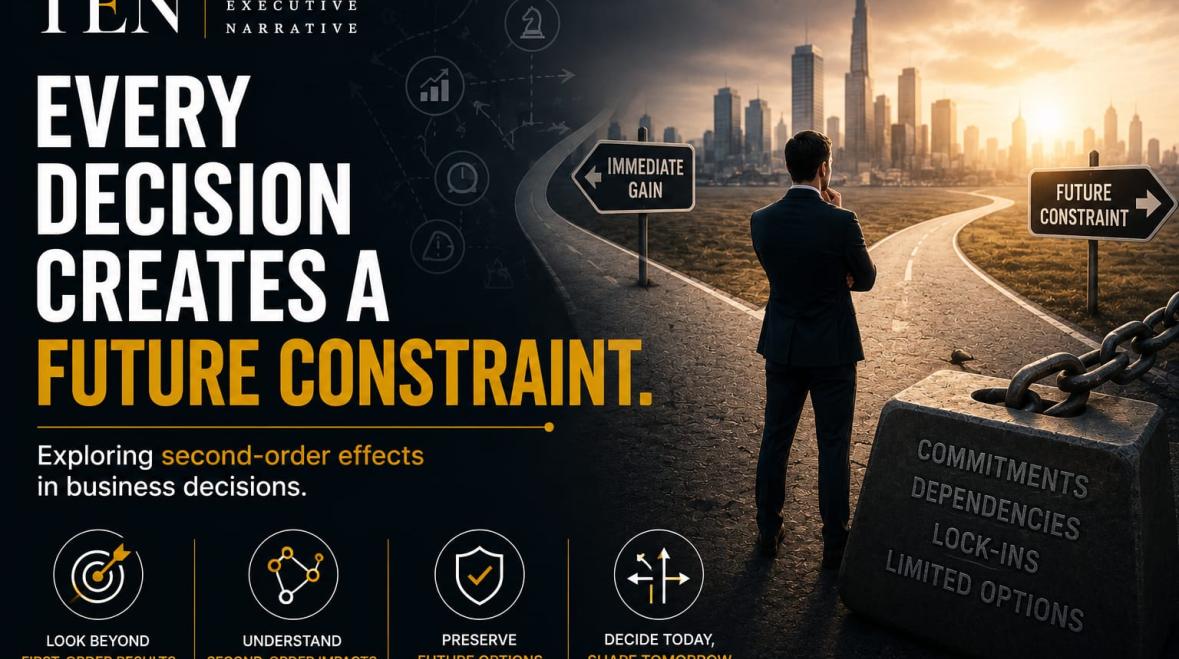
Every Choice Changes What Comes Next
Business decisions are often evaluated by what they produce immediately. Did the investment generate returns? Did the product launch on time? Did the new hire fill the role? Did the acquisition increase revenue? These questions matter, but they capture only the first layer of a decision.
Every meaningful decision also changes the conditions under which future decisions will be made.
A new technology creates dependencies. A pricing decision changes customer expectations. An organizational structure determines how information flows. An acquisition can create integration obligations that shape management attention for years. Even a successful decision can reduce future flexibility.
This is the overlooked dimension of decision-making: the consequences that appear after the original outcome has already been judged.
The First-Order Result Is Only the Beginning
The first-order effect is usually easy to see. A company cuts costs and expenses fall. It launches a product and revenue increases. It enters a new market and gains customers.
The second-order effects are less obvious.
Cost reductions may also reduce service quality, which affects retention. A successful product may increase operational complexity. Rapid hiring may solve an immediate capacity problem while creating a management structure that becomes difficult to change later.
None of these outcomes necessarily means the original decision was wrong.
It means the decision created a new starting point.
Strong leaders therefore ask not only, “What happens if we do this?” but also, “What becomes more difficult once we have done it?”
Success Can Create Constraints Too
Strategic constraints are not always created by failure. Some of the strongest constraints are created by success.
A company that builds a large customer base around a particular product may become reluctant to change it. A business that generates significant revenue from one market may find diversification harder because the existing market receives most of the capital and attention. A rapidly growing organization may create layers of management that later slow decision-making.
The decision worked.
The problem is that it also shaped what the company could do next.
This is why leaders need to distinguish between performance and flexibility. A decision can improve today's performance while reducing tomorrow's options.
The Hidden Cost of Irreversibility
Not every decision deserves the same level of analysis.
Some decisions are relatively easy to reverse. Others create commitments that become expensive to unwind. The difference should influence how leaders approach them.
A reversible decision can often be tested, measured and adjusted. An irreversible decision deserves deeper consideration because its consequences may extend far beyond the original objective.
Before making a major commitment, leaders should consider what it will lock the organization into: technology, contracts, cost structures, customer expectations, organizational capabilities or strategic assumptions.
The question is not whether constraints are bad.
Every business needs commitments.
The question is whether the constraints being created are intentional.
Decisions Compound Over Time
One decision rarely operates in isolation.
Today's choice becomes tomorrow's assumption, which becomes the foundation for another decision. Over several years, these choices can create an operating model that feels inevitable even though it was built through a series of individual decisions.
This is how strategic rigidity develops.
A company may not consciously decide to become dependent on one customer segment, one technology platform or one distribution channel. Instead, a series of sensible decisions gradually creates that dependence.
By the time the constraint becomes visible, changing direction requires significant cost.
Second-order thinking helps leaders see that accumulation earlier.
The Executive Responsibility
Leaders do not need to predict every consequence of every decision. That is impossible. Their responsibility is to identify the consequences that are material enough to influence the choice, especially those involving reversibility, dependency and future flexibility. Before committing significant resources, leaders should ask what the decision will make easier, what it will make harder and which future options it may eliminate. This creates a more disciplined approach to decision-making without turning every choice into an endless analysis exercise.
Think Beyond the Decision
Second-order thinking does not mean becoming afraid of commitment. Businesses cannot remain flexible by refusing to make choices.
It means understanding that every commitment has a price.
The best decisions therefore do more than solve the problem in front of the organization. They preserve enough flexibility to respond when circumstances change.
That might mean choosing a scalable technology rather than the cheapest one, designing contracts with appropriate flexibility, testing a new market before committing significant capital or avoiding organizational structures that become difficult to unwind.
The objective is not maximum optionality.
It is intentional optionality.
Executive Lessons
Strong decision-making requires leaders to look beyond immediate outcomes and consider how today's choices reshape tomorrow's choices. Leaders should pay particular attention to decisions that create dependencies, increase fixed commitments or reduce strategic flexibility. A decision should not be judged only by whether it solves today's problem, but also by whether it leaves the organization stronger and more capable of responding to what comes next.
TEN Perspective
Every decision closes some doors while opening others.
The most important question is not simply whether a decision creates value today. It is whether the constraints it creates are worth the opportunities they unlock.
Because strategy is not only about choosing where to go.
It is also about being deliberate about what your choices make impossible later.
The question leaders should ask is:
“If this decision succeeds exactly as planned, what will it force us to do next?”
Share:
Weekly trending

Stay Informed with Global Headlines
16 Jul, 2025
- 6 mins read

The Rise of Mindful Living in a Digital World
16 Jul, 2025
- 6 mins read

The Quiet Power of Present Living
16 Jul, 2025
- 6 mins read

Minimalism in Design: Why Less is Still More
16 Jul, 2025
- 6 mins read






Recommended for you
Breaking Down the Elements of a Masterpiece Painting
The Revival of Classical Art in a Digital Age
Must-See Art Exhibitions Around the World This Year
The Revival of Classical Art in a Digital Age