




-
5

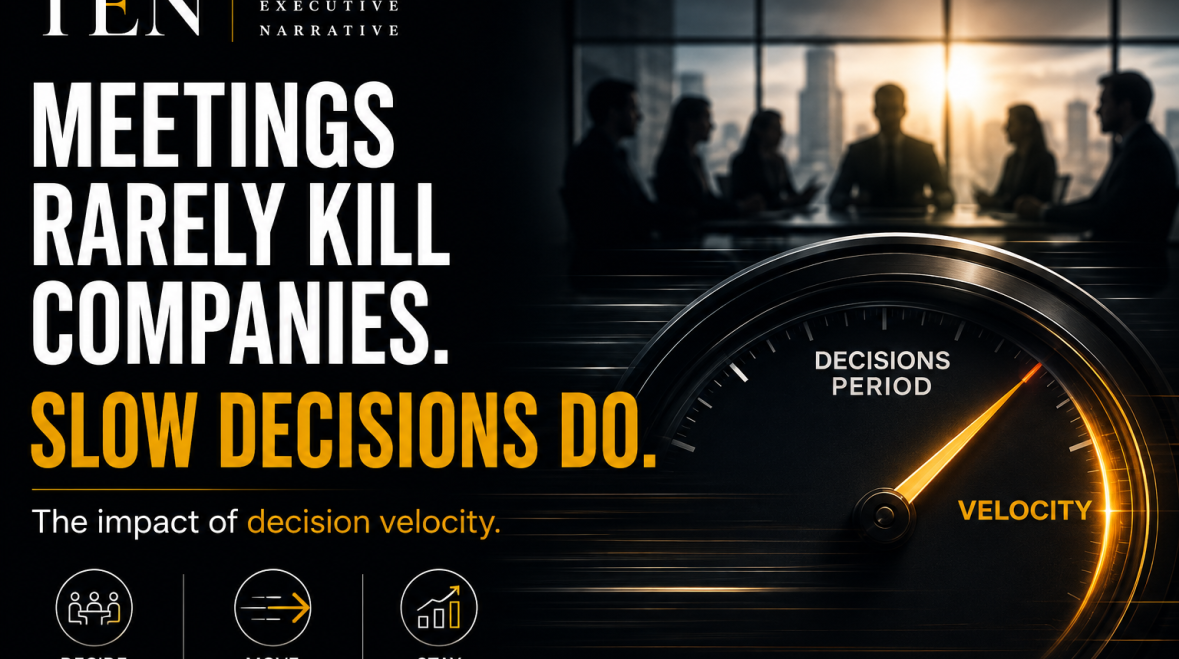
The Problem Is Not the Meeting. It Is What Happens After It.
Companies spend enormous amounts of time discussing decisions. Meetings are scheduled, presentations are prepared, opinions are exchanged and action items are recorded. Yet many organizations still struggle to move with urgency.
The problem is often misunderstood.
Meetings do not necessarily slow companies down. Unclear ownership, excessive consensus and delayed decisions do.
A meeting can create alignment in thirty minutes. But if nobody knows who owns the decision, if every stakeholder needs another discussion or if leaders keep postponing a difficult call, those thirty minutes become the beginning of a much longer delay.
In competitive markets, that delay compounds.
Decision Velocity Is a Strategic Capability
Speed is often associated with execution. But execution can only move as quickly as decisions allow.
A product team cannot ship what leadership has not approved. A sales team cannot pursue an opportunity while pricing remains undecided. A hiring team cannot close critical talent while every level of management continues debating the role.
The organization may look busy.
But underneath the activity, progress is waiting for permission.
Decision velocity is therefore not about making every decision quickly. It is about making the right decisions at the right level, with enough information to act and enough discipline to avoid unnecessary delay.
Not Every Decision Deserves the Same Process
One reason organizations become slow is that they treat different decisions as if they carry the same level of risk.
A strategic acquisition and a routine operational adjustment do not require identical approval processes. Yet many companies build layers of review that eventually make even relatively small decisions difficult.
The result is predictable: employees learn that waiting is safer than acting.
Strong organizations distinguish between decisions that are:
• Reversible, where speed matters more because mistakes can be corrected.
• Irreversible, where additional analysis and senior involvement may be justified.
• Strategic, where alignment matters because the consequences extend across the organization.
• Operational, where decisions should often remain close to the people doing the work.
The objective is not to eliminate governance.
It is to make governance proportional to the decision.
The Hidden Cost of Waiting
A delayed decision rarely carries only the cost of the delay itself.
It creates secondary consequences.
A competitor may move first. A customer opportunity may disappear. Employees may lose momentum. Teams may build workarounds around an unresolved issue. Managers may spend additional time revisiting the same question.
Eventually, the organization pays twice: once for the decision it delayed and again for everything that accumulated while waiting.
This is why decision latency can be more damaging than meeting volume.
A company can survive a long meeting if it leaves with clarity.
It struggles when it leaves with another meeting.
The Executive Responsibility
Decision speed is heavily influenced by leadership design.
When leaders insist on being involved in every decision, they unintentionally create a bottleneck. When teams are punished for making reasonable mistakes, they become reluctant to act. When accountability is unclear, decisions naturally move upward.
The solution is not simply to tell people to "move faster."
Leaders need to create conditions where decisions can move without unnecessary escalation.
That means making ownership explicit, defining decision rights and creating clear thresholds for when an issue should reach senior leadership.
The best leadership teams are not necessarily the ones that make every decision quickly.
They are the ones that know which decisions should not need them at all.
What Faster Decision-Making Actually Looks Like
Decision velocity improves when organizations reduce ambiguity around three questions:
Who decides?
What information is enough?
When does the decision need to be made?
Without those answers, teams naturally seek more information, more opinions and more approval.
That can feel responsible.
But beyond a certain point, additional information does not improve the decision. It simply delays it.
The goal is not perfect certainty.
It is sufficient clarity to act.
Executive Lessons
• Meetings are not the enemy. Unclear decisions are.
• Decision-making should be proportional to the risk and reversibility of the choice.
• Excessive consensus can create the appearance of alignment while reducing organizational speed.
• Leaders create bottlenecks when they retain decisions that should sit closer to the work.
• The cost of a decision should include the cost of waiting for it.
• Faster organizations are not necessarily less thoughtful. They are often clearer about who decides and when.
TEN Perspective
The strongest organizations do not measure decision-making by how many meetings they eliminate.
They measure it by how quickly clarity becomes action.
A company can have excellent people, strong strategy and significant resources and still lose momentum if important decisions continuously wait for another discussion.
The question leaders should ask is not:
“How many meetings can we remove?”
It is:
“Where is the organization waiting for a decision it already has enough information to make?”
Because in a fast-moving market, the advantage may not belong to the company that knows the most. It may belong to the company that can decide and act on what it knows fastest.
Share:
Weekly trending

Stay Informed with Global Headlines
16 Jul, 2025
- 6 mins read

The Rise of Mindful Living in a Digital World
16 Jul, 2025
- 6 mins read

The Quiet Power of Present Living
16 Jul, 2025
- 6 mins read

Minimalism in Design: Why Less is Still More
16 Jul, 2025
- 6 mins read






Recommended for you
Breaking Down the Elements of a Masterpiece Painting
The Revival of Classical Art in a Digital Age
Must-See Art Exhibitions Around the World This Year
The Revival of Classical Art in a Digital Age