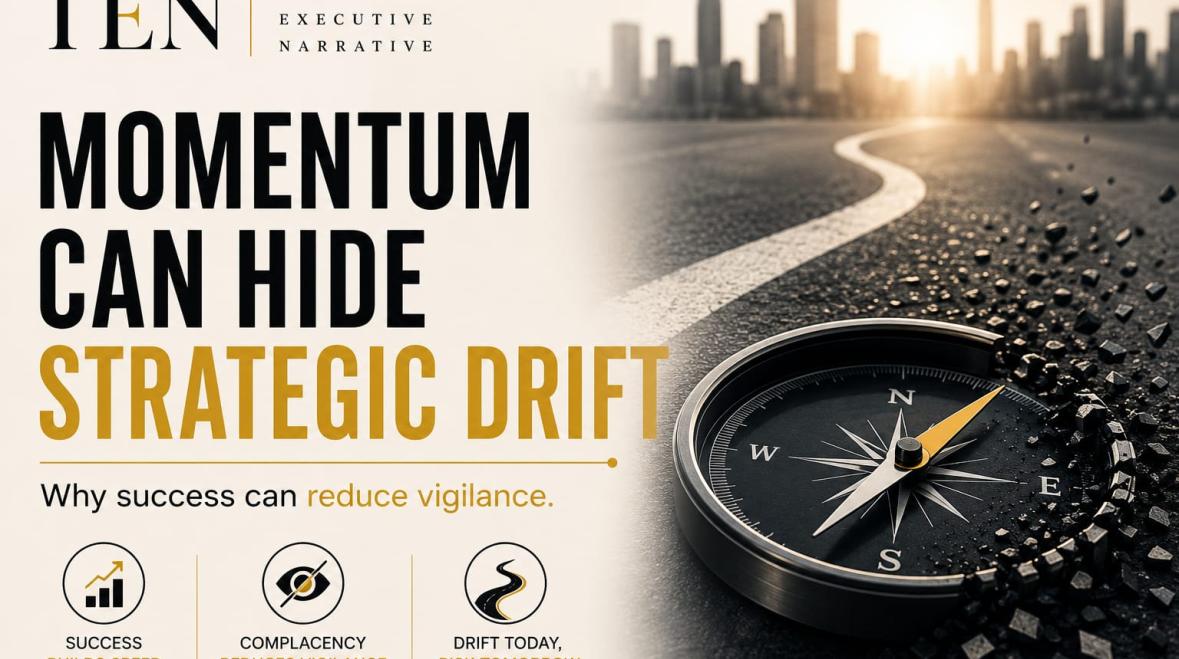
When Success Becomes a Blind SpotMomentum is one of the most valuable assets a company can build. Revenue is growing, customers are arriving, teams are expanding and the organization appears to be moving in the right direction. Success creates confidence, and confidence creates speed.
But momentum can also become dangerous.
When results remain positive, leaders have less reason to question the assumptions behind them. A strategy that worked yesterday continues receiving investment today. Processes that once created an advantage become standard practice. Decisions that produced growth become evidence that the company should keep doing more of the same.
The organization remains busy and successful while gradually moving away from what the market may require next.
Strategic drift rarely looks like failure while it is happening.
The Comfort of Positive Numbers
Weak performance naturally triggers scrutiny. Strong performance often reduces it.
When targets are being met, difficult questions can feel unnecessary. Why change the product when customers are still buying it? Why challenge the operating model when margins remain healthy? Why reconsider the market when growth continues?
This creates a subtle leadership trap: past success becomes evidence for future decisions.
But markets do not reward companies for having been right. They reward companies for remaining relevant.
A strategy can therefore become less effective without becoming immediately unprofitable. The gap between performance and relevance may remain invisible until the underlying advantage begins to weaken.
Momentum Can Mask Changing Conditions
The external environment rarely stays still.
Customer expectations evolve. Competitors change their business models. Technology lowers barriers to entry. New substitutes emerge. Regulation shifts. Entire categories can move in directions that were difficult to anticipate a few years earlier.
A company experiencing strong momentum may still notice these changes. The problem is that it may not respond to them with enough urgency.
Why?
Because the existing model is still producing results.
This is where strategic vigilance matters. Leaders need to distinguish between a strategy that is working because it remains strong and a strategy that is working because the environment has not yet exposed its weaknesses.
Those are not the same thing.
The Cost of Becoming Too Good at Yesterday
Organizations naturally become efficient at what they already know.
They build processes around successful products. They hire people who fit the current model. They reward behaviors that produced previous results. They invest in capabilities that reinforce existing strengths.
Over time, this creates consistency.
It can also create rigidity.
The company becomes exceptionally good at optimizing the current system while becoming less capable of questioning whether the system itself still makes sense.
This is why strategic drift often happens without a dramatic mistake. Nobody makes one obviously bad decision. Instead, hundreds of reasonable decisions continue reinforcing a direction that is slowly becoming less relevant.
Leaders Need a Deliberate Discomfort
The answer is not to abandon successful strategies every time conditions change.
Constant reinvention can be just as destructive as complacency.
The leadership challenge is to create enough constructive tension to question success without undermining it. That means regularly asking whether the assumptions behind current performance are still valid, whether customer needs are changing faster than the company is responding and whether today's competitive advantage could become tomorrow's vulnerability.
Some questions are particularly valuable:
What would have to change for our current strategy to stop working?
Which assumptions are we treating as permanent that may actually be temporary?
If we were building this business today, would we design it the same way?
These questions are uncomfortable precisely because a successful organization has strong reasons to defend the current model.
That is why they need to be asked deliberately.
Vigilance Is Not Pessimism
Strategic vigilance does not mean expecting failure.
It means refusing to confuse current performance with permanent relevance.
The strongest companies can celebrate success while still examining it critically. They understand that momentum provides resources and confidence, but it can also reduce the urgency to adapt.
Leaders should therefore treat strong performance as a reason to examine the strategy more closely, not less.
When the company has the time, capital and market position to experiment, it is often the best moment to challenge itself.
Waiting until performance collapses removes much of that freedom.
Executive Lessons
• Strong results can reduce the urgency to question the strategy producing them.
• Past success is evidence of what worked, not proof of what will work next.
• Strategic drift often happens through many reasonable decisions rather than one major mistake.
• Competitive advantages need to be tested against changing customer needs and market conditions.
• The best time to challenge a successful model is usually before the market forces you to.
• Vigilance is not about predicting failure. It is about refusing to become dependent on yesterday's assumptions.
TEN Perspective
Momentum is powerful because it creates movement without requiring constant intervention.
That is also what makes it dangerous.
A company can continue moving quickly while slowly moving in the wrong direction. By the time the numbers reveal the problem, the organization may already have invested years of capital, talent and attention into the wrong assumptions.
The responsibility of leadership is therefore not simply to maintain momentum.
It is to regularly question where that momentum is taking the company.
The important question is not:
“Are we still growing?”
It is:
“Are we growing in a direction that will still matter when today's advantages disappear?”

















Recommended for you
Breaking Down the Elements of a Masterpiece Painting
The Revival of Classical Art in a Digital Age
Must-See Art Exhibitions Around the World This Year
The Revival of Classical Art in a Digital Age