




-
6

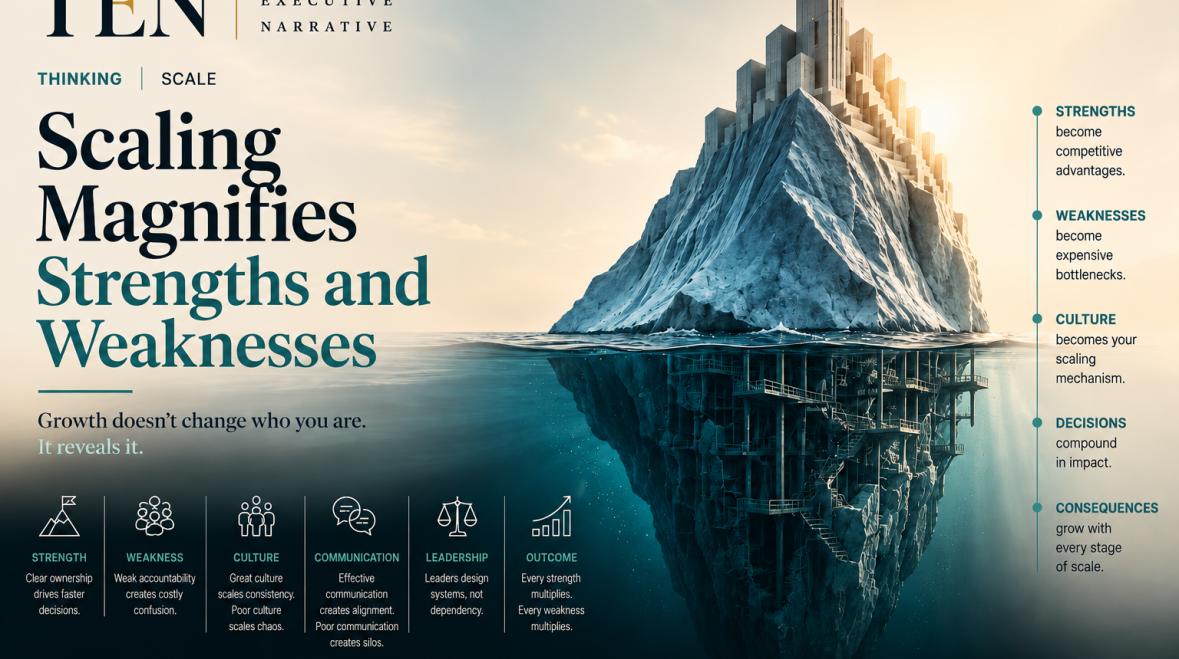
Growth is often celebrated as proof that a company has discovered a winning formula. Higher revenue, larger teams and expanding markets create the impression that the organisation is becoming stronger with every stage of scale.The reality is more nuanced. Scale rarely changes an organisation's character. It amplifies it. Processes that were once efficient become competitive advantages. Processes that were merely tolerated become operational bottlenecks. Strong cultures become defining strengths, while weak cultures become impossible to ignore.
Scale does not solve organisational problems. It gives them a larger audience.
Every company eventually discovers that growth is less about building something new and more about revealing what has always existed beneath the surface.
The Illusion of Growth
In the early stages of a business, speed often hides structural weaknesses. Founders make decisions instantly. Teams communicate informally. Processes are flexible because everyone sits close to the problem. Execution depends more on talented individuals than on organisational systems. This creates an illusion that the organisation is stronger than it actually is. As the company grows, those same habits begin reaching their limits. More employees require coordination. More customers demand consistency. More products introduce complexity.Scale doesn't create these challenges.It simply removes the ability to hide them.The organisations that struggle during periods of growth are rarely facing new problems.They are confronting old problems that have finally become impossible to ignore. Netflix and the Cost of Scaling
Netflix and the Cost of Scaling
Netflix's transformation from a DVD-by-mail business into one of the world's largest streaming platforms required far more than technological innovation. The company understood that growth would multiply organisational complexity just as quickly as customer demand. Rather than preserving the operating model that had worked at a smaller scale, Netflix deliberately invested in building a culture centred on talent density, clear accountability and decision-making freedom. Its now well-known Culture Memo was not created because the company was already large.
It was created because leadership recognised that scale would magnify every behaviour inside the organisation. A culture built on average performance would eventually produce average decisions at an extraordinary scale. A culture built on responsibility and trust could grow without requiring excessive control. Netflix understood an important principle. The larger an organisation becomes, the less leadership can personally influence every decision. Culture becomes the mechanism that scales judgment.
What Scale Actually Multiplies
Executives often ask what changes as organisations grow. The better question is what becomes impossible to hide. Scale magnifies everything already embedded within the business. It strengthens strengths. It enlarges weaknesses. It exposes assumptions that once appeared harmless. The effects become visible across the organisation.
•Strong decision-making becomes faster because clear ownership already exists.
•Weak accountability becomes more expensive because confusion spreads across larger teams. •Effective communication creates alignment across hundreds of employees instead of dozens.
•Poor communication creates competing priorities throughout the organisation.
•Healthy culture strengthens consistency as new people join.
•Weak culture multiplies uncertainty faster than leadership can correct it.
Growth is therefore not only an expansion of opportunity.It is an expansion of consequence.
The Leadership Challenge at Scale
Many executives respond to growth by introducing additional controls. More reporting. More approvals. More management layers. More governance. Some of these mechanisms are necessary. Many are simply attempts to compensate for capabilities the organisation never developed during its earlier stages. The most successful companies recognise that scale requires building better systems rather than increasing executive involvement. Leadership gradually shifts from making more decisions to designing an organisation capable of making consistently good decisions without constant executive intervention. That transition separates companies that continue scaling from those that become increasingly difficult to manage.
Scale Is an Organisational Mirror
Every organisation reaches a point where growth stops rewarding improvisation. Processes become visible. Culture becomes measurable .Leadership quality becomes institutional rather than individual. At that stage, scale functions less like an accelerator and more like a mirror. It reflects the quality of every decision the organisation has made over the years. Companies often believe scaling changes who they are. More often, it simply reveals who they have always been.
TEN Perspective
Most board discussions about growth focus on expansion. New markets. New products. New customers. New investments. Perhaps an equally important conversation deserves attention.
What will scale expose that success currently hides?
Revenue can multiply. Headcount can multiply. Operations can multiply. The question is whether the organisation's strengths will multiply faster than its weaknesses. Because growth rarely creates organisational character. It reveals it. If your company doubled in size over the next eighteen months, which part of your organisation would become your greatest competitive advantage—and which weakness would become impossible to ignore
Share:
Weekly trending

Stay Informed with Global Headlines
16 Jul, 2025
- 6 mins read

The Rise of Mindful Living in a Digital World
16 Jul, 2025
- 6 mins read

The Quiet Power of Present Living
16 Jul, 2025
- 6 mins read

Minimalism in Design: Why Less is Still More
16 Jul, 2025
- 6 mins read






Recommended for you
Breaking Down the Elements of a Masterpiece Painting
The Revival of Classical Art in a Digital Age
Must-See Art Exhibitions Around the World This Year
The Revival of Classical Art in a Digital Age