

Wise: Changing the Rules of Cross-Border Banking
August 06, 2026
- 3 mins read

2026 Copyright @ TEN.
All Rights Reserved
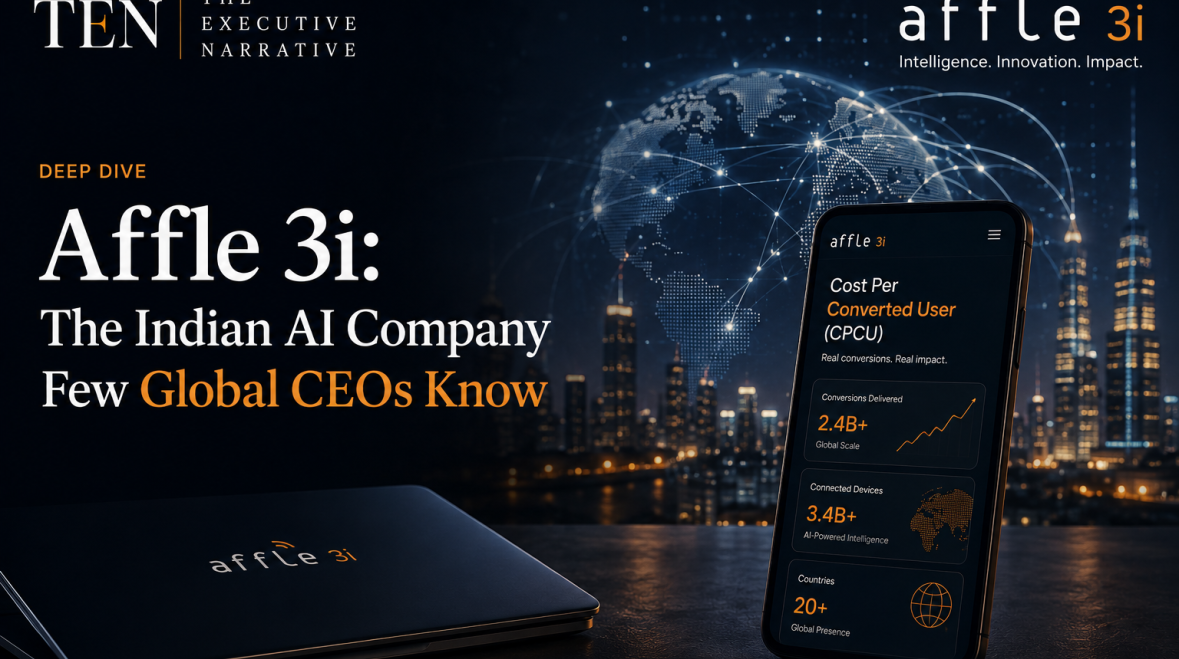
Global digital advertising was historically dominated by vanity ad impressions and high-click fraud. Affle 3i disrupted this model by pioneering an outcome-based Cost Per Converted User (CPCU) model powered by proprietary AI platforms. Today, its core competitive moat is converting global mobile ad spend directly into verified consumer transactions.
The Strategic Challenge
Mobile advertisers face massive budget waste driven by digital ad fraud, inaccurate targeting, and low post-click conversions. Traditional ad networks charge for raw impressions regardless of whether actual sales occur. Tying ad delivery to guaranteed transactions required processing billions of daily device signals without escalating infrastructure costs.
The Strategic Insight
Affle recognized that performance marketers would shift entirely toward verifiable ROI models if an ad platform assumed conversion risk. By building an agentic AI intelligence layer, Affle predicted user intent and optimized recommendations directly on mobile devices. Treating conversion data as an asset enabled a pure CPCU pricing model that aligns client costs with revenue.
The Competitive Mechanism
Affle's global competitive advantage operates through a self-reinforcing intelligence flywheel:
• Outcome-based CPCU pricing attracts high-budget advertisers seeking guaranteed ROI.
• Deeper ad spend increases device signal volume across 3.4+ billion connected mobile profiles.
• Proprietary AI algorithms refine audience prediction accuracy and lower user acquisition costs.
• Higher conversion efficiency generates recycled profits to acquire strategic regional AdTech platforms.
Operating Model
Affle operates a unified consumer intelligence platform backed by deep OEM handset partnerships and programmatic ad exchanges. By acquiring assets like Appnext, Jampp, Mediasmart, and YouAppi, Affle integrated on-device app recommendations with CTV and mobile retargeting. Centralized AI and finance operations allow rapid scaling across 20+ countries while maintaining high margins.
Strategic Trade-offs
Pioneering a CPCU model required Affle to absorb conversion risks that impression-based platforms actively avoid. The company rejected low-margin display ad volume to focus exclusively on high-intent consumer conversions. Additionally, Affle prioritized disciplined, value-accretive M&A over venture capital hyper-growth, securing strong balance sheet durability.
Why Competitors Struggle
Traditional ad networks cannot easily replicate Affle's CPCU model because their technology lacks the predictive accuracy needed to guarantee conversion pricing. Attempting to charge only on conversions without deep AI fraud detection causes severe margin compression. Furthermore, Affle's proprietary OEM integrations and accumulated device intelligence create massive data entry barriers.
Executive Lessons
Durable AdTech leadership requires aligning business revenue directly with client business outcomes. Executives must evaluate:
• Are we charging customers for vanity activities or delivering verifiable business conversions?
• How effectively does our technology stack turn operational data into a self-reinforcing competitive moat?
TEN Perspective
Affle 3i proves that world-class AI platforms can be built profitably out of emerging markets to command global scale. By taking conversion risk off advertisers and mastering programmatic M&A integration, the enterprise redefined performance marketing. Its lasting achievement is demonstrating that the future of digital advertising belongs to intelligent platforms that turn impressions into guaranteed commerce.














Recommended for you
Breaking Down the Elements of a Masterpiece Painting
The Revival of Classical Art in a Digital Age
Must-See Art Exhibitions Around the World This Year
The Revival of Classical Art in a Digital Age