

Every Decision Creates a Future Constraint
August 08, 2026
- 4 mins read

2026 Copyright @ TEN.
All Rights Reserved
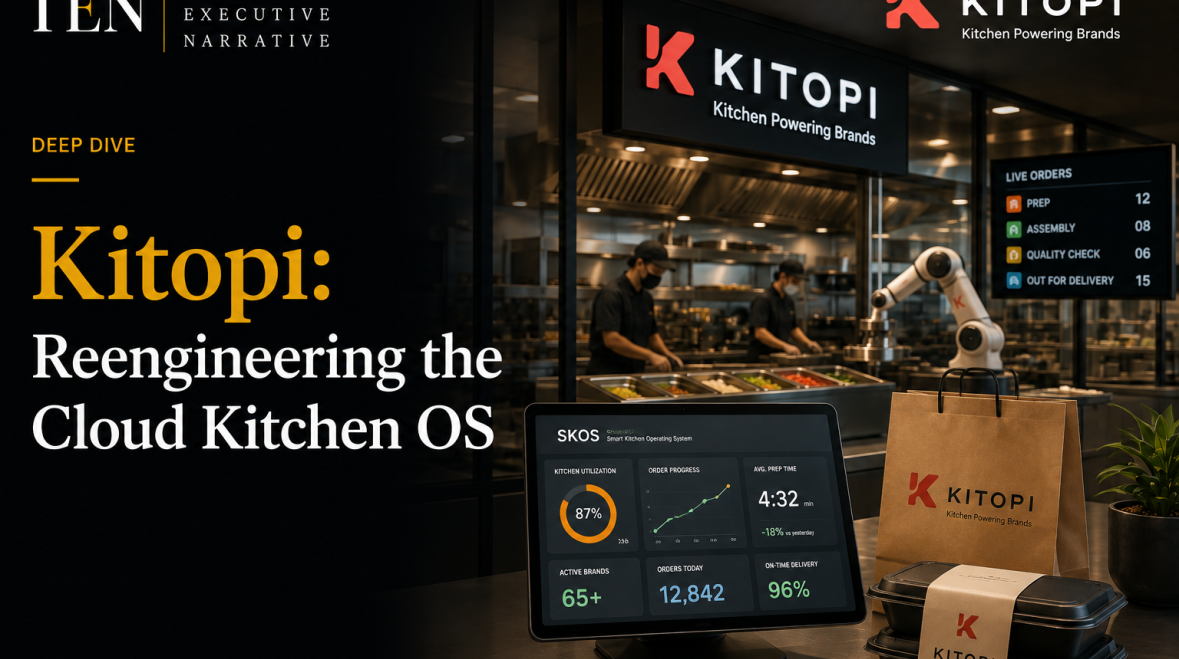
Restaurant expansion was historically constrained by heavy real estate leasing, high labor overhead, and complex supply chain logistics. Kitopi revolutionized food delivery by offering a Managed Cloud Kitchen platform powered by a proprietary Smart Kitchen Operating System (SKOS). Today, its core competitive moat is an automated culinary assembly engine that scales third-party food brands in sub-20-minute delivery windows.
The Strategic Challenge
Traditional food delivery aggregators optimized the ordering interface but left order preparation and kitchen bottlenecks unsolved. Restaurants expanding into new geographic zones faced prohibitive capital expenditures and inconsistent quality control across physical outlets. The primary challenge was orchestrating multi-brand food assembly in hyper-dense urban centers without degrading taste, speed, or unit economics.
The Strategic Insight
Kitopi recognized that ghost kitchens are fundamentally a software routing and supply chain engineering problem rather than a real estate leasing business. By centralizing food prep in master hubs and finalizing assembly in localized satellite kitchens, Kitopi maximized kitchen throughput. Treating cooking as an algorithmic workflow allowed a single kitchen line to prepare orders for dozens of distinct restaurant brands simultaneously.
The Competitive Mechanism
Kitopi's market leadership operates through a self-reinforcing operational flywheel:
• Proprietary SKOS technology automates prep stations, reducing order assembly times to under 5 minutes per brand.
• Master hub central procurement lowers food ingredient costs across a massive multi-brand portfolio.
• High kitchen utilization and dense delivery coverage attract top-tier global and regional restaurant brands.
Operating Model
Kitopi operates a hub-and-spoke infrastructure where central engineering facilities handle bulk prep and automated satellite kitchens handle final assembly. Powered by its SKOS software, the platform manages inventory forecasting, kitchen station routing, and delivery aggregator dispatch in real time. This operational architecture enables seamless brand onboarding and hyper-efficient kitchen line utilization.
Strategic Trade-offs
Building central hubs and proprietary kitchen automation required accepting substantial initial capital expenditure and complex supply chain management. Kitopi deliberately rejected pure asset-light software licensing to take full physical control of cooking and fulfillment operations. These capital-intensive investments secured complete quality control and unmatchable delivery speed across the GCC.
Why Competitors Struggle
Traditional restaurants and unorganized cloud kitchen operators cannot match Kitopi’s algorithmic kitchen routing and centralized supply chain scale. Replicating SKOS requires custom software engineering, master hub facilities, and deep delivery aggregator integrations that independent operators lack. Once a restaurant brand scales its revenues through Kitopi's network, rebuilding proprietary physical branches is financially irrational.
Executive Lessons
Durable operational advantage in foodtech comes from automating physical assembly line workflows rather than hosting software directories. Leaders must evaluate:
• Are we managing real estate leases or building an automated physical execution engine?
• How effectively does our operating software maximize yield and throughput per square meter?
TEN Perspective
Kitopi proves that physical food service becomes hyper-scalable when backed by intelligent software orchestration and centralized infrastructure. By transforming cooking into an automated, data-driven supply chain, the enterprise defined the future of quick-commerce dining. Its lasting achievement is demonstrating that true operational moats are built where digital software meets physical execution.














Recommended for you
Breaking Down the Elements of a Masterpiece Painting
The Revival of Classical Art in a Digital Age
Must-See Art Exhibitions Around the World This Year
The Revival of Classical Art in a Digital Age