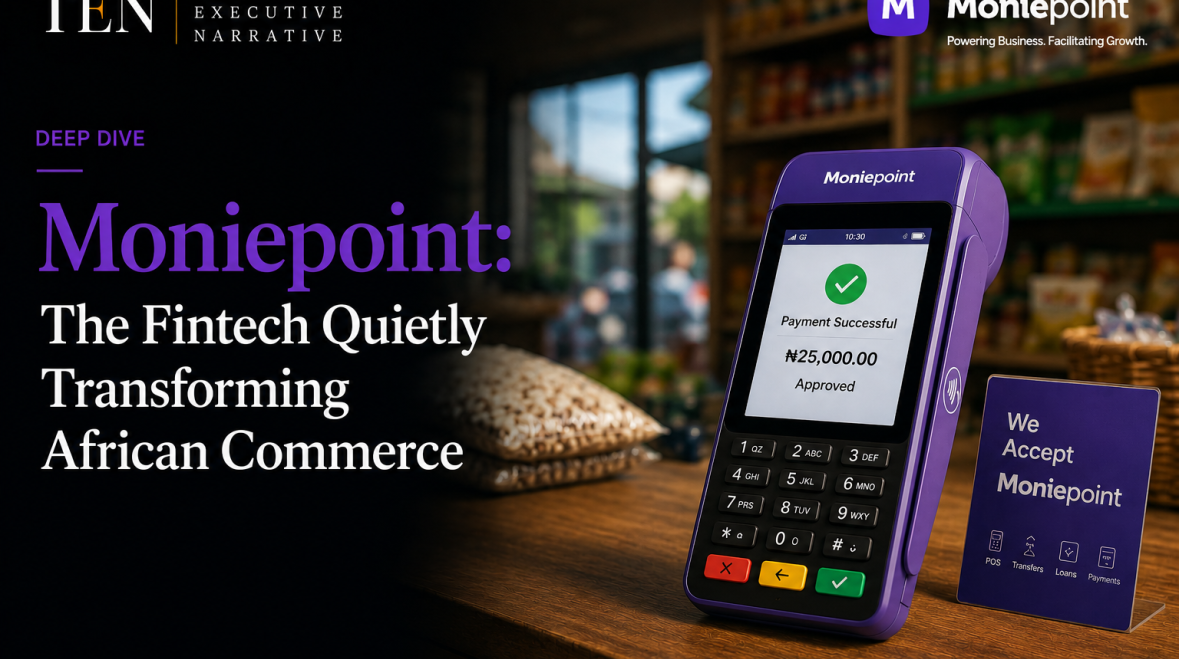
African commerce historically relied on cash, leaving millions of informal merchants without access to formal banking or digital payment acceptance. Moniepoint disrupted this ecosystem by deploying low-cost point-of-sale (POS) terminals and agency banking networks tailored for micro, small, and medium enterprises (MSMEs). Today, its core competitive moat is an expansive offline-to-online merchant infrastructure powering daily financial transactions across Nigeria.
The Strategic Challenge
Operating merchant services in emerging African markets involves unreliable internet connectivity, high card transaction failure rates, and widespread cash dependency. Consumer-facing fintechs struggled to digitize informal retail because local merchants lacked trust in digital settlement systems. The primary challenge was building a hyper-reliable offline payment acceptance and working capital network across fragmented informal markets.
The Strategic Insight
Moniepoint recognized that digitizing African commerce required serving the merchant first rather than chasing consumer app downloads. By providing reliable POS hardware, instant transaction settlement, and localized relationship agents, Moniepoint earned merchant trust on the ground. Treating business banking as an infrastructure utility enabled the platform to capture offline transaction flow and convert cash into digital financial velocity.
The Competitive Mechanism
Moniepoint's market dominance operates through a compounding merchant infrastructure flywheel:
• Reliable POS terminals and instant settlement attract informal merchants seeking trusted payment acceptance.
• High transaction volume provides real-time cash flow data, enabling automated working capital loans with low default rates.
• Integrated merchant accounts and agency banking networks lower cash-in/cash-out costs and drive ecosystem retention.
Operating Model
Moniepoint operates an offline-first merchant acquiring and business banking network supported by a distributed agent network across Nigeria. The platform integrates hardware terminal management, real-time transaction processing, and automated credit scoring into a single business operating system. This hybrid physical-digital infrastructure ensures payment processing reliability even in low-bandwidth rural regions.
Strategic Trade-offs
Pioneering merchant infrastructure required heavy upfront capital investment in POS hardware deployment and field agent operations. Moniepoint deliberately rejected consumer-first marketing campaigns and asset-light app models to focus exclusively on ground-level merchant distribution. These operational trade-offs built deep physical trust that pure digital entrants cannot easily copy.
Why Competitors Struggle
Consumer-focused fintechs and traditional banks struggle to replicate Moniepoint's ground-level agent presence and terminal reliability. Legacy banks are hampered by slow transaction clearing and poor customer support, while digital-only apps lack physical cash-in/cash-out touchpoints. Once a merchant relies on Moniepoint for daily payments, working capital, and business banking, switching costs become insurmountable.
Executive Lessons
Durable market leadership in emerging economies comes from building physical-digital infrastructure that solves core merchant friction. Leaders must evaluate:
• Are we building digital software apps or solving ground-level physical execution barriers?
• Does our platform leverage operational transaction data to de-risk credit and financial services?
TEN Perspective
Moniepoint proves that the true engine of African financial inclusion is merchant infrastructure rather than consumer wallet apps. By digitizing informal commerce from the ground up, the enterprise established the operational backbone for West Africa's business economy. Its lasting achievement is demonstrating that financial inclusion becomes sustainable when it powers merchant profitability.

















Recommended for you
Breaking Down the Elements of a Masterpiece Painting
The Revival of Classical Art in a Digital Age
Must-See Art Exhibitions Around the World This Year
The Revival of Classical Art in a Digital Age