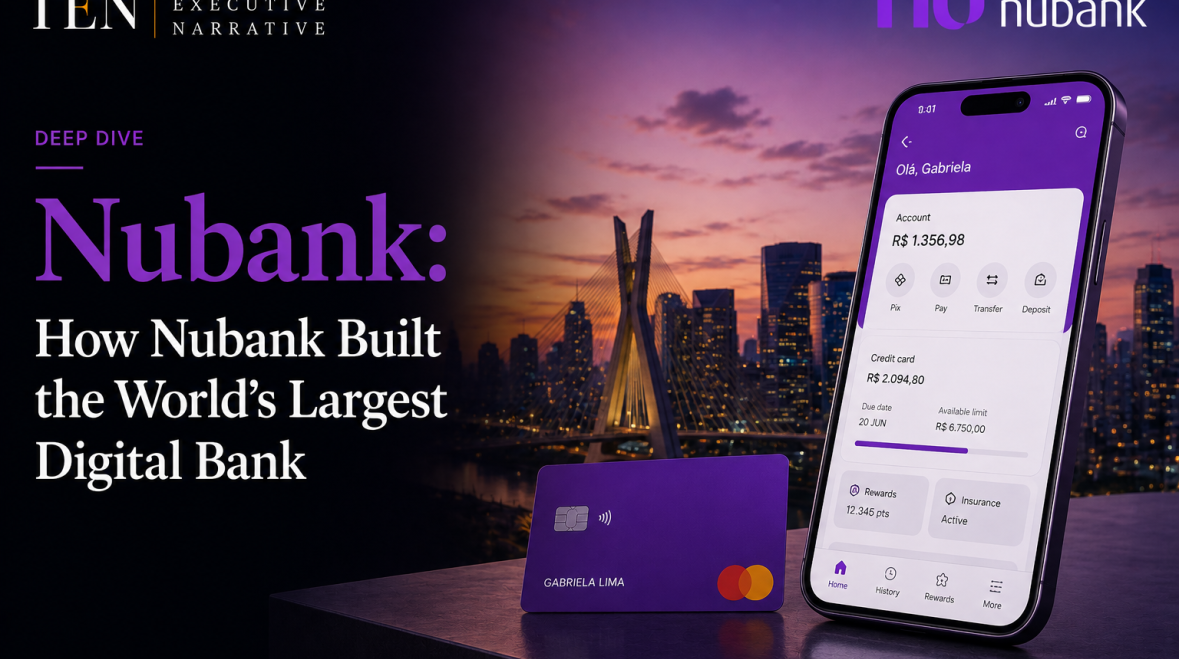
Traditional Latin American banking was long dominated by an oligopoly charging sky-high fees and delivering atrocious customer service. Nubank disrupted this market by offering a zero-fee purple credit card controlled entirely through an intuitive mobile app. Today, its core competitive moat is a low-cost, cloud-native technology platform powering fanatical customer loyalty across Latin America.
The Strategic Challenge
Brazilian banks operated with extreme bureaucracy, high interest rates, and predatory hidden fees, locking out tens of millions of citizens. Legacy branch networks created massive operational overhead while delivering frustrating, slow customer experiences. The primary challenge was building a scalable, low-cost digital banking infrastructure in a complex regulatory environment without physical branches.
The Strategic Insight
Nubank recognized that eliminating fees and treating customers with radical empathy would generate unmatched brand equity in a hated industry. By building a proprietary, cloud-native core banking system using functional programming (Clojure), Nubank reduced serving costs per user to a fraction of legacy banks. Treating customer experience as a core technology engine turned underserved consumers into hyper-vocal brand advocates.
The Competitive Mechanism
Nubank's market dominance operates through a compounding low-cost flywheel:
• Zero-fee entry products drive massive organic user acquisition, keeping CAC at industry-low levels (~$5).
• Proprietary credit scoring models and low serving costs expand margins as users adopt multi-product banking (savings, loans, crypto, insurance).
• High customer satisfaction (NPS > 80) powers word-of-mouth expansion across Brazil, Mexico, and Colombia.
Operating Model
Nubank operates a 100% digital, cloud-native architecture powered by microservices, real-time data analytics, and automated decision engines. Without physical branches or legacy IT systems, the platform serves over 100 million customers with ultra-lean operational overhead. This software-driven model allows continuous feature deployment and instant cross-border expansion across Latin America.
Strategic Trade-offs
Pioneering digital banking required accepting low initial average revenue per active user (ARPU) by offering fee-free credit cards. Nubank deliberately rejected high short-term fee revenue and physical branch presence to focus on long-term user trust and digital engagement. These strategic trade-offs allowed Nubank to achieve low-cost scale before monetizing through broader credit and investment products.
Why Competitors Struggle
Incumbent banks cannot match Nubank's cost structure without cannibalizing their lucrative credit card fees and closing thousands of physical branches. Replicating Nubank's real-time credit engine and Clojure-based architecture requires complete IT infrastructure overhauls that legacy banks cannot execute quickly. Once consumers experience instant, fee-free digital banking, returning to bureaucratic legacy institutions is unthinkable.
Executive Lessons
Sustained FinTech dominance stems from radically lowering serving costs while building fanatical customer trust. Leaders must evaluate:
• Is our tech stack enabling sub-dollar customer serving costs, or are legacy systems inflating operational overhead?
• Are we relying on hidden fees for revenue, or creating genuine customer value that drives organic growth?
TEN Perspective
Nubank proves that customer-centric software design can dismantle entrenched banking oligopolies in emerging markets. By combining a low-cost cloud architecture with obsessive customer service, the enterprise built the world's largest digital bank outside Asia. Its enduring achievement is demonstrating that in modern financial services, radical empathy combined with low-cost technology is the ultimate competitive moat.





















Recommended for you
Breaking Down the Elements of a Masterpiece Painting
The Revival of Classical Art in a Digital Age
Must-See Art Exhibitions Around the World This Year
The Revival of Classical Art in a Digital Age