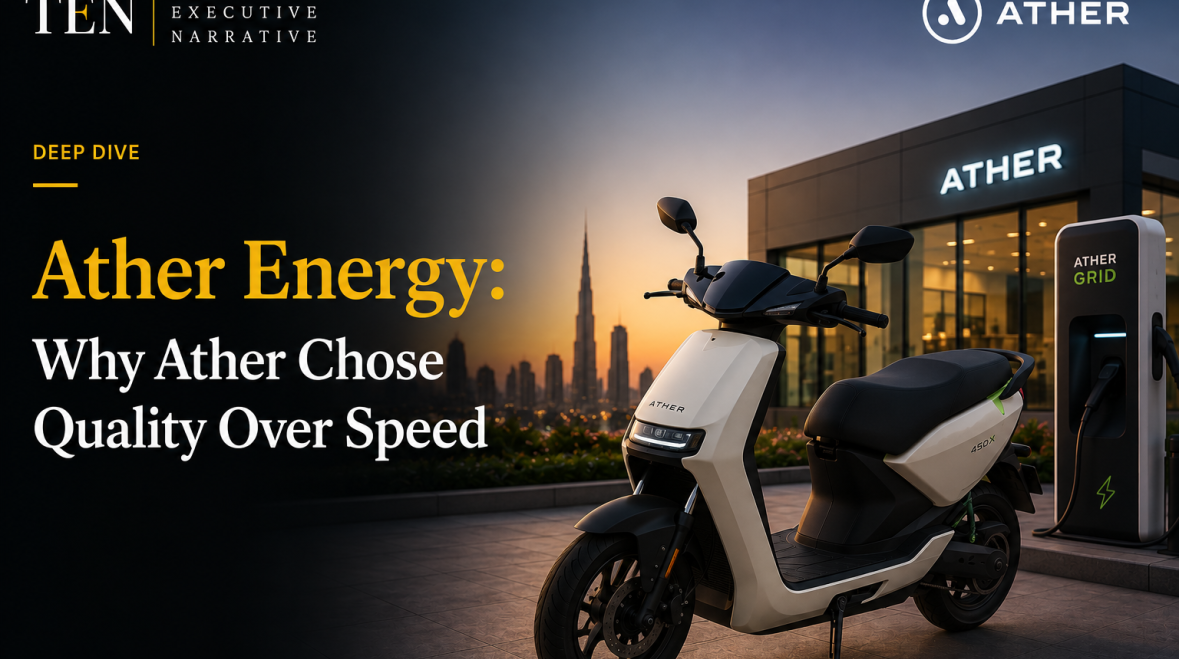
India’s electric two-wheeler market was initially rushed by low-cost assemblers importing off-the-shelf components and VC-funded startups prioritizing hyper-scale over reliability. Ather Energy rejected this high-volume playbook, choosing to spend years building proprietary motors, battery packs, and software in-house. Today, its core competitive moat is an ecosystem of deep engineering, battery safety, and the proprietary Ather Grid fast-charging network.
The Strategic Challenge
The Indian two-wheeler market is notoriously price-sensitive, plagued by harsh road conditions, extreme summer heat, and unpredictable thermal management risks. Early EV entrants faced frequent battery fires, poor build quality, and high customer churn due to imported white-label parts. The fundamental hurdle was designing an electric vehicle capable of enduring Indian road realities while building consumer trust in an unproven mobility category.
The Strategic Insight
Ather recognized that long-term EV leadership would be determined by battery safety, software integration, and charging reliability rather than rapid assembly speed. Instead of outsourcing core components, the company built an end-to-end stack—from the Atherstack OS to proprietary thermal battery management. Treating the vehicle as an integrated hardware-software ecosystem transformed EV ownership from a risky trial into a premium, dependable daily commute.
The Competitive Mechanism
Ather's market leadership operates through a self-reinforcing quality and ecosystem flywheel:
• In-house component engineering ensures industry-leading battery thermal safety and zero recall-driven reputation damage.
• Widespread deployment of the Ather Grid fast-charging network eliminates range anxiety and drives brand loyalty.
• Continuous over-the-air (OTA) software updates enhance vehicle performance and maintain high resale value.
Operating Model
Ather operates as an integrated technology and manufacturing enterprise controlling R&D, software, battery assembly, and direct-to-consumer Experience Centres. The platform integrates vehicle telemetry, cloud diagnostics, and proprietary charging infrastructure under a single operational umbrella. This full-stack control enables real-time vehicle monitoring, rapid software iteration, and high-touch customer support.
Strategic Trade-offs
Choosing deep engineering over fast assembly required Ather to accept slower initial volume expansion and higher early R&D expenditure. The company deliberately avoided competing in low-margin, mass-market price wars, focusing exclusively on premium and mid-premium urban commuters. These strategic trade-offs sacrificed vanity sales numbers to build an unassailable brand reputation for safety and reliability.
Why Competitors Struggle
Assemblers and low-cost competitors struggle because white-label hardware lacks integrated thermal management and custom software optimization. VC-backed startups prioritizing hyper-growth face severe quality control crises, frequent recalls, and rising warranty costs. Once consumers experience Ather’s seamless vehicle performance, integrated charging grid, and reliable software, switching to lower-quality alternatives introduces unacceptable safety risks.
Executive Lessons
Durable mobility leadership requires prioritizing deep technical fundamentals and product safety over short-term market share grabs. Leaders must evaluate:
• Are we rushing unvalidated products to market or building proprietary engineering capability that defends our brand?
• Does our product ecosystem create long-term customer trust and high post-purchase retention?
TEN Perspective
Ather Energy proves that in hardware and clean mobility, deep engineering discipline beats hasty market assembly every time. By resisting speculative VC pressure and building an end-to-end EV ecosystem, the enterprise established the benchmark for Indian electric mobility. Its lasting achievement is demonstrating that true brand equity is forged when product quality, safety, and infrastructure come before speed.


















Recommended for you
Breaking Down the Elements of a Masterpiece Painting
The Revival of Classical Art in a Digital Age
Must-See Art Exhibitions Around the World This Year
The Revival of Classical Art in a Digital Age