Growth has a way of making ambition look like strategy.A company succeeds in one market, demand begins to rise, investors push for faster expansion, and suddenly the conversation shifts from "How do we strengthen our position?" to "Which country should we enter next?"
The logic feels compelling. More markets should mean more customers, more revenue, and a larger global footprint.Then an experienced board member asks a question no one expected.
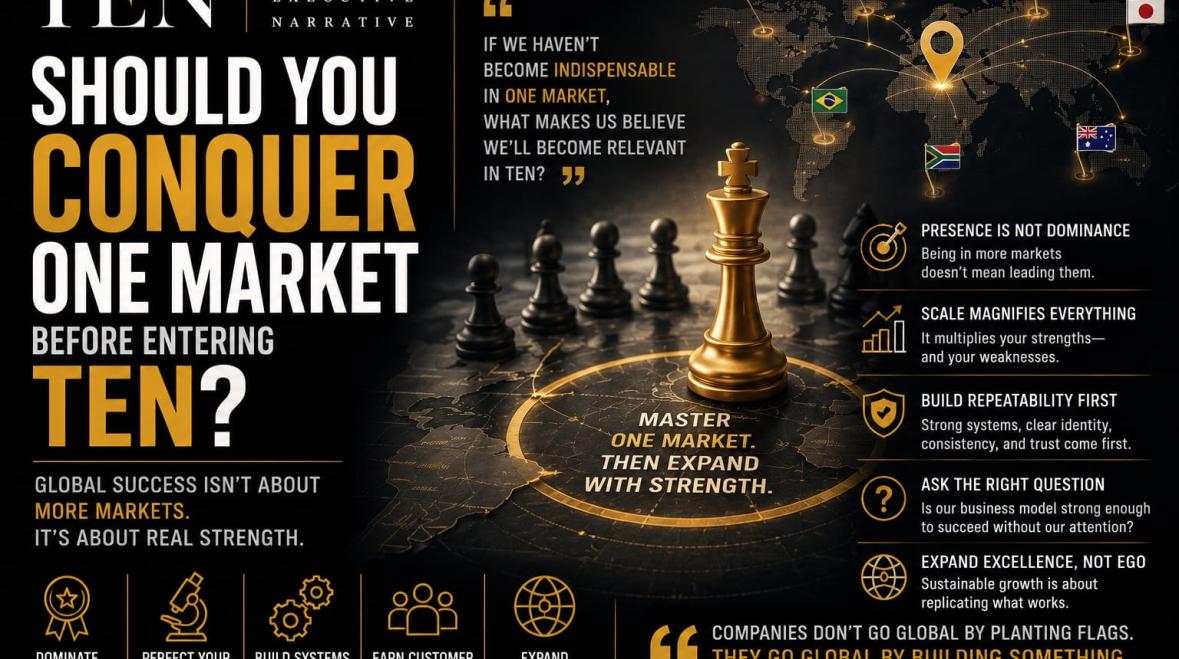
"If we haven't become indispensable in one market, what makes us believe we'll become relevant in ten?"
The room becomes quieter. Because expansion and leadership are often confused, even though they are entirely different achievements.
Presence Is Not Dominance
Many organisations celebrate geographic expansion as evidence of growth. Maps filled with country flags look impressive in annual reports. New offices signal momentum. International revenue creates headlines. Yet none of these prove competitive strength. Being present in multiple markets is not the same as leading them. History repeatedly shows that companies rarely build enduring global businesses by becoming average everywhere. They first become exceptional somewhere. Their home market becomes a laboratory where products improve, operations mature, and customer trust compounds.
Dominance creates the foundation.
Expansion simply extends it.
Scale Magnifies Strengths—And Weaknesses
Expansion is often viewed as a growth strategy.
In reality, it is a multiplier.
If an organisation has built a disciplined operating model, expansion multiplies efficiency. If customer loyalty is strong, expansion multiplies reputation. But if internal processes are inconsistent or competitive advantage remains unclear, expansion magnifies those weaknesses just as quickly.
Growth does not solve operational problems.
It exposes them. The companies that struggle internationally are rarely defeated by foreign competitors alone. They are overwhelmed by the complexity they introduced before mastering simplicity.
The Companies That Travel Furthest Usually Stay Home the Longest
The world's strongest global businesses rarely rushed abroad.Starbucks perfected its operating model before becoming an international brand. Costco built decades of operational discipline before expanding selectively. IKEA established an identity so distinctive that entering new markets became an extension of an already proven formula rather than an experiment.
Their success was not driven by speed.It was driven by repeatability.They expanded only after discovering something worth repeating.
The Better Boardroom Question
Perhaps executives are debating the wrong decision.
Not,
"Which market should we enter next?"
But,
"Have we built a business model strong enough to succeed without our direct attention?"
That question changes the conversation completely.Expansion stops being a race for territory and becomes a test of organisational maturity. Leadership begins evaluating culture, operational consistency, capital allocation, and customer loyalty before discussing geography.
Because sustainable expansion is never about adding markets.
It is about replicating excellence.
TEN Perspective
Every company dreams of becoming global.Far fewer build something worth exporting.Markets can be entered with capital. Competitive leadership cannot. It is earned through years of disciplined execution, relentless customer focus, and operational consistency that competitors struggle to imitate.
Perhaps the first responsibility of leadership is not to ask where the company should grow next, but to ask whether the business has become so strong in one market that success can travel without losing its identity.
Because companies don't become global by planting flags.
They become global by building something every new market wants to adopt.

















Recommended for you
Breaking Down the Elements of a Masterpiece Painting
The Revival of Classical Art in a Digital Age
Must-See Art Exhibitions Around the World This Year
The Revival of Classical Art in a Digital Age