

The Illusion of the War Room
July 03, 2026
- mins read





2026 Copyright @ TEN.
All Rights Reserved
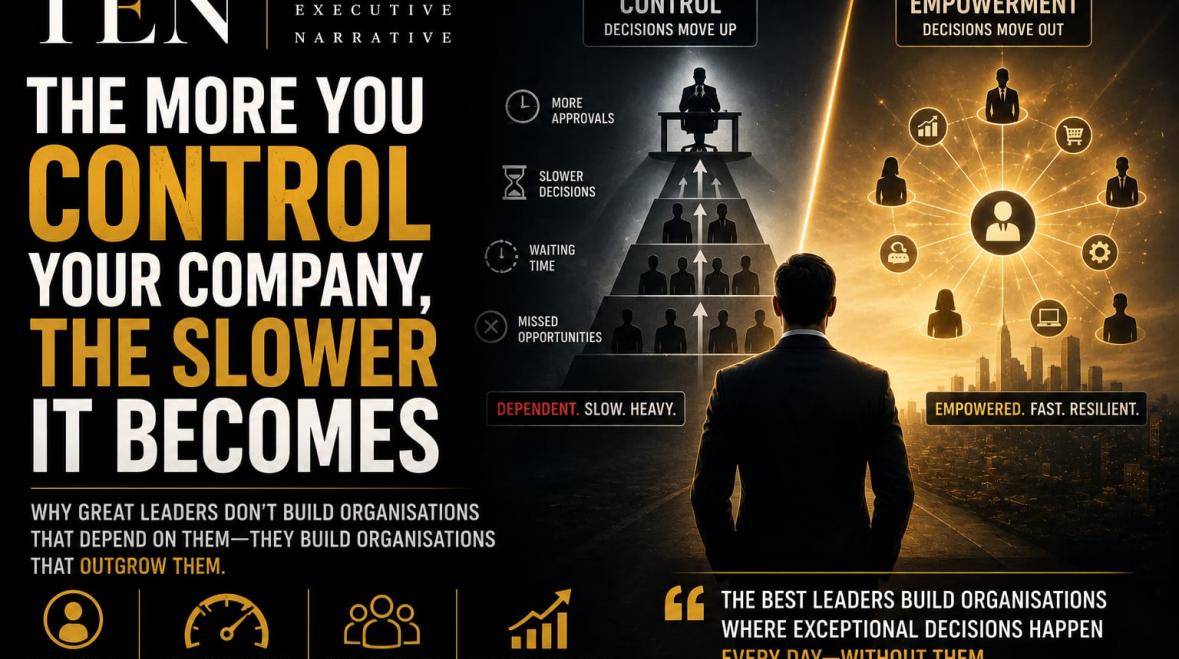
Why great leaders don't build organisations that depend on them—they build organisations that outgrow them.
Every founder dreams of building a company that grows faster every year. Ironically, growth often creates the very problem that slows it down.As organisations expand, leaders naturally become more involved. More decisions require approval, more meetings appear on the calendar, and more departments begin looking upward before taking action. What once felt like decisive leadership gradually becomes organisational dependency.
The result isn't immediately visible.
Revenue may continue growing. Customers may remain satisfied. The warning signs appear somewhere else.
The organisation begins waiting.
The Leadership Trap Few People Notice
Most people believe companies become slower because they become bigger.
That's only partially true.
In reality, companies become slower because their decision-making grows in the wrong direction. In healthy organisations, decisions move outward—towards the people closest to customers, operations, and markets. In unhealthy organisations, decisions move upward—towards leadership. Every new approval adds another stop. Every stop increases waiting time. Over months and years, the organisation doesn't simply become larger.
It becomes heavier.
A Lesson Most Leaders Learn Too Late
There is an important difference between control and governance.Many leaders confuse the two.Control means leaders approve decisions. Governance means leaders design systems where good decisions happen consistently—even when they aren't in the room.The distinction matters.One builds dependence.The other builds capability.
Companies with strong governance don't need the CEO involved in every important conversation because clear principles already guide decision-making. That is why governance scales. Control doesn't.
The Hidden Competitive Advantage Nobody Talks About
Most businesses believe they compete through better products, lower prices, or stronger marketing.
They do. But they also compete through something less obvious.
Decision velocity.
Decision velocity is the speed at which an organisation can recognise a problem, make a high-quality decision, and execute before competitors respond.Imagine two companies discovering the same market opportunity.One spends three weeks seeking approvals.The other empowers the team closest to the customer to act within 48 hours.Both had the same idea. Only one reached the market first.
In modern business, speed isn't just operational efficiency. It's competitive advantage.
The Decision Every CEO Eventually Faces
As organisations grow, leaders eventually face a choice.
Should every important decision continue flowing upward? Or should leadership build a company where excellent decisions happen throughout the organisation?
The first creates dependency.
The second creates resilience. One scales hierarchy. The other scales judgment. The companies that outperform over decades rarely have leaders making every important decision.They have leaders building systems where thousands of good decisions happen every day without requiring executive approval.
TEN Perspective
Leadership is often misunderstood.
Many people believe great leaders make the best decisions.
The best leaders build organisations that no longer depend on them to make every decision.
That is the difference between managing a company...
...and building one.
Perhaps the real measure of leadership isn't how many decisions reach the CEO.
Perhaps it's how many exceptional decisions happen because the organisation has learned to think for itself.











Recommended for you
Breaking Down the Elements of a Masterpiece Painting
The Revival of Classical Art in a Digital Age
Must-See Art Exhibitions Around the World This Year
The Revival of Classical Art in a Digital Age