The Most Expensive AI Decision CEOs Will Make This Decade
Executive Summary
Every board is debating Artificial Intelligence.
The discussion almost always begins with the same question: Should we build AI or buy it? It appears to be the defining strategic decision of this decade. Yet the choice between building and buying is rarely the decision that determines long-term competitive advantage.
The more consequential decision is identifying what the organisation must continue to own when Artificial Intelligence becomes available to everyone.
Strategic Challenge
A leadership team recently presented its AI strategy to the board. The roadmap was comprehensive—internal capabilities, specialised talent, proprietary models and a multi-year investment plan. The discussion focused on execution: investment size, implementation timelines and expected returns.
Then one board member asked a different question.
"If every competitor successfully executes this same roadmap within five years, what will customers still choose us for?"
The meeting stopped being about AI.
It became a conversation about competitive advantage.
The Strategic Insight
Technology rarely creates lasting differentiation on its own.
History shows that technologies become more accessible, costs decline and adoption spreads across industries. What initially appears to be a competitive advantage gradually becomes a market expectation. The organisations that continue outperforming are not necessarily those with the best technology, but those that understand where competitive value moves after the technology becomes commonplace.
Artificial Intelligence is unlikely to be different.
________________________________________
The Decision
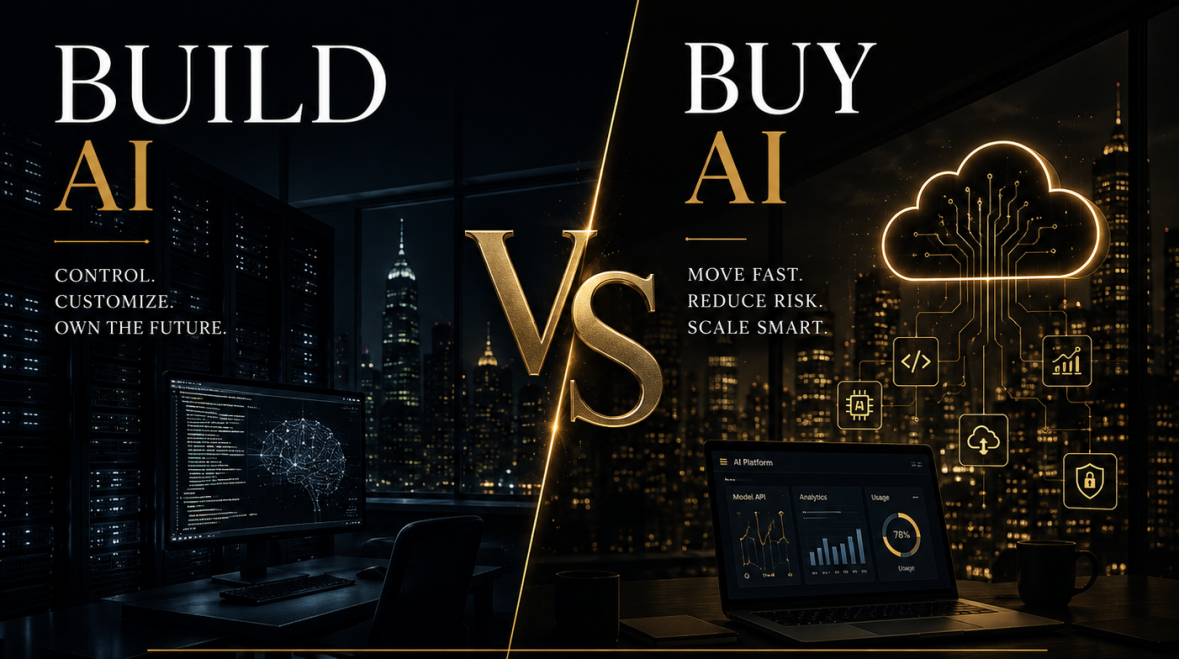
Building AI creates ownership, control and proprietary capability. Buying AI creates speed, flexibility and efficient capital allocation. Both strategies have produced exceptional companies because both can be correct under different circumstances.
The real decision sits beneath the technology.
Leadership is deciding which capability deserves long-term ownership. That decision reflects a belief about where future competitive advantage will exist, not simply how AI should be implemented.Boards often spend months analysing execution risk.
Far fewer spend time questioning the strategic assumption that justifies the investment.
Strategic Trade-offs
Every AI investment represents a prediction about the future. Not a prediction about which model will perform better. A prediction about which capabilities will remain scarce after intelligence becomes abundant.
Manufacturing once differentiated industry leaders. Infrastructure once created enduring advantage. Enterprise software once transformed competitive positioning. Over time, each became widely available, forcing organisations to compete on something else.
The question for today's executives is simple but uncomfortable.
Which capability will remain valuable after AI becomes ordinary?
Why This Decision Matters
The answer fundamentally changes how organisations allocate capital.
If long-term differentiation comes from proprietary knowledge, building may become essential. If advantage comes from customer relationships, execution or trust, buying may prove to be the more strategic choice. The same technology decision produces different outcomes because the underlying business assumptions are different.
AI is therefore not the strategy. It is an investment made in support of a broader strategic belief.
Executive Lessons
Before approving the next AI investment, leadership should pause and ask three questions.
• What capability will customers continue paying a premium for?
• Is that capability becoming more scarce or less scarce?
• Are we investing in technology, or are we investing in the future source of competitive advantage?
The answers matter far more than whether the organisation builds or buys AI.
________________________________________
TEN Perspective
Every generation believes it is investing in the technology that will define the future. History usually reaches a different conclusion.
The organisations that create enduring value are those that correctly identify where competitive advantage migrates before everyone else does. They understand that technology eventually becomes accessible, but strategic capabilities rarely do.
Perhaps the defining AI decision of this decade is not whether organisations build intelligence or buy it.
Perhaps it is whether leadership correctly identifies what must remain unmistakably theirs long after intelligence is no longer scarce.

















Recommended for you
Breaking Down the Elements of a Masterpiece Painting
The Revival of Classical Art in a Digital Age
Must-See Art Exhibitions Around the World This Year
The Revival of Classical Art in a Digital Age