

Shipping Faster Isn't Always Winning Faster
August 09, 2026
- 5 mins read





2026 Copyright @ TEN.
All Rights Reserved
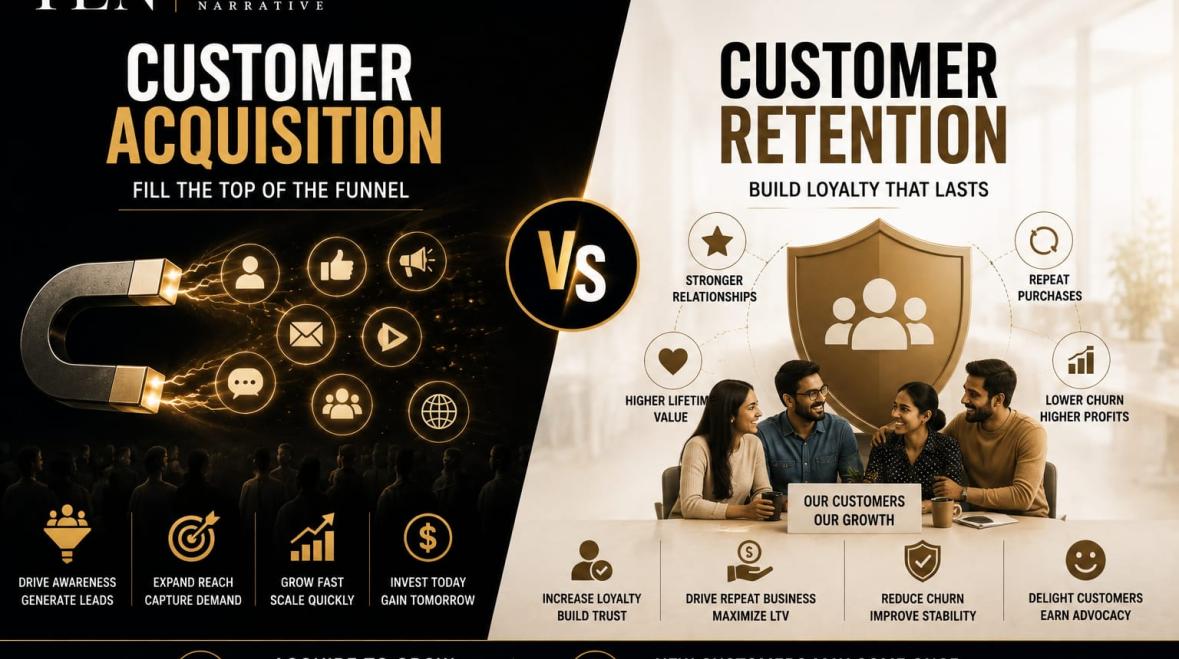
Growth is often measured by the number of new customers a business acquires. Investor updates celebrate acquisition, marketing teams optimize for lead generation, and sales targets revolve around expanding the customer base. Yet the businesses that create enduring value understand that growth does not begin with the next customer. It begins with ensuring the current one never has a reason to leave.
The Strategic Challenge
Acquiring new customers is visible. It creates headlines, quarterly momentum, and measurable progress. Retention is quieter. It improves gradually through better products, stronger relationships, and consistent customer experiences. The challenge for leadership is deciding where the next dollar should be invested. Pursuing acquisition without strengthening retention often turns growth into an expensive cycle of replacement rather than expansion.
The Strategic Insight
Acquisition increases revenue.
Retention compounds it.
Every customer who stays generates more than repeat purchases. They reduce marketing costs, strengthen brand credibility through referrals, provide valuable feedback, and increase lifetime value over time. Businesses that constantly replace departing customers may appear to grow while making little progress in building durable advantage.
The Competitive Mechanism
Organizations with high retention create a reinforcing cycle.
•Long-term customers generate predictable revenue.
•Predictable revenue enables greater investment in products and customer experience.
•Better experiences strengthen loyalty and attract new customers through trust rather than advertising.
Growth becomes an outcome of customer satisfaction instead of continuous acquisition spending.
Operating Model
Leading organizations treat customer retention as a company-wide responsibility rather than a function owned by customer support. Product teams improve usability, operations ensure consistency, sales manage expectations, and leadership measures long-term customer value alongside new business growth. Every interaction is designed to increase the probability that customers choose to stay.
Strategic Trade-offs
Prioritizing acquisition can accelerate market expansion but often demands increasing marketing expenditure and aggressive pricing. Focusing on retention may produce slower visible growth while strengthening profitability, customer loyalty, and long-term resilience. The trade-off is not between attracting customers and keeping them. It is deciding whether growth should be driven by replacement or by relationships.
Why Competitors Struggle
Many organizations celebrate acquisition while treating customer churn as an operational metric rather than a strategic warning. As competition intensifies, customer acquisition becomes increasingly expensive. Businesses that fail to retain customers find themselves investing more each year simply to maintain the same level of growth. Their scale increases, but their competitive position does not.
Executive Lessons
Executives should ask:
•Are we creating new customers faster than we are losing existing ones?
•Does every additional marketing dollar create lasting relationships or temporary revenue?
•If customer acquisition stopped tomorrow, would our current customers sustain the business?
TEN Perspective
Every company knows the cost of acquiring a customer.
Far fewer understand the cost of losing one.
Competitors can outspend your marketing budget.
They cannot easily replace the trust built through years of consistently delivering value.
The strongest businesses do not grow because they constantly find new customers. They grow because existing customers keep choosing them when every alternative is only one click away.











Recommended for you
Breaking Down the Elements of a Masterpiece Painting
The Revival of Classical Art in a Digital Age
Must-See Art Exhibitions Around the World This Year
The Revival of Classical Art in a Digital Age