For years, leaders have debated whether employees should work remotely or return to the office. The discussion has become a contest between flexibility and presence, productivity and culture. Yet the organizations making the strongest workforce decisions are asking a different question altogether. Competitive advantage does not come from where people work. It comes from designing work that creates value regardless of location.
The Strategic Challenge
The return-to-office debate often assumes there is a universal answer. Some organizations mandate office attendance to rebuild collaboration, while others embrace remote work to attract talent and reduce costs. Both approaches risk becoming policies driven by ideology rather than business strategy. The real challenge is aligning the workplace with the type of work the organization is trying to accomplish.
The Strategic Insight
Location is not a strategy. Coordination is.
Routine, process-driven work can often succeed from anywhere with the right systems and accountability. Innovation, complex problem-solving, and leadership alignment frequently benefit from richer interaction and faster decision cycles. Treating every role the same creates unnecessary friction. The most effective organizations design work around outcomes, not addresses.
The Competitive Mechanism
Organizations that outperform in the future will not be defined by remote or office policies alone. Their advantage comes from matching work environments to business priorities.
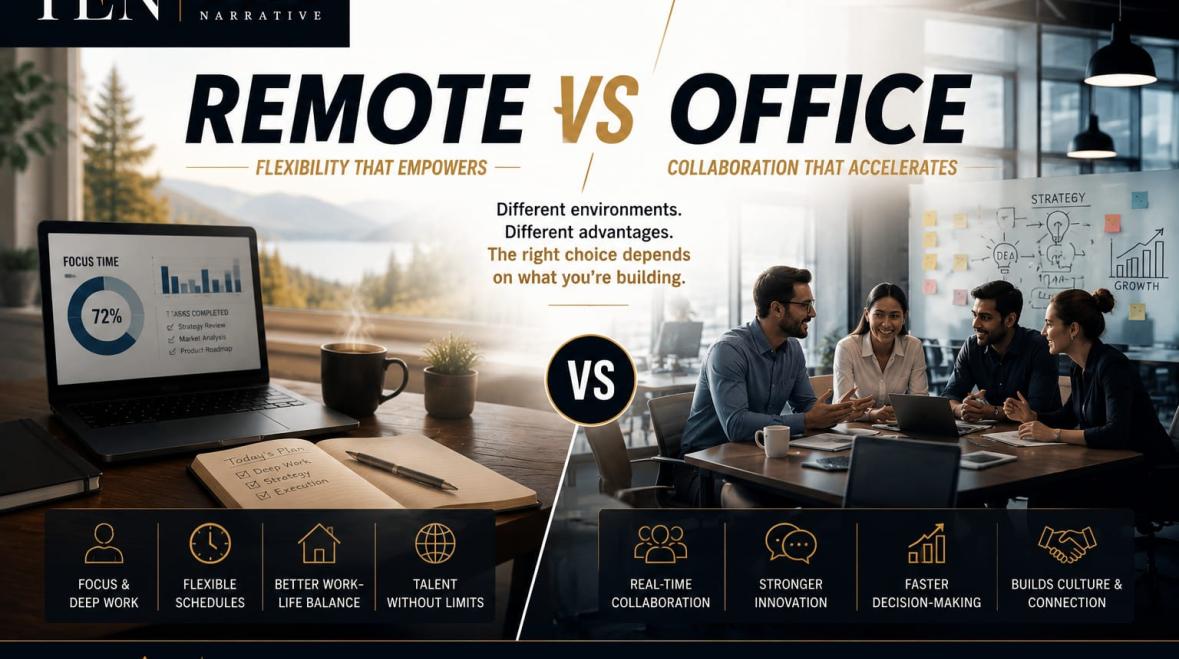
•Individual execution thrives where focus is protected.
•Creative collaboration improves where ideas move quickly between people.
•Leadership decisions accelerate when trust and communication are intentionally designed.
The workplace becomes a strategic tool rather than a fixed destination.
Operating Model
Leading organizations are moving beyond blanket policies. They identify which activities require physical proximity and which benefit from flexibility. Customer-facing innovation, strategic planning, and executive alignment may justify in-person collaboration, while analytical, operational, and independent work can often remain location-agnostic. The operating model becomes adaptive instead of uniform.
Strategic Trade-offs
Mandating office attendance may strengthen culture while limiting access to global talent. Fully remote models expand hiring opportunities but can weaken informal collaboration and organizational cohesion if left unmanaged. Neither choice is inherently superior. The trade-off lies between consistency and adaptability, not between buildings and video calls.
Why Competitors Struggle
Many organizations continue debating where employees should work instead of examining how work actually happens. They optimize attendance metrics while overlooking decision quality, execution speed, and customer outcomes. As a result, workplace strategy becomes an HR policy rather than a source of competitive advantage.
Executive Lessons
Executives should ask:
•Which work genuinely improves when people are together?
•Which activities gain nothing from physical presence?
•Are we measuring attendance, or are we improving performance?
TEN Perspective
The future of work will not be decided by office occupancy rates or remote work policies.
It will be decided by organizations that understand the difference between presence and performance.
Every competitor can choose the same workplace model.
Far fewer can build an operating system where collaboration happens deliberately, decisions move faster, and talent performs at its best regardless of location.
The real debate was never about where people work. It is about where your organization creates its greatest advantage.

















Recommended for you
Breaking Down the Elements of a Masterpiece Painting
The Revival of Classical Art in a Digital Age
Must-See Art Exhibitions Around the World This Year
The Revival of Classical Art in a Digital Age