Pricing is often viewed as a commercial decision. In reality, it is a strategic choice about the type of business a company wants to build. Competing on price can accelerate customer acquisition and market share, while premium pricing creates room for innovation, service, and brand differentiation. The question is not which strategy generates more sales. It is which strategy competitors will struggle to replicate.
The Strategic Challenge
Many organizations reduce prices when growth slows or competition intensifies. The decision appears logical—lower prices attract more customers. Yet every price reduction reshapes customer expectations, compresses margins, and limits future investment. What begins as a short-term response can gradually redefine how the market values the business. The challenge is deciding whether growth should come from affordability or distinctiveness.
The Strategic Insight
Price is easy to copy. Value is not.
A competitor can match a discount overnight, but replicating superior products, exceptional service, trusted relationships, or a respected brand requires years of disciplined execution. Businesses that compete primarily on price often enter a race where every victory is temporary. Businesses that compete on value create reasons for customers to stay when cheaper alternatives appear.
The Competitive Mechanism
Organizations that sustain premium pricing rarely charge more because they can.
They charge more because customers perceive greater value.
•Strong products reduce the importance of price.
•Brand trust lowers customer risk.
•Superior experiences increase loyalty beyond transactions.
Pricing becomes the outcome of differentiation rather than the driver of demand.
Operating Model
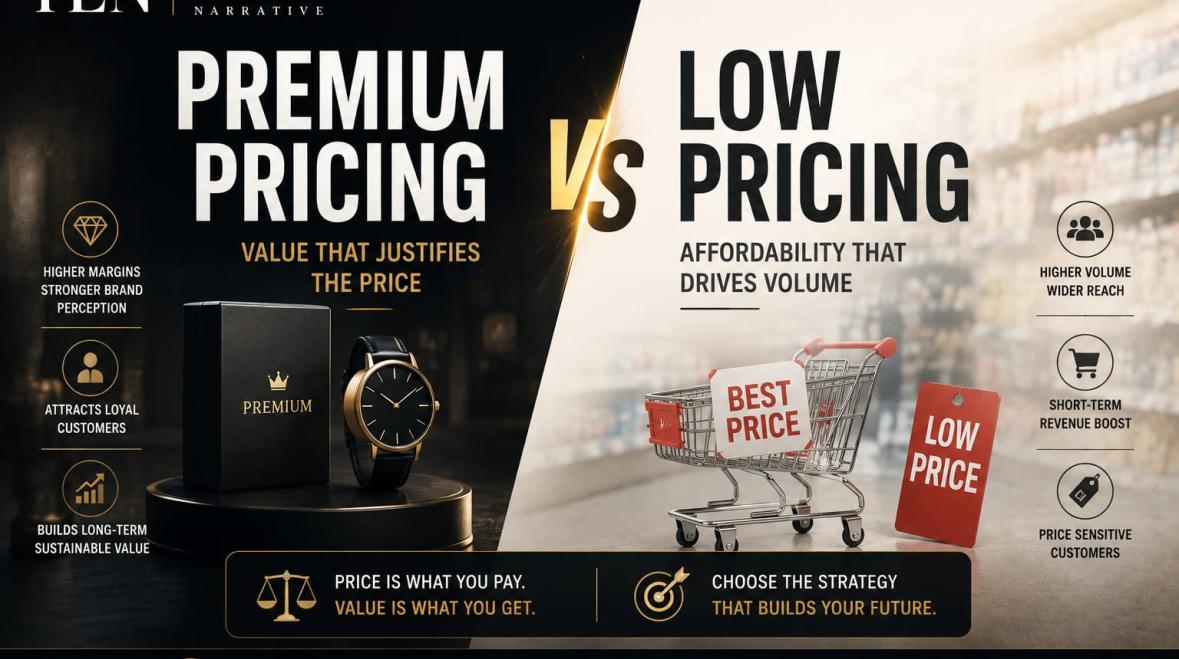
Value-driven businesses invest consistently in innovation, customer experience, talent, and operational excellence. Every function strengthens the promise behind the premium. Price-led businesses, by contrast, depend on efficiency, scale, and cost discipline to remain competitive. Both models can succeed, but each demands complete organizational alignment rather than occasional pricing adjustments.
Strategic Trade-offs
Premium pricing may reduce short-term customer volume while strengthening profitability and long-term brand equity. Low pricing can expand market reach but often creates constant pressure on margins and operational efficiency. The trade-off is not between expensive and affordable. It is between building loyalty through differentiation or relying on continuous price competition.
Why Competitors Struggle
Many companies believe lowering prices is the fastest path to growth. Few recognize that competitors can respond with even deeper discounts. The businesses that prove hardest to challenge are those customers compare on outcomes, trust, and experience—not on price tags. Their advantage survives because it cannot be negotiated away.
Executive Lessons
Executives should ask:
•Are customers choosing us because we are cheaper or because we are better?
•If a competitor reduced prices tomorrow, what reason would customers have to stay?
•Are we investing in value creation or simply defending price?
TEN Perspective
Markets rarely remember the company that offered the lowest price.
They remember the company that became the hardest to replace.
Every discount can increase demand.
Very few increase competitive advantage.
The real pricing decision is not how much customers are willing to pay today. It is whether your business is building something they will still choose when a cheaper alternative arrives.

















Recommended for you
Breaking Down the Elements of a Masterpiece Painting
The Revival of Classical Art in a Digital Age
Must-See Art Exhibitions Around the World This Year
The Revival of Classical Art in a Digital Age