
Why Efficient Companies Often Stop Innovating
August 09, 2026
- 5 mins read

2026 Copyright @ TEN.
All Rights Reserved
Executive Snapshot
• Objective: Build an enterprise operating system that systematically compounds competitive advantages, turning scale into an accelerating moat over time.
• Best Fit: Market Leaders, High-Growth Scale-Ups, Industrial Conglomerates, Capital-Intensive Enterprises, Platform Operators.
• Avoid If: Early pre-product/market fit startups or transactional, single-deal businesses with no recurring customer interactions.
• Research Base: Synthesizes recurring operating systems from Costco, Amazon, Apple, Nvidia, and Danaher.
• Executive Takeaway: Learn five actionable plays to convert operational efficiencies into scale flywheels, secure critical ecosystem bottlenecks, and compound enterprise value year after year.
Why This Strategy Exists
Most competitive advantages degrade as organizations grow larger.
In typical companies, scaling introduces operational complexity, organizational bloat, and diminishing returns on capital. What began as a sharp competitive edge gets eroded by rising coordination costs, aggressive fast-followers, and margin compression.
Competitive advantage is not a static asset; it is a compounding trajectory.
Companies that treat competitive advantage as a fixed state eventually get overtaken. Exceptional organizations design operating systems where scale actively strengthens their competitive position. Every unit of growth lowers unit costs, deepens customer switching costs, and expands supply chain dominance—making the business exponentially harder to disrupt each year.
Exceptional organizations do not merely defend market share. They build self-reinforcing operational flywheels where daily execution compounds enterprise value, widening the gap between themselves and competitors.
THE PLAYBOOK
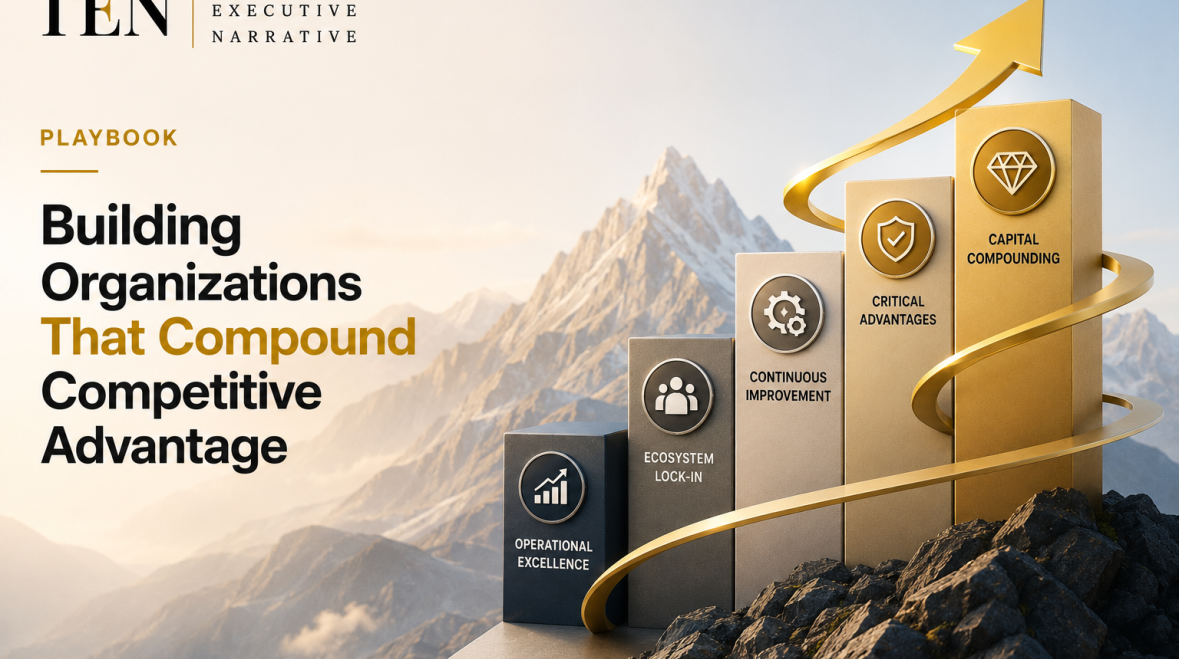
PLAY ONE: Reinvest Operational Efficiencies into Customer Value Flywheels
Objective: Convert cost savings directly into lower prices or enhanced customer value to widen scale barriers.
Executive Problem: Organizations frequently capture operational savings as short-term profit margin expansion, inviting new competitors into the market.
Why It Works: Passing operational savings back to customers accelerates volume growth, expands market share, and creates a self-reinforcing flywheel competitors cannot match.
How Exceptional Organizations Execute It:
• Costco caps gross margins at 14% and passes all purchasing scale savings back to members in lower prices, compounding member loyalty and warehouse volume.
• Amazon relentlessly lowers its fulfillment cost structure to pass savings to buyers, driving merchant adoption and marketplace network effects.
• Danaher uses efficiency gains from the Danaher Business System (DBS) to fund core platform R&D, continuously improving product value for customers.
Implementation: Establish a policy to reinvest a fixed percentage of operational efficiency gains directly into customer price reductions or enhanced core product value.
Success Indicators:
• Unit operating costs decrease as volume scales.
• Customer retention and market share expansion accelerate.
• Price differential over nearest competitors widens.
PLAY TWO: Build Tight Hardware-Software-Service Ecosystem Lock-In
Objective: Interlock products, proprietary software, and services to create compounding customer switching costs.
Executive Problem: Standalone products face commoditization over time as competitors match individual features and compress gross margins.
Why It Works: Integrating hardware, software, and services creates structural switching costs, transforming customer retention into an escalating, compounding asset.
How Exceptional Organizations Execute It:
• Apple integrates proprietary silicon, iOS software, and services like iCloud, making customer switching costs prohibitively high.
• Nvidia pairs its GPU hardware with its proprietary CUDA software architecture, locking AI developers into its computing ecosystem.
• Amazon links e-commerce, Prime delivery, video streaming, and AWS cloud into a single unified customer membership flywheel.
Implementation: Map your product portfolio to identify horizontal integration points. Build proprietary software or service layers that connect hardware/core offerings.
Success Indicators:
• Customer churn rates drop sharply as multi-product adoption increases.
• Customer lifetime value (LTV) expands faster than acquisition cost (CAC).
• Third-party developer or service ecosystem activity expands around the core platform.
PLAY THREE: Institutionalize Continuous Improvement as an Operational System
Objective: Embed daily root-cause problem-solving into company culture to compound operational efficiency gains year-over-year.
Executive Problem: Operational improvements are often treated as temporary cost-cutting events, resulting in operational drift once the initiative ends.
Why It Works: Systematizing daily continuous improvement turns efficiency into a compounding operational habit that deepens cost and quality moats.
How Exceptional Organizations Execute It:
• Danaher deploys the Danaher Business System (DBS) across every acquired company, driving continuous, compounding margin expansion and operational quality.
• Costco enforces rigid operational discipline across warehouse layouts and inventory turns, compounding incremental efficiency every year.
• Nvidia continuously co-optimizes silicon architecture, software drivers, and networking stacks to deliver compounding compute efficiency gains.
Implementation: Mandate an enterprise-wide problem-solving methodology (e.g., DBS or Kaizen). Require weekly visual management reviews focusing on operational variance.
Success Indicators:
• Operational defect rates and inventory cycle times drop consistently.
• Operating margins expand through continuous process gains rather than price hikes.
• 100% of business units utilize the standardized operational execution framework.
PLAY FOUR: Secure Critical Strategic Bottlenecks Years Before Market Demand
Objective: Pre-emptively secure foundational infrastructure and key supply chain bottlenecks before market demand explodes.
Executive Problem: Waiting for market validation before making major infrastructure investments leaves companies vulnerable to supply shortages and fast-following competitors.
Why It Works: Securing key technological, manufacturing, or distribution bottlenecks creates asymmetric scale and supply advantages when demand accelerates.
How Exceptional Organizations Execute It:
• Nvidia invested over a decade in CUDA software and accelerated computing hardware long before generative AI demand emerged.
• Apple uses its massive cash balance to pre-fund and lock up advanced semiconductor manufacturing capacity years in advance.
• Amazon built out global logistics infrastructure and AWS data centers years ahead of industry demand, securing market dominance.
Implementation: Identify 3-to-5-year technological or supply chain bottlenecks in your industry. Commit long-term capital to secure exclusive access or platform capacity.
Success Indicators:
• Secured supply or infrastructure capacity exceeds nearest competitors by a wide margin.
• Time-to-market advantage on next-generation capabilities is measured in years.
• Gross margins remain resilient during industry-wide supply shortages.
PLAY FIVE: Enforce Capital Allocation Discipline to Fuel High-Return Engines
Objective: Channel generated cash strictly into high-ROIC core advantages while ruthlessly exiting low-return projects.
Executive Problem: Corporate growth often breeds capital bloat and vanity projects, diluting return on invested capital (ROIC) and slowing enterprise compounding speed.
Why It Works: Concentrating capital exclusively where the business holds structural competitive advantage compounds per-share intrinsic value exponentially faster than revenue expansion.
How Exceptional Organizations Execute It:
• Danaher uses a disciplined capital allocation model to acquire underperforming businesses and rapidly elevate their ROIC using DBS.
• Apple combines disciplined internal R&D on core platform technologies with massive share repurchases when stock is undervalued.
• Costco reinvests capital strictly into high-return warehouse expansion and member value, refusing high-risk acquisitions.
Implementation: Establish strict hurdle rates based on ROIC and free cash flow yield. Require annual capital efficiency audits to prune or divest underperforming assets.
Success Indicators:
• Return on Invested Capital (ROIC) exceeds industry averages consistently.
• Free cash flow per share grows faster than total corporate revenue.
• Capital from low-return projects is systematically redeployed to core advantages.
Common Implementation Mistakes
• Capturing Efficiency Gains as Short-Term Profit: Pocketing cost savings instead of reinvesting them into lower customer prices or product value.
• Allowing Ecosystem Silos to Persist: Operating products as isolated offerings rather than tightly integrating hardware, software, and services.
• Treating Operational Improvement as an Event: Running periodic cost-cutting drives instead of embedding daily continuous improvement frameworks.
• Hesitating on Long-Term Infrastructure Bets: Waiting for clear market demand before securing foundational supply chain and technical bottlenecks.
• Diluting Capital in Low-Return Vanity Projects: Spreading free cash flow across low-ROIC initiatives instead of concentrating capital in core moats.
Executive Scorecard
Evaluate your leadership team against these 5 diagnostic questions:
1. Value Reinvestment: Are operational efficiency gains regularly reinvested into lowering customer prices or enhancing core value?
2. Ecosystem Lock-In: Do your products, software, and services interlock to create escalating customer switching costs?
3. Systemic Improvement: Is continuous operational improvement institutionalized via a single, daily management framework?
4. Pre-emptive Infrastructure: Has your organization pre-funded or secured critical supply and technology bottlenecks 3–5 years ahead?
5. ROIC Discipline: Is enterprise capital allocated strictly to high-ROIC core moats while underperforming projects are ruthlessly pruned?
TEN Principle
Exceptional organizations do not rely on static competitive advantages. They win by designing operational systems where scale actively strengthens their competitive position, compounding enterprise value with every unit of growth.
Scale provides size; compounding operating systems provide defensibility. When an enterprise reinvests savings into customer value, locks in ecosystems, institutionalizes continuous improvement, pre-empts critical bottlenecks, and enforces ROIC capital discipline, competitive advantage ceases to be a fragile asset and becomes an accelerating, insurmountable moat.














Recommended for you
Breaking Down the Elements of a Masterpiece Painting
The Revival of Classical Art in a Digital Age
Must-See Art Exhibitions Around the World This Year
The Revival of Classical Art in a Digital Age