

Growth Can Bankrupt Great Companies
August 09, 2026
- 5 mins read





2026 Copyright @ TEN.
All Rights Reserved
Executive Snapshot
• Objective: Build an organizational product discovery engine that uncovers and solves root customer problems rather than reacting to superficial feature requests.
• Best Fit: Product-Led Tech Companies, SaaS Enterprises, Digital Commerce Platforms, Scale-Ups, Multi-Product Tech Platforms.
• Avoid If: Bespoke IT service providers or custom software consultancies where client specifications are contractually mandated.
• Research Base: Synthesizes core product discovery principles from Amazon, Stripe, Canva, Apple, and Intuit.
• Executive Takeaway: Learn five actionable plays to separate customer requests from root friction, reduce product bloat, and build scalable capabilities customers love and retain.
Why This Strategy Exists
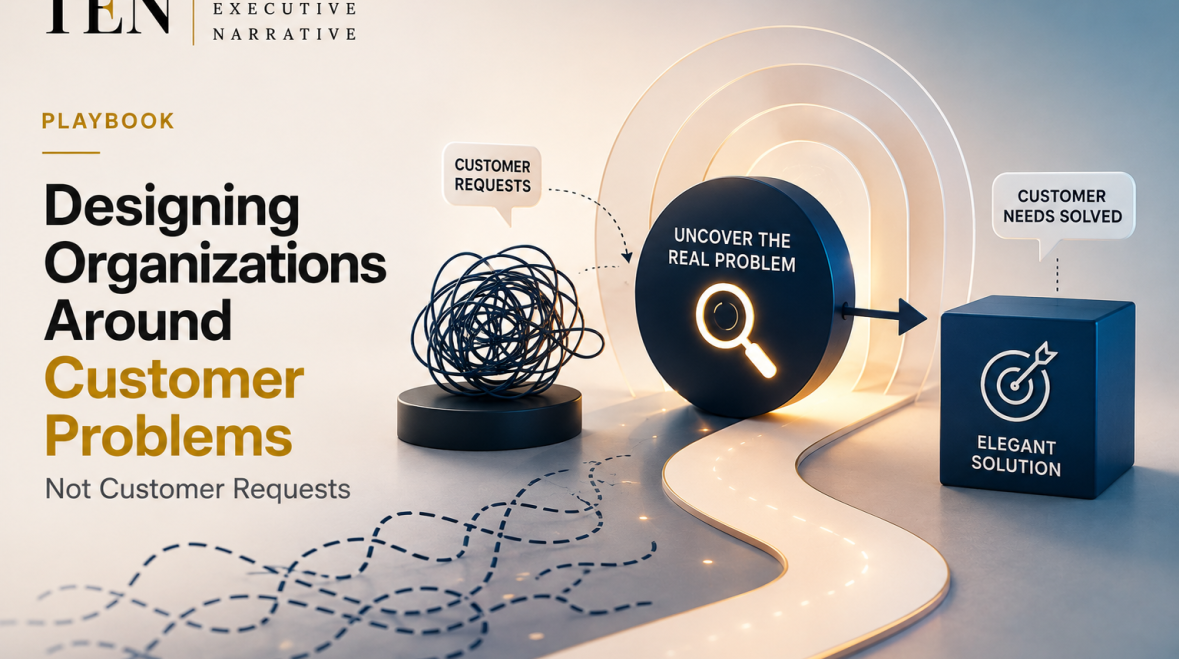
Most product organizations fall into the 'feature factory' trap by mistaking customer requests for customer problems.
When customers ask for a specific button, setting, or custom integration, they are articulating their crude attempt at a solution—not the underlying problem. Building every requested feature creates a fragmented, bloated product experience that increases technical debt, degrades UI simplicity, and accelerates churn.
Customers are experts in their pain; they are rarely experts in product architecture.
If Henry Ford had asked people what they wanted, they would have said faster horses. Exceptional product companies dig beneath surface requests to uncover the root operational friction. By solving category-level customer problems rather than fulfilling individual feature tickets, they create simple, elegant solutions that scale across the entire customer base.
THE PLAYBOOK
PLAY ONE: Separate Customer Requests from Underlying Customer Problems
Objective: Systematically dissect user feature requests to isolate the root operational pain before writing code.
Executive Problem: Product teams often treat customer feedback as a literal backlog, building bespoke features that clutter the UI/UX and increase maintenance costs without solving core user friction.
Why It Works: Uncovering the root cause allows engineering to build one elegant capability that solves the pain point for thousands of users instead of fifty custom band-aids.
How Exceptional Organizations Execute It:
• Amazon uses 'Working Backwards' PR/FAQ documents to define the exact customer problem and experience before a single line of code is written.
• Intuit conducts 'Follow-Me-Home' observational studies, watching users in their natural environment to discover unstated frictions rather than relying on feature request surveys.
• Stripe analyzes developer API integration friction to identify underlying workflow blocks rather than building one-off custom endpoints for individual enterprise clients.
Implementation: Establish a mandatory 'Problem Definition Canvas' for all roadmap items. Require product managers to document the root friction and user context before proposing a feature solution.
Success Indicators:
• Product specs detail root problem metrics before describing feature mechanics.
• Reduction in one-off custom feature requests added to the roadmap.
• Higher feature adoption and satisfaction metrics across the user base.
PLAY TWO: Conduct Contextual Observation Over Survey Feedback
Objective: Observe customer behavior in their native operational environment to discover implicit, unarticulated friction.
Executive Problem: Asking customers what they want via surveys yields linear, superficial ideas constrained by their current habits and lack of technical imagination.
Why It Works: Direct observational data reveals workarounds, emotional friction points, and inefficiencies that users take for granted and never report in surveys.
How Exceptional Organizations Execute It:
• Intuit pioneered 'Follow-Me-Home' visits where designers observe small business owners managing finances, revealing unarticulated pain that birthed TurboTax and QuickBooks features.
• Canva continuously observes user design sessions in real time, identifying micro-hesitations and friction points to aggressively simplify complex workflows.
• Apple studies user ergonomics and behavioral interactions in usability labs, refining interfaces until software feels instinctive without manuals.
Implementation: Mandate that product managers and lead engineers spend at least 10 hours per month directly observing customers operating their products in real time.
Success Indicators:
• Product teams generate unarticulated problem statements from direct observation.
• Reduction in reliance on superficial customer survey data for roadmap decisions.
• Increased user speed-to-value and reduced onboarding drop-off.
PLAY THREE: Simplify Product Architecture by Eliminating Feature Bloat
Objective: Aggressively prune unused features and consolidate workflows to protect product simplicity and speed.
Executive Problem: Continuous feature addition creates product bloat, making the platform complex for new users and expensive for engineering to maintain.
Why It Works: Radical simplicity lowers cognitive load, improves user onboarding velocity, and reduces software maintenance overhead.
How Exceptional Organizations Execute It:
• Canva continuously consolidates complex design tools into single-click AI actions, preserving extreme simplicity while adding powerful capabilities.
• Apple relentlessly removes legacy ports, buttons, and redundant UI elements, forcing software and hardware to embody strategic simplicity.
• Stripe maintains clean, developer-first API abstractions, deprecating legacy parameters to keep integration simple and predictable.
Implementation: Institute annual 'Product Pruning' reviews. Deprecate or consolidate features with low engagement to maintain a lean, high-utility product experience.
Success Indicators:
• Active feature usage concentration remains above 80% across the user base.
• Reduction in UI/UX complexity and customer support ticket volume.
• Engineering velocity increases as codebase technical debt is retired.
PLAY FOUR: Build Category Solutions That Scale Across the Customer Base
Objective: Transform multi-client feature requests into standardized, platform-level capabilities that benefit all customers.
Executive Problem: Enterprise sales teams often push product teams to build bespoke features for specific high-value prospects, turning a scalable software business into a fragmented custom dev shop.
Why It Works: Abstracting individual client requests into platform-wide capabilities preserves software leverage, high gross margins, and product coherence.
How Exceptional Organizations Execute It:
• Stripe refuses custom API builds for enterprise clients, instead generalizing complex financial infrastructure into universal, self-serve APIs.
• Amazon converts internal operational and seller pain points into universal platform capabilities (e.g., FBA, Multi-Channel Fulfillment).
• Canva turns complex enterprise brand governance requests into universal team workspace templates and brand kit controls available to all organizations.
Implementation: Enforce a policy requiring executive approval for any feature request that cannot be generalized to benefit at least 30% of the customer base.
Success Indicators:
• Zero bespoke, single-tenant custom features in the core product codebase.
• Platform capabilities drive expansion revenue across multiple customer segments.
• Gross margins remain high as engineering capacity is focused on core platform leverage.
PLAY FIVE: Measure Customer Problem Outcomes Over Feature Delivery Output
Objective: Evaluate product team performance by the reduction of customer friction rather than the number of features shipped.
Executive Problem: Measuring teams on velocity or volume of features shipped incentivizes 'feature factories' that ship low-value code just to meet quarterly release deadlines.
Why It Works: Aligning success metrics with customer problem resolution (e.g., task completion time, workflow error rates) ensures engineering resources create tangible economic value.
How Exceptional Organizations Execute It:
• Amazon measures customer experience defects, delivery speed, and friction reduction metrics rather than raw output volume.
• Intuit tracks 'time to complete tax return' and 'accuracy rate,' measuring success by the drastic reduction of user labor.
• Canva evaluates success by 'time to design completion' and user publishing success rates rather than raw feature release counts.
Implementation: Replace release-count roadmaps with outcome-based roadmaps. Define target problem-reduction metrics before development begins.
Success Indicators:
• Product team OKRs are tied to user task completion speed and error reduction.
• Customer retention and Net Promoter Scores (NPS) improve consistently.
• Product releases yield immediate, measurable improvements in user workflow efficiency.
Common Implementation Mistakes
• Treating Customer Feature Requests as Literal Roadmap Items: Building requested features without dissecting the root operational friction point.
• Relying Solely on Surveys and Focus Groups: Gathering superficial, linear ideas rather than observing actual user behavior in their native environment.
• Succumbing to Enterprise Sales Pressure for Custom Builds: Turning a scalable software platform into a fragmented custom dev shop for individual clients.
• Measuring Output Instead of Outcomes: Evaluating product teams on feature shipping volume rather than friction reduction metrics.
• Accumulating Feature Bloat Without Pruning: Continuously adding features without retiring or consolidating obsolete capabilities.
Executive Scorecard
Evaluate your leadership team against these 5 diagnostic questions:
1. Problem vs Request: Do your product specs explicitly articulate the root customer problem before describing feature mechanics?
2. Direct Observation: Do product managers and lead engineers spend at least 10 hours per month observing customers operating the product?
3. Feature Pruning: Does your organization actively retire or consolidate low-engagement features annually?
4. Platform Scalability: Do you enforce executive approval for any feature that cannot benefit at least 30% of your user base?
5. Outcome Metrics: Are product team OKRs evaluated by task completion speed and friction reduction rather than features shipped?
TEN Principle
Exceptional organizations do not win by building every feature customers ask for. They win by building operating systems that uncover the root friction behind those requests and delivering solutions so simple and scalable that customers wonder how they ever lived without them.
Requests yield features; problem discovery creates category-defining products. When an enterprise separates requests from root pain, observes contextual behavior, prunes feature bloat, builds universal category solutions, and measures problem outcomes, product development transforms from a reactive feature factory into an insurmountable strategic moat.











Recommended for you
Breaking Down the Elements of a Masterpiece Painting
The Revival of Classical Art in a Digital Age
Must-See Art Exhibitions Around the World This Year
The Revival of Classical Art in a Digital Age