

Nvidia: Building An Infrastructure Monopoly
July 28, 2026
- 4 mins read

2026 Copyright @ TEN.
All Rights Reserved
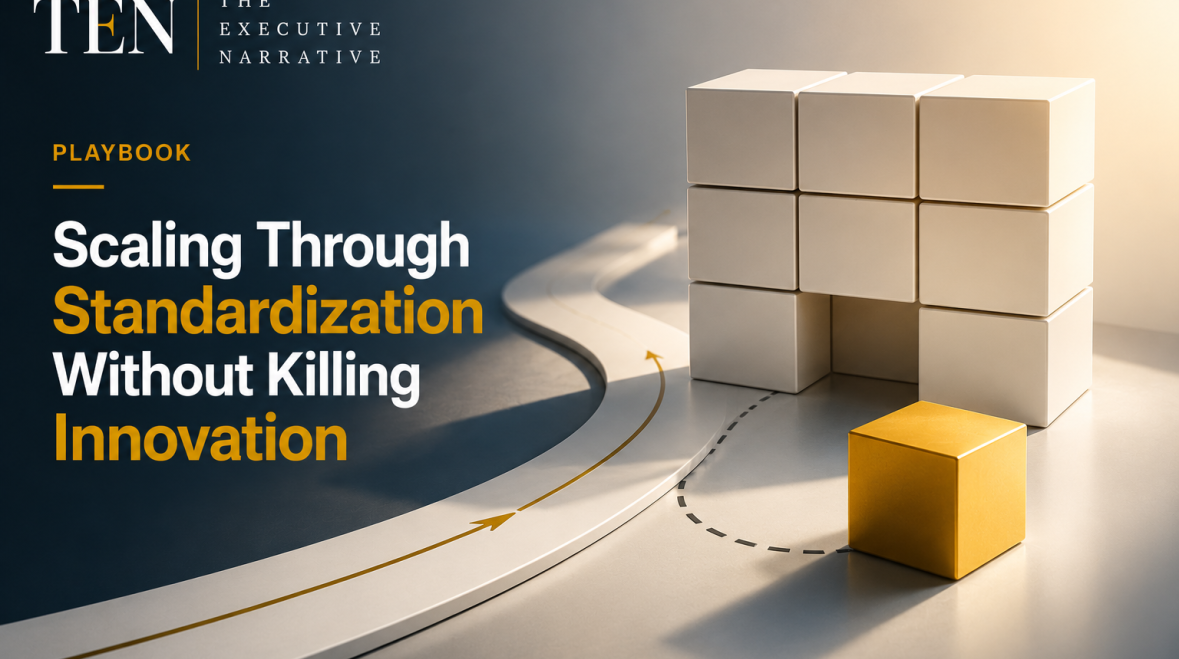
Executive Snapshot
• Objective: Build a standardized operating foundation that drives operational efficiency and scale while preserving front-line innovation and strategic flexibility.
• Best Fit: Multi-Site Operations, Global Retailers, Manufacturing Enterprises, High-Growth Franchises, Scaling Tech Platforms.
• Avoid If: Bespoke agency services or early R&D labs where process repeatability is not required.
• Research Base: Synthesizes core operational systems from McDonald's, Toyota, Amazon, IKEA, and Zara.
• Executive Takeaway: Learn five actionable plays to standardize operational interfaces, mistake-proof workflows, and empower front-line teams to continuously evolve operating standards.
Why This Strategy Exists
Most scaling organizations view standardization and innovation as opposing forces.
As companies expand, leadership introduces standard operating procedures (SOPs) to ensure quality control, risk mitigation, and cost efficiency. However, when standardization is enforced top-down as rigid rules rather than enabling interfaces, it creates operational bureaucracy, kills local initiative, and slows execution speed.
Standardization should liberate innovation, not restrict it.
Without standardized baselines, every operational problem becomes an isolated fire that requires custom intervention. Teams waste bandwidth reinventing basic processes rather than focusing creative energy on customer differentiation and product improvement.
Exceptional organizations treat standardization as a foundation for speed and flexibility. They standardize routine operations and handoff interfaces, freeing teams to innovate safely and adapt rapidly to local market demands.
THE PLAYBOOK
PLAY ONE: Standardize Handoff Interfaces, Not Local Execution
Objective: Define strict standards for inter-departmental interfaces while granting teams total autonomy over internal execution.
Executive Problem: Organizations often over-regulate how work is performed inside individual teams, creating rigid bureaucracy that stifles local problem-solving and adaptation.
Why It Works: Standardizing interfaces (data inputs, handoff criteria) eliminates cross-functional friction while allowing teams to optimize local workflows independently.
How Exceptional Organizations Execute It:
• Amazon mandates standardized API contracts between autonomous 'two-pizza' teams, allowing rapid internal innovation without coordination overhead.
• McDonald's standardizes core kitchen interfaces and supply chain requirements while allowing international regional teams to adapt localized menus.
• Toyota standardizes assembly handoffs so downstream stations receive zero defects, while empowering workers to optimize local step sequences.
Implementation: Map cross-departmental handoffs. Define explicit input/output criteria for each interface, and grant local teams complete ownership over internal processes.
Success Indicators:
• Cross-functional handoff friction and delays decrease significantly.
• Local teams iterate on internal workflows without needing corporate approvals.
• Standardized API or operational contracts prevent inter-departmental blame.
PLAY TWO: Build Modular Operating Blocks for Rapid Replication
Objective: Transform recurring operational workflows into modular, reusable building blocks to accelerate scaling.
Executive Problem: Reinventing operational processes for new locations, product lines, or business units creates exponential complexity and operational fragility.
Why It Works: Modular building blocks allow rapid, predictable scaling while maintaining consistent enterprise quality and lower operational overhead.
How Exceptional Organizations Execute It:
• IKEA standardizes flat-pack product modules and store layout blueprints globally, enabling massive global store scalability at low cost.
• Zara standardizes fabric dyeing and central distribution hubs, enabling rapid 2-week design-to-shelf production cycles.
• McDonald's uses modular restaurant equipment layouts that allow rapid franchisee deployment across diverse real estate formats.
Implementation: Identify recurring operational workflows. Deconstruct them into standardized, modular components that can be deployed across new projects or markets.
Success Indicators:
• Operational deployment times for new sites or products drop significantly.
• Unit operating costs decrease through modular standardization.
• Operational quality remains consistent across disparate geographic locations.
PLAY THREE: Empower Front-Line Workers to Evolve Standards
Objective: Treat standard operating procedures as living artifacts updated continuously by front-line employees.
Executive Problem: Corporate SOPs dictated from headquarters quickly become obsolete, breeding compliance cynicism and hiding operational bottlenecks.
Why It Works: Involving front-line workers in updating standards ensures operational rules reflect daily reality and drives a culture of continuous improvement.
How Exceptional Organizations Execute It:
• Toyota empowers assembly workers to pull the 'Andon cord' to halt production and submit Kaizen proposals that immediately update standard work procedures.
• Zara collects daily store manager feedback directly into central design databases to immediately adjust production runs.
• Amazon uses automated operational metrics and front-line feedback loops to continually update fulfillment center standard workflows.
Implementation: Establish a formal protocol allowing front-line workers to propose updates to SOPs, with a mandatory 48-hour management review turnaround.
Success Indicators:
• High frequency of front-line process improvement proposals.
• Average time to update standard operating procedures is under 72 hours.
• Front-line worker engagement and compliance scores improve.
PLAY FOUR: Decouple Core Standardized Scale from Innovation Sandboxes
Objective: Isolate early-stage experimental initiatives from strict operational compliance rules until they achieve scale readiness.
Executive Problem: Enforcing enterprise-wide operational standards on early-stage experiments suffocates innovation before ideas can be validated.
Why It Works: Separating the high-efficiency core from exploratory sandboxes preserves scale efficiency while enabling rapid experimentation.
How Exceptional Organizations Execute It:
• Zara keeps 15% of production flexible and uncommitted, using rapid small-batch testing before standardizing mass production runs.
• Amazon incubates new initiatives in isolated sandbox environments exempt from core operational metrics until initial validation.
• Toyota uses specialized 'Pilot Plants' to test experimental manufacturing techniques before introducing them to global production lines.
Implementation: Define explicit sandbox criteria where experimental teams operate without standard SOP compliance until reaching defined scaling milestones.
Success Indicators:
• Experimental initiatives achieve faster validation and iteration cycles.
• Core production efficiency remains protected from experimental volatility.
• Smooth transition of validated sandboxes into standardized operations.
PLAY FIVE: Automate Mistake-Proofing to Eliminate Manual Inspection
Objective: Embed automated visual and technical guardrails directly into workflows to enforce standards without management overhead.
Executive Problem: Relying on manual inspection and manager oversight to enforce compliance creates heavy administrative bloat and slows operational velocity.
Why It Works: Automated mistake-proofing (Poka-Yoke) detects and prevents process variances in real time without adding management layers.
How Exceptional Organizations Execute It:
• Toyota embeds physical 'Poka-Yoke' devices on assembly lines that physically prevent incorrect parts from being installed.
• Amazon utilizes automated software deployment pipelines with continuous testing that automatically halts flawed code releases.
• McDonald's uses automated kitchen timers and pre-calibrated cooking equipment to ensure consistent food safety and quality without manual monitoring.
Implementation: Audit high-defect workflows. Implement automated physical or digital guardrails that make process errors impossible or instantly detectable.
Success Indicators:
• Operational defect and error rates drop toward zero.
• Management time spent on compliance inspection decreases sharply.
• Real-time automated error detection prevents customer-facing failures.
Common Implementation Mistakes
• Standardizing Outputs Instead of Interfaces: Attempting to force uniform end-products rather than standardizing input/output handoff criteria.
• Freezing Standards in Corporate Static Manuals: Treating SOPs as unchangeable rules rather than living artifacts updated by front-line teams.
• Imposing Standards Without Front-Line Input: Designing processes at corporate headquarters without validating operational realities at the front line.
• Enforcing Heavy Standards on Innovation Sandboxes: Suffocating early-stage exploratory bets with mature-stage operational compliance.
• Relying on Manual Inspection Over Automation: Adding management oversight layers instead of embedding automated mistake-proofing guardrails.
Executive Scorecard
Evaluate your leadership team against these 5 diagnostic questions:
1. Interface vs Output: Are your operational standards focused on handoff interfaces rather than over-regulating local team execution?
2. Modular Replicability: Can your business open new locations, deploy products, or scale teams using modular, standardized building blocks?
3. Front-Line Ownership: Do front-line employees have a structured, rapid protocol to update and improve standard operating procedures?
4. Sandbox Isolation: Are early-stage experimental initiatives protected from enterprise operational compliance requirements?
5. Automated Mistake-Proofing: Are process standards enforced by automated technical guardrails rather than manual managerial inspection?
TEN Principle
Exceptional organizations do not view standardization as a mechanism for bureaucratic control. They treat standardization as an operational baseline that liberates front-line teams to innovate, move fast, and respond to change with confidence.
Standardization provides speed; innovation provides growth. When an enterprise standardizes handoff interfaces, builds modular operating blocks, empowers front-line teams to evolve standards, insulates innovation sandboxes, and automates mistake-proofing, operational scale transforms from a rigid burden into an insurmountable competitive advantage.














Recommended for you
Breaking Down the Elements of a Masterpiece Painting
The Revival of Classical Art in a Digital Age
Must-See Art Exhibitions Around the World This Year
The Revival of Classical Art in a Digital Age