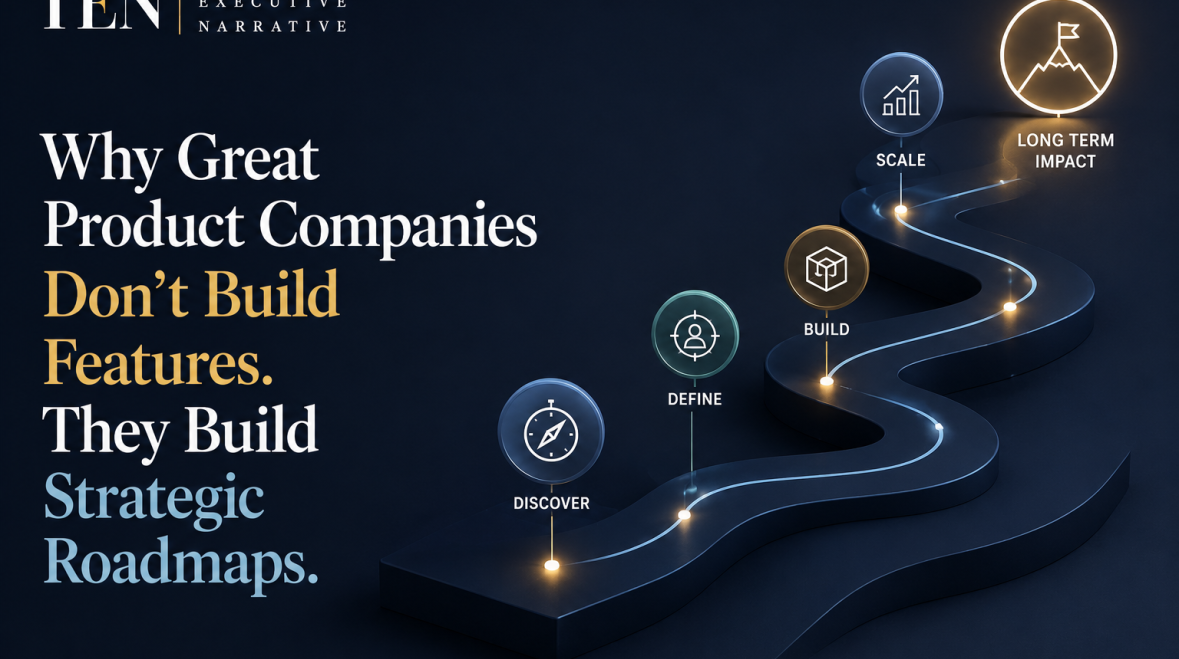
A product roadmap is often treated as a list of features waiting to be built.
That is a mistake.
As organizations grow, customer requests multiply, competitors move faster and internal teams compete for product resources. Without a clear strategic system, roadmaps become collections of requests rather than expressions of strategy.
Exceptional product companies approach roadmaps differently.
Apple, Atlassian, Canva, Figma and Notion have built products by connecting customer needs with broader product direction, platform capabilities and long term strategic priorities.
The objective is not to build more.
It is to build what strengthens the product's position over time.
This Playbook identifies five principles leadership teams can use to build product roadmaps that create durable growth.
THE EXECUTIVE PROBLEM
Product teams constantly face competing priorities.
Customers want new features.
Sales wants enterprise requirements.
Engineering wants architectural improvements.
Marketing wants competitive differentiation.
Leadership wants growth.
If every request enters the roadmap, the roadmap eventually becomes a negotiation between stakeholders.
The result is predictable.
Teams ship more features but create less strategic progress.
A strong roadmap therefore answers a more important question:
What should the organization build now that will make the product more valuable in the future?
PLAY ONE
Start With Strategic Outcomes, Not Features
A feature describes what will be built.
An outcome describes what should change.
This distinction fundamentally changes roadmap decisions.
Apple's product strategy demonstrates the importance of thinking beyond individual features toward broader product experiences. Canva similarly builds around making design more accessible rather than simply accumulating functionality.
The principle is transferable.
A roadmap should begin with the strategic outcome the organization wants to create.
Implementation
Before approving a major initiative, define:
What customer problem are we solving?
What behaviour should change?
Why does solving it matter strategically?
What business outcome should follow?
Only then determine which features or capabilities are required.
Success Indicator
Product teams can explain the strategic purpose of major roadmap initiatives without referring to feature specifications.
PLAY TWO
Separate Customer Requests From Customer Problems
Customers are valuable sources of information.
They are not always the best source of product solutions.
A customer may request a specific feature because they are experiencing a deeper problem.
Building exactly what was requested may solve one customer's immediate issue while making the broader product more complicated.
Companies such as Figma and Notion have grown by creating flexible product systems that allow users to solve multiple problems rather than continuously adding isolated solutions.
Implementation
For every significant customer request, ask:
What problem is the customer actually experiencing?
How many customers share this problem?
Can the problem be solved through an existing capability?
Would solving the underlying problem create value for a broader customer segment?
Success Indicator
Roadmap decisions increasingly address recurring customer problems rather than isolated requests.
PLAY THREE
Protect Long Term Product Investments
Not every valuable product initiative produces immediate revenue.
Platform improvements, infrastructure, usability improvements and new product capabilities may take time before their commercial impact becomes visible.
If roadmaps are evaluated entirely through short term returns, these investments are often pushed aside.
Exceptional product organizations protect strategic investments because they understand that today's infrastructure can become tomorrow's competitive advantage.
Implementation
Divide roadmap capacity between:
Customer driven improvements.
Core product improvements.
Platform and infrastructure investments.
Long term experimentation.
Review the balance at the leadership level rather than allowing short term demand to consume every category automatically.
Success Indicator
Long term product capabilities continue receiving investment even when short term commercial priorities increase.
PLAY FOUR
Build Roadmaps Around Capabilities, Not Just Releases
A release is temporary.
A capability can compound.
A feature may solve one problem today.
A platform capability can enable dozens of future solutions.
Atlassian's broader product ecosystem demonstrates how capabilities can support multiple products and use cases over time.
The strategic question therefore becomes:
Will this initiative create something the organization can build upon?
Implementation
For every major roadmap initiative, evaluate whether it:
Solves only one immediate problem.
Creates a reusable capability.
Improves the underlying product architecture.
Enables future products or customer experiences.
Prioritize initiatives that increase future product leverage.
Success Indicator
Roadmap investments increasingly create capabilities that support multiple future initiatives.
PLAY FIVE
Continuously Reevaluate the Roadmap
A roadmap should provide direction.
It should not become a contract.
Markets change.
Customer behaviour changes.
Technology changes.
New information can invalidate assumptions made months earlier.
Strong product organizations therefore treat roadmaps as strategic systems that evolve as evidence changes.
Canva's rapid expansion of its product capabilities illustrates the value of responding to changing user needs while maintaining a broader product direction.
Implementation
Review major roadmap assumptions regularly.
For each initiative, ask:
What have we learned?
Has the customer problem changed?
Has the competitive environment changed?
Is this still the highest value use of product capacity?
If the answer changes, change the roadmap.
Success Indicator
Product resources move toward the highest value opportunities instead of remaining locked into outdated commitments.
THE COMMON IMPLEMENTATION MISTAKES
The most common mistake is turning the roadmap into a feature backlog.
When every request becomes a roadmap item, strategic priorities disappear.
Another mistake is allowing sales commitments to determine product direction. Enterprise feedback can be valuable, but individual customer requirements should not automatically dictate the product's long term architecture.
A third mistake is measuring roadmap success by delivery.
Shipping everything on time does not mean the roadmap succeeded.
The real question is whether the product became more valuable, differentiated and strategically stronger.
EXECUTIVE SCORECARD
Ask your leadership team:
What strategic outcomes does our roadmap exist to achieve?
How much of our roadmap is driven by customer problems versus individual requests?
Are we protecting long term product investments?
Which roadmap initiatives create reusable capabilities?
How often do we challenge existing roadmap assumptions?
Are we measuring outcomes or simply counting releases?
If these questions cannot be answered clearly, the organization may have a roadmap but not a product strategy.
TEN PRINCIPLE
Great product companies do not win because they build the most features.
They win because they make better decisions about what not to build.
Apple, Atlassian, Canva, Figma and Notion demonstrate different approaches to product development, but the underlying principle remains consistent:
A strategic roadmap is not a prediction of what a company will build. It is a system for deciding where product investment creates the greatest long term advantage.
The strongest roadmaps therefore balance three forces:
Customer needs.
Business strategy.
Future product capability.
When those three converge, product development becomes more than delivery.
It becomes a source of compounding competitive advantage.

















Recommended for you
Breaking Down the Elements of a Masterpiece Painting
The Revival of Classical Art in a Digital Age
Must-See Art Exhibitions Around the World This Year
The Revival of Classical Art in a Digital Age