

Scaling Magnifies Strengths and Weaknesses
August 07, 2026
- 6 mins read

2026 Copyright @ TEN.
All Rights Reserved
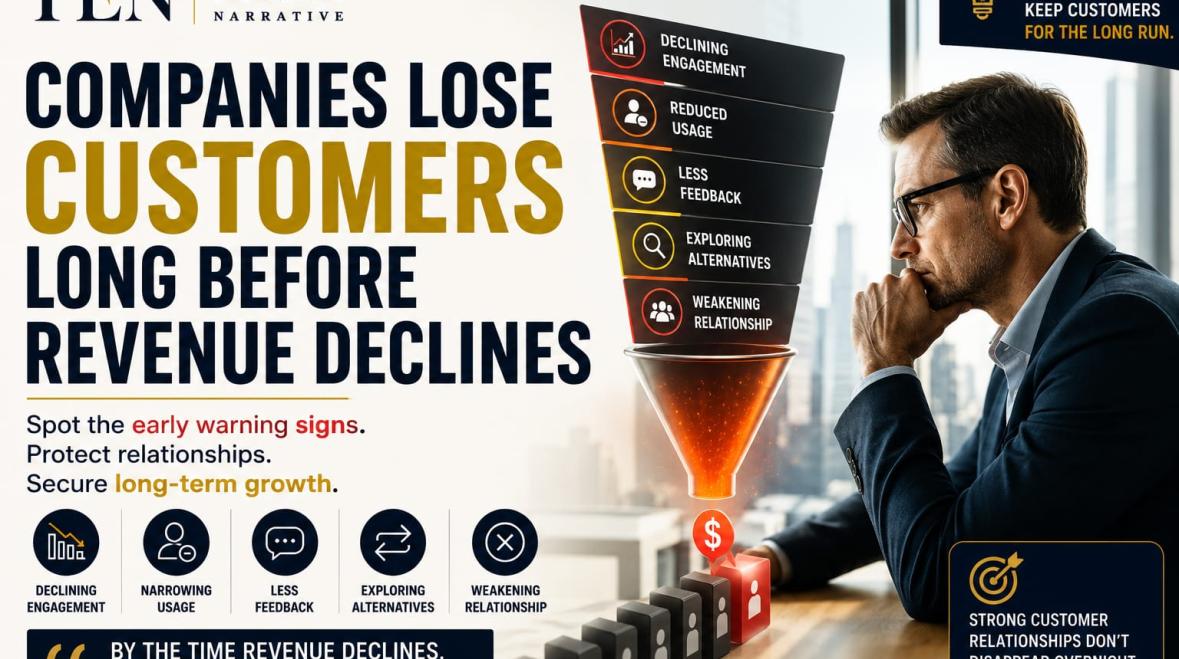
The Warning Signs Appear Earlier Than the Numbers
Revenue is often treated as the clearest measure of customer health. When it is growing, companies assume relationships are strong. When it starts falling, leaders begin asking what went wrong.
But by the time revenue declines, the problem may already be old. Customers rarely disappear overnight. They usually leave gradually, through a series of small changes that do not immediately appear on a financial statement. Engagement weakens. Usage declines. Complaints become more frequent. Renewal conversations become harder. Customers stop exploring new products. The relationship becomes transactional before it becomes lost.
The real challenge for leaders is not identifying churn. It is recognizing customer erosion before churn becomes visible.
The Customer Relationship Has a Half-Life
A customer relationship can weaken long before a customer formally leaves. A company may still have the same number of customers, the same contracts and even similar revenue. Yet the underlying relationship can be deteriorating. Customers may be using less of the product. They may be relying on fewer features. They may stop recommending the company internally. They may begin comparing alternatives without telling the account team.
These signals are easy to dismiss because none of them looks like a crisis individually. Together, they can be a warning. The mistake is measuring customer health primarily through outcomes rather than through the behaviors that produce those outcomes.
The Early Signals Leaders Should Watch
The most valuable customer indicators are often behavioral rather than financial.
• Engagement is declining. Customers interact with the product, service or account team less frequently.
• Usage is becoming narrower. Customers continue using the core offering but stop adopting additional capabilities.
• Feedback becomes less specific. Highly engaged customers tend to explain what they want improved. Disengaged customers often simply stop responding.
• Expansion opportunities disappear. When existing customers no longer consider additional products or services, it may indicate declining confidence.
• Decision-makers become less involved. A relationship that once had executive attention becomes limited to operational contacts.
• Support issues repeat. Customers may tolerate individual problems, but repeated friction changes their perception of the entire relationship.
None of these necessarily means a customer is about to leave. The important point is that they can reveal direction before they reveal damage.
The Danger of Looking Only at Revenue
Financial metrics are lagging indicators.
A customer can continue paying while becoming less satisfied. A contract can remain active while internal support for the relationship is weakening. A renewal can happen once even though the customer has already started questioning the long-term value.
This creates a dangerous illusion of stability.
Leaders often ask, “How much revenue are we at risk of losing?” A better question may be:
“What is changing in customer behavior before revenue becomes at risk?”
That shift matters because it moves the organization from reacting to churn toward managing customer health.
Customer Erosion Is Often a Value Problem
Not every customer leaves because a competitor offers a lower price. Sometimes the customer simply stops seeing enough value in continuing. As businesses evolve, what created value at the beginning may no longer matter as much. A product can become more sophisticated while becoming less relevant to the customer's actual priorities. A service can add features while making the experience harder. A company can optimize its internal processes while making the customer journey more complicated.
This is where customer erosion becomes a strategic issue. The question is not simply whether customers are satisfied. It is whether the company continues to solve a problem that matters to them.
What Leaders Should Measure Differently
Customer retention cannot be delegated entirely to sales or customer success teams. It is an organizational responsibility.
Leaders should build a broader view of customer health by connecting financial data with behavioral signals. That means looking beyond:
• Revenue
• Renewal rates
• Customer counts
And examining:
• Product engagement
• Frequency of meaningful interactions
• Adoption of new capabilities
• Customer complaints and recurring friction
• Response rates
• Expansion behavior
• Changes in decision-maker involvement
The objective is not to create another dashboard filled with metrics. It is to identify which changes predict a weakening relationship early enough to act. The Strategic Advantage of Seeing It Early
Companies that identify customer erosion early have more options. They can redesign an experience, fix a recurring problem, improve product value or reconnect with decision-makers before the relationship becomes difficult to recover.
Once the customer has already decided to leave, most of those options become defensive.
The strongest customer strategies therefore do not focus only on preventing churn. They focus on understanding why customer confidence is increasing or declining in the first place.
Retention is not simply an outcome. It is a signal of whether the organization continues to earn its position in the customer's world.
Executive Lessons
• Revenue tells leaders what has happened. Customer behavior can reveal what is about to happen.
• A customer who is still paying is not necessarily a healthy customer.
• Declining engagement can be more informative than a single negative feedback score.
• Customer erosion often begins when perceived value falls faster than the company realizes.
• The earlier leaders identify weakening relationships, the more strategic choices they have.
TEN Perspective
Companies rarely lose customers at the moment they cancel. They lose them through a gradual decline in relevance, engagement and confidence that becomes visible only when the revenue finally moves. The best customer strategy is therefore not simply asking who are we losing? It is asking:
Who is becoming less engaged?
Why is their behavior changing?
And what would make them choose us more strongly six months from now than they do today?
That is where customer retention becomes more than a metric.
It becomes a measure of whether the company is still earning its place.














Recommended for you
Breaking Down the Elements of a Masterpiece Painting
The Revival of Classical Art in a Digital Age
Must-See Art Exhibitions Around the World This Year
The Revival of Classical Art in a Digital Age