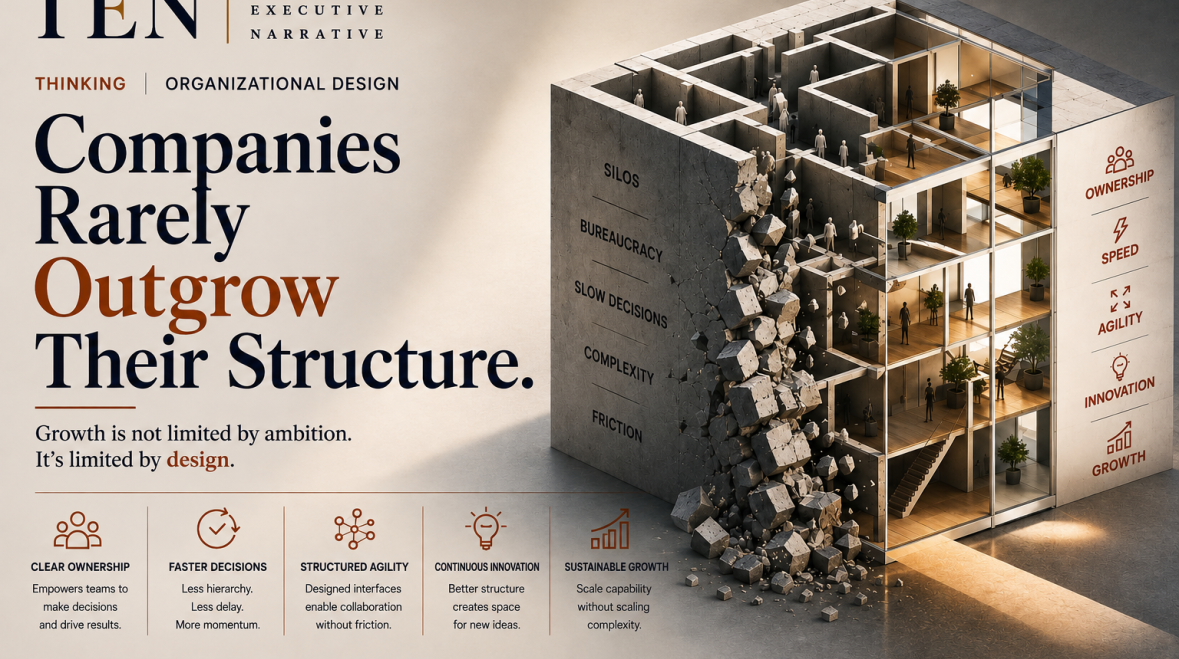
High-growth companies often assume that scaling depends on hiring more talent, expanding into new markets, or investing in technology. Those decisions certainly matter, but they rarely become the first constraint on growth. More often, growth begins to slow because the organisation continues operating through a structure designed for a much smaller business. Sustainable growth is not only about expanding capacity. It is about redesigning how decisions, accountability and collaboration move through the organisation.
The Strategic Challenge
Most organisational structures are built to solve immediate problems. A startup optimises for speed. A growing company introduces managers.Business units emerge. Specialised functions are created.
Governance becomes more formal.Each decision makes sense at the time. The challenge appears years later. As the business evolves, reporting lines, approval processes and decision rights often remain tied to assumptions that no longer reflect how the company creates value. Teams spend increasing amounts of time coordinating work rather than delivering it. What was originally designed to enable growth gradually becomes the system that limits it.
The Strategic Insight
Amazon recognised early that scale could not depend on larger teams making more collective decisions. Instead, it redesigned the organisation around small, autonomous teams with clear ownership. Jeff Bezos' "two-pizza team" philosophy was not simply a management principle. It was an organisational design decision that reduced coordination overhead while allowing the company to continue growing across multiple businesses.
The insight was simple but powerful.
Growth is sustained not by adding more people to existing structures, but by creating structures that preserve speed as the organisation becomes more complex.
The Competitive Mechanism
Organisation design shapes competitive advantage through a reinforcing cycle.
• Clear ownership accelerates decision-making.
• Faster decisions improve execution.
• Better execution enables continuous innovation.
• Innovation strengthens customer value.
• Stronger customer value creates new opportunities for growth.
Companies often attempt to improve performance by investing in technology or increasing resources. Those investments create limited value when organisational design prevents decisions from moving efficiently across the business.
Operating Model
The most adaptable organisations treat structure as a strategic capability rather than an administrative framework. Decision-making authority is intentionally distributed. Teams understand what they own. Collaboration happens through clearly defined interfaces rather than excessive approval layers. As the organisation grows, its operating model evolves alongside its strategy instead of preserving structures that solved yesterday's challenges. This allows scale to increase organisational capability rather than organisational complexity.
Strategic Trade-offs
Redesigning an organisation is rarely comfortable.
Leadership may need to:
• Remove management layers.
• Redefine reporting relationships.
• Shift decision authority closer to execution.
• Retire governance processes that no longer create value.
These decisions often create short-term disruption. However, preserving outdated structures simply because they once worked creates a far greater long-term cost: slower execution and declining adaptability.
Why Competitors Struggle
Many organisations recognise slowing execution and respond by introducing additional coordination. More meetings.
More committees.
More reporting.
More approvals.
These mechanisms reduce uncertainty but rarely improve speed.
The companies that continue scaling successfully recognise a different reality.
Growth is not constrained by the number of employees an organisation has.
It is constrained by the number of decisions its structure can process without creating friction. That distinction explains why competitors with similar technology, capital and talent often produce dramatically different outcomes.
Executive Lessons
Organisation design should not be viewed as an operational concern delegated to HR or transformation teams. It is a leadership responsibility that directly influences strategic execution.
Executives should continually ask:
• Does our structure accelerate decisions or delay them?
• Are reporting relationships aligned with how we create value today?
• Have coordination mechanisms become substitutes for ownership?
• If we were designing this organisation today, would it look the same?
TEN Perspective
Every successful company eventually redesigns its products.
Many redesign their strategy.
Far fewer redesign the organisation expected to execute that strategy.
Markets evolve.
Customers evolve.
Technology evolves.
Organisations often assume their structure can remain unchanged.
Perhaps that is why so many businesses struggle to sustain the momentum that created their early success. The question for leadership is not whether the company is growing.
It is whether the organisation responsible for that growth has evolved at the same pace.
If your organisation chart disappeared tomorrow, would you rebuild the same company— or would you design one that is better suited for the future you are trying to create

















Recommended for you
Breaking Down the Elements of a Masterpiece Painting
The Revival of Classical Art in a Digital Age
Must-See Art Exhibitions Around the World This Year
The Revival of Classical Art in a Digital Age