
Every Budget Is a Strategy Document
August 08, 2026
- 5 mins read

2026 Copyright @ TEN.
All Rights Reserved
The Problem Is No Longer Information
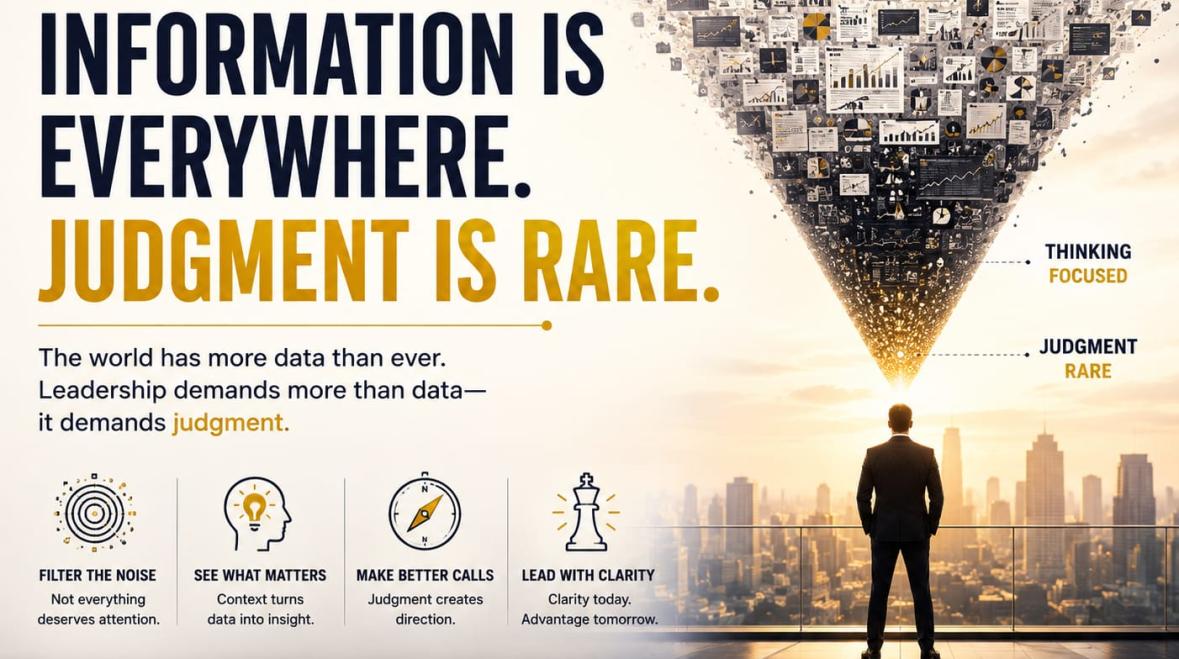
Executives have never had access to more information. Market reports arrive instantly, dashboards update in real time, analysts publish their views, competitors announce their moves and artificial intelligence can summarize almost anything in seconds. Information is no longer the scarce resource it once was.
The scarce resource is knowing what deserves attention, what should be ignored and what actually matters.
More information does not automatically create better decisions. In many organizations, it creates more noise. Leaders can spend hours consuming analysis without becoming meaningfully clearer about what they should do next.The advantage increasingly belongs to those who can turn information into judgment.Information Tells You What Is Happening. Judgment Asks Why.
Information Tells You What Is Happening. Judgment Asks Why.
Data can show that revenue declined. A report can explain that customer acquisition costs increased. A market analysis can identify a new competitor.
But none of these automatically tells a CEO what the development means.Is the revenue decline temporary or structural? Should the company respond immediately or wait? Is the competitor actually a threat or simply creating noise? Should capital be redirected, or would that reaction weaken the existing strategy?
These are judgment questions.
The value of executive thinking begins where information stops.
The Executive Challenge Is Selection
Senior leaders do not have the luxury of treating every piece of information equally.
Every day brings new developments, opinions, trends and signals competing for attention. The ability to identify the few that could materially affect the business is therefore a strategic capability.This is why executive judgment depends on selection.
What should receive attention? What deserves deeper analysis? Which signal contradicts an existing assumption? Which trend is temporary, and which one could reshape the business?
The best leaders are not necessarily those who know the most.
They are often the ones who know what matters most.
From Information to Perspective
TEN's role is not simply to add another stream of information to an already crowded executive environment.It is to create perspective.Perspective connects individual developments to larger questions. It asks what a trend means for leadership, how a decision could reshape competitive advantage, where an organization may be creating unnecessary complexity and which assumptions deserve to be challenged.
This requires moving beyond reporting what happened.
it requires asking why it matters.
An executive does not need another summary of the world. They need a sharper way of seeing it.
Judgment Creates the Difference
Two executives can receive exactly the same information and reach completely different conclusions.One may see a threat. Another may see an opportunity. One may react immediately. Another may recognize that the situation requires patience. Both have access to the same facts.
The difference is judgment.
Judgment comes from experience, context, pattern recognition and the willingness to question assumptions. It cannot be completely automated by adding more information.Technology can make information easier to access. It can accelerate analysis and reveal patterns. But the responsibility for deciding what those patterns mean remains deeply human.
That responsibility becomes even more important as information becomes cheaper.
The Executive Responsibility
Executives have a responsibility to protect their attention as carefully as they protect capital. That means resisting the temptation to consume everything and instead developing the discipline to focus on what could change a decision, challenge an assumption or reveal an emerging opportunity. Leadership requires creating distance from the noise long enough to form an independent view. The objective is not to know everything happening in the market. It is to understand enough of what matters to make better decisions.
Why TEN Exists
TEN is built around a simple belief: executives do not need more information. They need better thinking.
The purpose of executive intelligence is therefore not to overwhelm leaders with more content, but to help them see situations differently. The strongest insights may not provide an answer at all. They may simply introduce a better question, expose a hidden assumption or make a familiar problem look different.That is where thinking becomes valuable.Because leadership is rarely about having access to information that nobody else possesses.It is about seeing meaning in information that everyone can access.
TEN Perspective
Information creates awareness.Judgment creates direction.In a world where information is increasingly abundant, the competitive advantage will belong to leaders who can filter noise, recognize significance and make decisions with clarity.
TEN's philosophy is therefore simple: do not just tell executives what is happening. Help them think about what it means.
The question is no longer:
“How much information do we have?”
It is:
“What are we capable of seeing that the information alone cannot tell us?”
Because information may be everywhere.
But judgment remains rare.














Recommended for you
Breaking Down the Elements of a Masterpiece Painting
The Revival of Classical Art in a Digital Age
Must-See Art Exhibitions Around the World This Year
The Revival of Classical Art in a Digital Age