

The Office Debate Is Asking the Wrong Question
August 09, 2026
- 5 mins read





2026 Copyright @ TEN.
All Rights Reserved
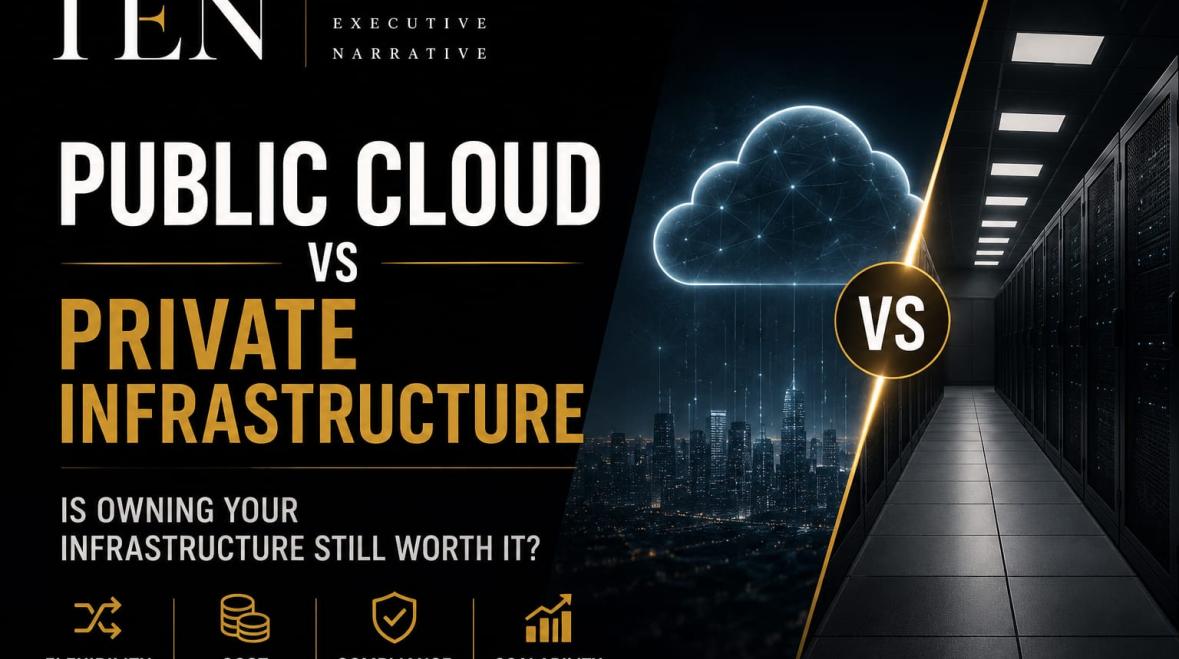
For years, owning infrastructure was treated as a sign of control.
Companies invested in servers, data centers, networking equipment, storage, and the teams required to operate them. The logic was simple: if the infrastructure is yours, the control is yours.
But technology has changed.
Public cloud has made infrastructure available on demand, turning computing from something companies purchase and maintain into something they can consume as a service.
The question is no longer whether cloud computing works.The harder question is whether owning infrastructure still makes business sense.
Control Comes With a Cost
Private infrastructure offers something businesses value deeply: control.
Organizations can decide exactly where their data lives, how systems are configured, and how infrastructure is managed. For highly regulated industries, this control can simplify certain compliance and security requirements.
But control is not free.
Hardware must be purchased, maintained, upgraded, secured, and eventually replaced. Capacity must also be planned before demand arrives.A company may spend heavily on infrastructure that sits underutilized for months simply because it needs enough capacity for occasional peaks.
Ownership provides control.
It also creates responsibility.
Cloud Changes the Economics
Public cloud changes the traditional infrastructure equation.
Instead of making a large upfront investment, companies can access computing resources when they need them. Infrastructure can expand during periods of high demand and contract when demand falls.This flexibility can be especially valuable for startups and growing businesses.
A company launching a new application does not necessarily need to predict exactly how many servers it will require three years from now.It can start smaller.Then scale as the business grows.
But cloud does not automatically mean cheaper.Poorly managed cloud environments can become expensive quickly through unused resources, inefficient architectures, data transfer costs, and uncontrolled consumption.The real advantage is not simply lower cost.It is the ability to align infrastructure spending more closely with actual demand.
Scalability Is More Than Capacity
Scalability is one of the strongest arguments for public cloud.A successful product can suddenly attract millions of users. A seasonal business can experience enormous spikes in demand. A new application may grow faster than anyone expected.Cloud infrastructure can respond to these changes far more quickly than traditional infrastructure in many cases.
Private infrastructure can scale too.
But scaling often requires purchasing additional hardware, expanding facilities, increasing power and cooling capacity, and waiting for deployment.
Cloud turns scalability into an operational capability rather than a long-term infrastructure project.
That difference can matter when markets move quickly.
Compliance Changes the Decision
The public-versus-private debate becomes more complicated when regulation enters the picture.
Financial services, healthcare, government, and other highly regulated sectors may face strict requirements around data residency, access controls, auditing, and security.That does not automatically mean private infrastructure is the only answer.Public cloud providers offer extensive security and compliance capabilities, and many organizations operate regulated workloads in the cloud.
The real question is more specific:
“Which infrastructure model allows us to meet our regulatory requirements without creating unnecessary complexity?”
Sometimes the answer is public cloud.
Sometimes it is private infrastructure.
Increasingly, it may be both. The Rise of the Hybrid Approach
The debate is often presented as a choice between two extremes.
Own everything.Or move everything to the cloud.
But many organizations are discovering that the better answer is somewhere in between.
Sensitive workloads can remain on private infrastructure while scalable applications operate in the public cloud. Organizations can keep tighter control over certain data while using cloud services for flexibility and speed.
This hybrid approach recognizes an important reality:
Different workloads have different requirements.
Infrastructure strategy should therefore be driven by business needs, not by technology fashion.
TEN Perspective
The question is not whether companies should own infrastructure.
The better question is:
“Which infrastructure model gives the business the right balance of control, cost, compliance, and scalability?”
Private infrastructure can provide control and predictability.
Public cloud can provide flexibility and speed.
Neither is automatically the better choice.
The competitive advantage comes from knowing where each model creates value—and avoiding the mistake of choosing infrastructure based on ideology rather than economics.
Owning infrastructure may still be worth it.
But in a world where infrastructure can be rented, scaled, and automated on demand, ownership itself is no longer the advantage.
The advantage is having the right infrastructure for the right workload at the right cost.











Recommended for you
Breaking Down the Elements of a Masterpiece Painting
The Revival of Classical Art in a Digital Age
Must-See Art Exhibitions Around the World This Year
The Revival of Classical Art in a Digital Age