Executive Snapshot
• Objective: Build a disciplined capital allocation framework that channels enterprise resources into high-return, moat-deepening strategic investments.
• Best Fit: Capital-Intensive Enterprises, Cash-Generative Corporations, Multi-Business Conglomerates, Private Equity Portfolio Companies.
• Avoid If: Early pre-revenue startups focused strictly on basic survival rather than capital deployment choices.
• Research Base: Synthesizes core capital strategies from Berkshire Hathaway, Amazon, Apple, Zoho, and Costco.
• Executive Takeaway: Learn five actionable plays to evaluate investments by free cash flow, maintain patient liquidity, deepen core competitive moats, and dynamically distribute capital.
Why This Strategy Exists
Most corporate leaders focus heavily on operational management while treating capital allocation as a secondary financial duty.
Chief executives spend decades mastering product development, sales strategy, and team building. Yet, once at the helm, their single most consequential decision is how to deploy the capital their operations generate. When capital allocation is dictated by budget cycles, political compromise, or short-term earnings smoothing, shareholder value is systematically destroyed.
Capital allocation is the ultimate test of executive strategy.
Deploying capital into low-return projects or expensive acquisitions dilutes intrinsic value even in high-performing operating businesses. Conversely, deploying capital with high hurdle rates and long-term patience compounds competitive advantage exponentially over time.
Exceptional organizations treat capital allocation as a core strategic discipline. They evaluate every dollar spent—whether on R&D, capital expenditures, acquisitions, or share repurchases—against its ability to widen their competitive moat and generate long-term free cash flow.
THE PLAYBOOK
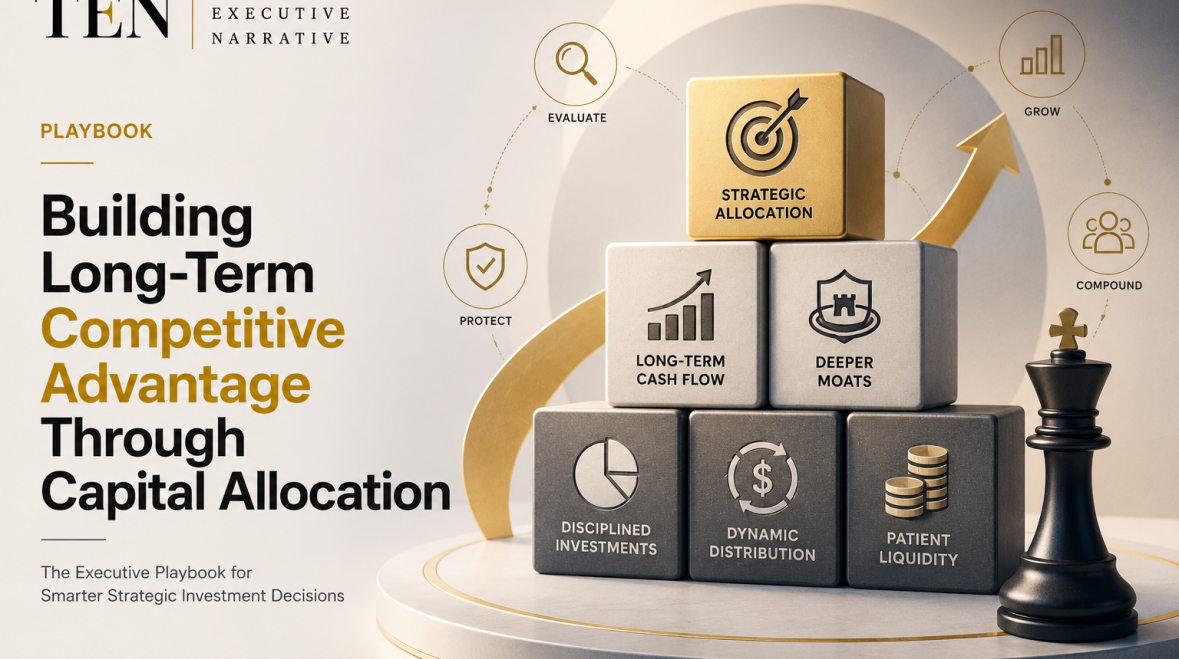
PLAY ONE: Evaluate Investments by Long-Term Cash Generation, Not Accounting Earnings
Objective: Focus capital deployment on compounding long-term free cash flow per share rather than short-term accounting earnings.
Executive Problem: Executive teams frequently prioritize projects that smooth short-term GAAP earnings, starving capital from high-return, multi-year strategic initiatives.
Why It Works: Free cash flow is the true measure of economic value creation. Aligning capital deployment with cash yield prevents accounting distortion.
How Exceptional Organizations Execute It:
• Berkshire Hathaway evaluates business units based on 'owner earnings' and cash generation rather than short-term reported GAAP fluctuations.
• Amazon relentlessly optimizes for long-term free cash flow per share, willingly suppressing GAAP net income to fund massive infrastructure bets.
• Apple focuses capital on highly cash-generative product platforms, ensuring high return on invested capital across every business segment.
Implementation: Mandate free cash flow yield and return on invested capital (ROIC) as primary criteria for all capital allocation decisions over $1M.
Success Indicators:
• Capital proposals evaluate multi-year free cash flow impact rather than quarterly GAAP earnings.
• ROIC targets are met or exceeded across new capital deployments.
• Executive reviews prioritize cash flow generation metrics.
PLAY TWO: Maintain Patient Cash Reserves for Asymmetric Opportunities
Objective: Preserve strategic liquidity to deploy aggressively during market dislocations and distressed industry cycles.
Executive Problem: Pressure to deploy annual budgets leads managers to overpay for assets at market peaks, leaving zero liquidity when high-return opportunities appear.
Why It Works: Having cash optionality during downturns allows an organization to acquire assets, talent, and market share at steep discounts when competitors are constrained.
How Exceptional Organizations Execute It:
• Berkshire Hathaway maintains massive cash reserves, refusing to overpay during market booms and deploying capital decisively during financial crises.
• Zoho maintains a private, debt-free capital structure, using patient cash reserves to fund long-term R&D without market pressure.
• Costco maintains conservative leverage and disciplined cash management, allowing steady, patient warehouse expansion through all economic cycles.
Implementation: Establish a minimum strategic cash buffer that cannot be allocated to routine operations, dedicated exclusively to high-conviction or distressed opportunities.
Success Indicators:
• Strategic liquidity buffers remain protected during economic expansions.
• Capital deployment accelerates during industry downturns or asset repricings.
• Zero high-priced, debt-fueled acquisitions made at market peaks.
PLAY THREE: Reinvest Uncompromisingly in Core Competitive Moats
Objective: Channel retained earnings primarily into expanding cost, scale, technology, or network advantages that deepen the core business moat.
Executive Problem: Organizations often diversify into unfamiliar markets to chase short-term revenue growth, underfunding the core capabilities that created their advantage.
Why It Works: Reinvesting in core moats deepens switching costs and scale barriers, making the core business increasingly impossible for competitors to displace.
How Exceptional Organizations Execute It:
• Costco continuously passes operational savings back to members through lower prices, cementing member loyalty and scale dominance.
• Amazon reinvests operating cash flow directly into fulfillment density, delivery speed, and AWS infrastructure to widen its scale moat.
• Zoho reinvests profits directly into internal software engineering and R&D, expanding its unified application suite without external capital.
Implementation: Audit capital allocation to ensure at least 70% of growth capital directly strengthens the core business competitive moat.
Success Indicators:
• Core business market share and customer retention metrics expand.
• Cost advantages over primary industry competitors widen.
• New entrants face rising capital and operational barriers.
PLAY FOUR: Enforce High Hurdle Rates and Exit Unproductive Capital Traps
Objective: Apply strict ROIC thresholds and divest or shut down assets that consistently fail to meet capital efficiency targets.
Executive Problem: Sunk cost fallacy and internal politics prevent organizations from exiting underperforming projects, causing legacy assets to drain capital and focus.
Why It Works: Pruning low-return initiatives frees up capital and management bandwidth for high-conviction opportunities, elevating enterprise-wide ROIC.
How Exceptional Organizations Execute It:
• Berkshire Hathaway refuses to inject fresh capital into operating units that lack structural moats or clear paths to high returns.
• Apple ruthlessly prunes underperforming product lines and non-viable projects to concentrate capital on high-margin platforms.
• Amazon enforces strict operational hurdles on new bets, rapidly shutting down projects that fail to demonstrate scale potential.
Implementation: Institute annual capital efficiency reviews. Require any business unit or project underperforming its hurdle rate for two years to submit a restructuring or divestment plan.
Success Indicators:
• Underperforming business lines are restructured or divested within 12 months.
• Enterprise ROIC improves consistently year-over-year.
• Capital from closed initiatives is reallocated to top-performing business units.
PLAY FIVE: Execute Dynamic Capital Distribution via Buybacks and Dividends
Objective: Return capital to shareholders only when internal reinvestment opportunities yield lower returns than the company's cost of capital.
Executive Problem: Executive teams often treat buybacks and dividends as routine corporate habits rather than opportunistic, dynamic capital allocation decisions.
Why It Works: Repurchasing stock when shares trade below intrinsic value creates immediate per-share value, whereas overpaying for acquisitions or marginal projects destroys value.
How Exceptional Organizations Execute It:
• Apple repurchases equity dynamically when shares are attractively priced, significantly reducing share count and boosting per-share metrics.
• Berkshire Hathaway executes share buybacks strictly when management determines the stock trades below its conservatively estimated intrinsic value.
• Costco uses special dividends dynamically when excess cash accumulates beyond internal reinvestment needs, maintaining capital flexibility.
Implementation: Establish a dynamic capital return framework. Prioritize high-return internal reinvestment first, buying back stock only when shares trade below intrinsic value.
Success Indicators:
• Share buybacks are executed dynamically at attractive intrinsic valuations.
• Capital distribution policies adjust dynamically based on internal reinvestment yields.
• Per-share free cash flow growth accelerates faster than total revenue growth.
Common Implementation Mistakes
• Managing for Short-Term GAAP Earnings: Prioritizing quarterly earnings per share over long-term free cash flow compounding.
• Fully Deploying Budgets at Market Peaks: Exhausting liquidity during expansions, leaving zero capital available during market downturns.
• Diworsification into Unfamiliar Markets: Chasing growth in non-core industries instead of reinvesting to deepen core competitive moats.
• Falling Victim to Sunk Cost Fallacy: Continuing to fund underperforming legacy projects rather than divesting and reallocating capital.
• Executing Mechanical Share Buybacks: Repurchasing stock indiscriminately at market highs rather than dynamically buying back shares when undervalued.
Executive Scorecard
Evaluate your leadership team against these 5 diagnostic questions:
1. Cash Flow Focus: Are major capital expenditure proposals evaluated on long-term free cash flow yield and ROIC rather than GAAP earnings?
2. Strategic Liquidity: Does your organization maintain a dedicated cash reserve reserved exclusively for opportunistic or distressed investments?
3. Moat Reinvestment: Is at least 70% of growth capital directed toward expanding core competitive advantages and scale barriers?
4. Pruning Discipline: Does your company actively exit or restructure business units that fail to meet hurdle rates for two consecutive years?
5. Dynamic Distribution: Are share repurchases and dividends executed dynamically based on intrinsic valuation rather than mechanical corporate routine?
TEN Principle
Exceptional organizations do not build enduring competitive advantage through operational performance alone. They build it by treating capital allocation as an active, strategic discipline that compounds intrinsic value with every dollar deployed.
Operations generate capital; allocation determines compounding speed. When an enterprise evaluates investments by free cash flow, holds patient liquidity, reinvests relentlessly in core moats, ruthlessly prunes underperforming assets, and dynamically returns excess capital, capital allocation transforms from an administrative duty into an insurmountable strategic moat.


















Recommended for you
Breaking Down the Elements of a Masterpiece Painting
The Revival of Classical Art in a Digital Age
Must-See Art Exhibitions Around the World This Year
The Revival of Classical Art in a Digital Age