

Why Cheap Is Rarely a Winning Strategy
August 09, 2026
- 5 mins read





2026 Copyright @ TEN.
All Rights Reserved
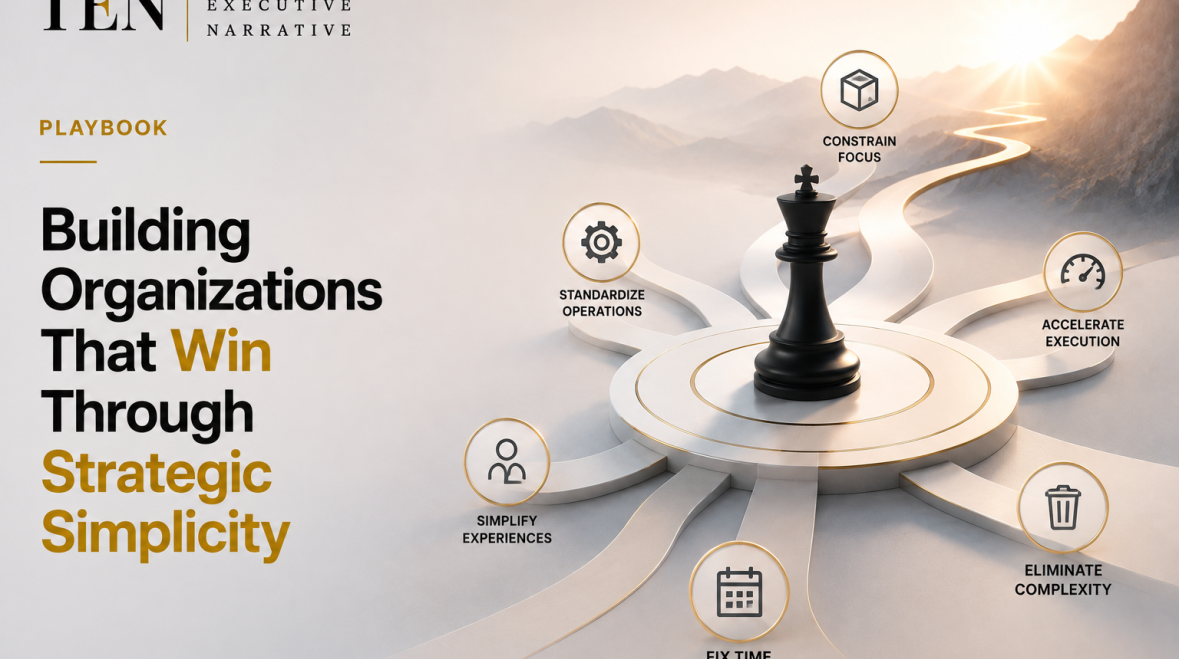
Executive Snapshot
• Objective: Build an operating model that systematically eliminates organizational, product, and operational complexity to accelerate execution and amplify customer value.
• Best Fit: Scaling Tech Platforms, Multi-Product Enterprises, Global Retailers, Airline & Transport Operators, High-Growth SaaS Companies.
• Avoid If: Early pre-product/market fit startups where initial core processes have not yet been established.
• Research Base: Synthesizes core operating strategies from Apple, Canva, IKEA, Southwest Airlines, and Basecamp.
• Executive Takeaway: Learn five actionable plays to prune operational drag, constrain product scope, streamline decision loops, and build an insurmountable simplicity moat.
Why This Strategy Exists
Most enterprise friction is self-inflicted through the silent accumulation of organizational complexity.
As companies scale, they naturally add product variants, management approval layers, custom service options, and complex internal software tools. Each addition feels rational in isolation, but collectively they create exponential operational drag. Decision-making stalls, overhead balloons, and customer experiences become fragmented.
Complexity is an operational tax; simplicity is a compounding competitive advantage.
Average companies attempt to manage complexity by adding project managers, steering committees, and elaborate governance matrices. Exceptional organizations take a radically different approach: they systematically eliminate complexity at its root. By constraining choices, standardizing operations, and pruning unnecessary features, they unlock speed, lower cost structures, and deliver intuitive customer value that competitors cannot replicate.
THE PLAYBOOK
PLAY ONE: Constrain Core Product Offerings to Maximize Focus and Speed
Objective: Eliminate low-margin product variations and non-essential features to focus enterprise resources on high-impact offerings.
Executive Problem: Product line expansion creates manufacturing, software, and supply chain bloat, diluting focus and confusing customer buying decisions.
Why It Works: Restricting product options lowers operational overhead, concentrates design and engineering power, and accelerates customer purchasing velocity.
How Exceptional Organizations Execute It:
• Apple radically simplified its product lineup upon Steve Jobs's return in 1997, cutting dozens of desktop variants down to a simple 2x2 grid (Consumer/Professional, Desktop/Portable).
• Southwest Airlines maintains a single aircraft fleet type (Boeing 737), drastically simplifying pilot training, maintenance, and gate turnarounds.
• Basecamp refuses to build custom enterprise features or bloated settings, maintaining a single, clean project management software suite.
Implementation: Conduct an annual product catalog audit. Prune the bottom 20% of low-margin product SKUs or low-engagement features to concentrate engineering and operational bandwidth.
Success Indicators:
• Active product or SKU count is reduced without sacrificing core revenue.
• Customer purchasing conversion rates and speed-to-value increase.
• Manufacturing, supply chain, or code maintenance overhead decreases.
PLAY TWO: Standardize Operational Workflows to Lower Unit Cost Structures
Objective: Establish uniform, modular operational processes that eliminate custom workarounds and lower operating expenses.
Executive Problem: Allowing regional units or departments to invent custom workflows creates operational fragmentation and inflates training and maintenance costs.
Why It Works: Standardized, highly repeatable workflows maximize execution velocity and lower cost structures, enabling disruptive customer pricing.
How Exceptional Organizations Execute It:
• IKEA standardizes store layouts, flat-pack packaging, and self-service warehouse models globally to maintain ultra-low cost structures.
• Southwest Airlines standardizes 10-to-15 minute aircraft turnaround procedures, achieving industry-leading fleet utilization rates.
• Canva standardizes complex graphic design mechanics into automated, one-click templates that eliminate professional design overhead for users.
Implementation: Map core operational delivery processes. Eliminate custom process branches and establish standardized, modular execution templates across all sites.
Success Indicators:
• Unit delivery or operational cycle times decrease significantly.
• Operational defect rates and training overhead drop toward zero.
• Gross margin expands as scale efficiencies are realized across operations.
PLAY THREE: Eliminate Decision Hierarchies to Accelerate Execution Velocity
Objective: Flatten approval loops by granting front-line teams clear operational context and direct decision authority.
Executive Problem: Multi-layered management hierarchies create decision latency, forcing simple operational choices through tedious approval chains.
Why It Works: Decentralized decision-making within clear strategic guardrails restores agility, reduces administrative bloat, and empowers front-line execution.
How Exceptional Organizations Execute It:
• Basecamp operates without project managers, empowering autonomous 2-person product teams to make direct scope and execution trade-offs.
• Canva decentralizes product development into autonomous 'crazy big goal' squads that own end-to-end feature delivery without corporate review boards.
• Southwest Airlines empowers gate agents and cabin crew to make immediate operational choices to resolve passenger delays without supervisor sign-off.
Implementation: Audit internal approval chains. Require zero manager pre-approval for decisions below a defined financial or scope threshold.
Success Indicators:
• Decision cycle times for daily operational choices drop from weeks to hours.
• Management approval layers are reduced across core workflows.
• Front-line employee engagement and execution speed increase.
PLAY FOUR: Design Intuitive Interfaces That Require Zero User Manuals
Objective: Abstract away technical complexity to deliver effortless, intuitive customer experiences.
Executive Problem: Exposing backend technical complexity to end users increases cognitive load, onboarding friction, and customer support ticket volume.
Why It Works: Hiding underlying technical mechanics behind simple, intuitive interfaces drives viral user adoption and lowers customer support costs.
How Exceptional Organizations Execute It:
• Apple pioneered touch interfaces and hardware design so intuitive that toddlers and seniors can operate devices without instruction manuals.
• Canva abstracted professional graphic design software into simple drag-and-drop tools, making visual communication accessible to non-designers.
• IKEA uses universal, wordless visual assembly instructions, eliminating language barriers and simplifying global customer self-assembly.
Implementation: Institute mandatory usability testing. Require product teams to measure time-to-first-value and eliminate any step that requires explicit user instructions.
Success Indicators:
• Customer onboarding time and time-to-value drop sharply.
• Customer support ticket volume related to user confusion decreases.
• Organic user adoption and Net Promoter Scores (NPS) expand.
PLAY FIVE: Enforce Fixed-Time, Variable-Scope Boundaries to Prevent Feature Creep
Objective: Cap development timeframes and adjust scope dynamically to prevent missed deadlines and bloated initiatives.
Executive Problem: Allowing project timelines to expand to accommodate open-ended feature scopes leads to delayed releases, cost overruns, and team fatigue.
Why It Works: Fixing timeframes forces teams to prioritize essential value, aggressively cutting non-critical scope to deliver high-quality, lean outputs on schedule.
How Exceptional Organizations Execute It:
• Basecamp enforces strict 6-week 'Shape Up' cycles where time is fixed, and scope is dynamically reduced if work exceeds the window.
• Apple enforces uncompromising annual hardware release schedules, deferring incomplete features to future cycles rather than delaying launches.
• Canva utilizes short, time-boxed sprint cycles to continuously ship incremental value without allowing feature creep to stall core updates.
Implementation: Adopt fixed-time development windows (e.g., 6 weeks). Require teams to reduce feature scope rather than extend project deadlines when obstacles arise.
Success Indicators:
• 100% of product releases ship on schedule within fixed timeframes.
• Non-essential feature creep is eliminated prior to launch.
• Development team velocity and release predictability improve consistently.
Common Implementation Mistakes
• Managing Complexity Instead of Eliminating It: Adding management layers and tools to handle operational bloat rather than pruning non-essential offerings.
• Mistaking Simplicity for Lack of Capability: Failing to recognize that radical simplicity requires deep engineering and design effort beneath the surface.
• Tolerating Product Line Bloat to Satisfy Niche Requests: Adding low-margin SKUs or custom features that fragment core focus and inflate operating overhead.
• Over-Regulating Decision Approval Chains: Requiring multi-layered executive sign-offs for simple operational choices, crippling team execution velocity.
• Extending Project Deadlines to Fit Expanding Scope: Allowing feature creep to delay launches rather than fixing timeframes and dynamically flexing scope.
Executive Scorecard
Evaluate your leadership team against these 5 diagnostic questions:
1. Product Concentration: Does your organization actively prune low-margin SKUs or underused features annually to protect core focus?
2. Workflow Standardization: Are core operational processes standardized into modular, repeatable templates across all sites and teams?
3. Decision Autonomy: Can front-line teams execute operational choices without navigating multi-layered executive approval chains?
4. Interface Simplicity: Can new customers achieve core product value without needing training, manuals, or complex onboarding?
5. Fixed-Time Discipline: Do project teams enforce fixed development timeframes by flexing scope rather than extending launch deadlines?
TEN Principle
Exceptional organizations do not win by managing complexity better than their peers. They win by building operating models that aggressively remove complexity, turning strategic simplicity into an unassailable competitive advantage.
Complexity breeds drag; simplicity creates velocity. When an enterprise constrains core offerings, standardizes operations, flattens decision hierarchies, designs intuitive interfaces, and enforces fixed-time boundaries, strategic simplicity transforms from an aesthetic preference into an insurmountable operational moat.











Recommended for you
Breaking Down the Elements of a Masterpiece Painting
The Revival of Classical Art in a Digital Age
Must-See Art Exhibitions Around the World This Year
The Revival of Classical Art in a Digital Age