
Execution Begins With Clarity, Not Motivation
August 08, 2026
- 5 mins read







2026 Copyright @ TEN.
All Rights Reserved
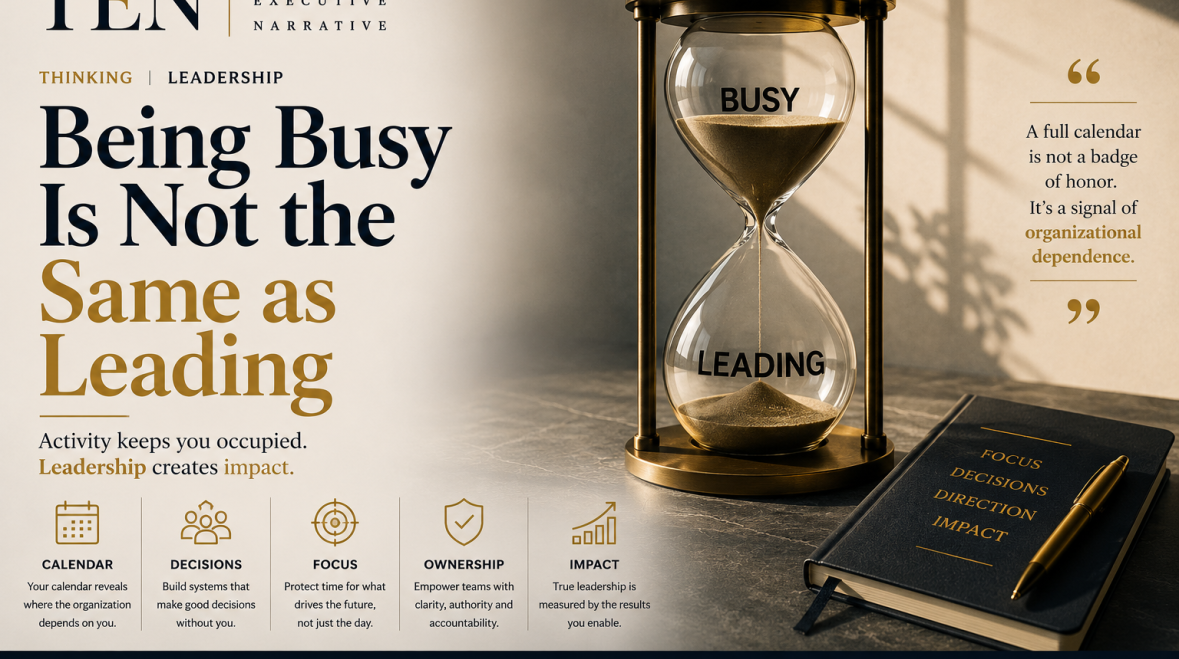
Executive calendars have never been fuller. Board meetings, investor updates, customer reviews, operational check-ins, hiring discussions, crisis management and endless streams of communication compete for every available hour. In many organisations, constant activity has quietly become the visible symbol of leadership.
Yet organisations are rarely transformed by leaders who are constantly occupied.They are transformed by leaders who consistently improve the quality of the organisation's decisions.The distinction matters because activity is easy to observe, while effectiveness is much harder to measure.
A leader's calendar is not simply a schedule of commitments. It is one of the most accurate diagnostics of how the organisation truly operates.
Every recurring meeting, every repeated escalation and every executive intervention reveals work the organisation has not yet learned to perform without its leaders.
The Executive Activity Trap
Leadership rarely becomes busy overnight. The transformation is gradual. A customer issue becomes a weekly review. A product launch introduces another governance meeting. Cross-functional projects require additional alignment. Operational risks create new approval processes. Each decision appears sensible in isolation because every challenge deserves attention. Over time, however, leadership begins responding to the organisation instead of shaping it.
Calendars become collections of inherited responsibilities rather than deliberate expressions of executive priorities. Busyness starts replacing judgment as the measure of contribution. The organisation celebrates responsiveness while quietly reducing leadership to coordination.
The pattern is surprisingly consistent.
•Meetings become the default response to uncertainty.
•Executive approvals replace distributed decision-making.
•Leaders spend more time reviewing work than defining direction.
•Urgent operational issues consistently displace strategic conversations.
•A full calendar becomes mistaken for organisational value.
The organisation appears highly active. Progress becomes increasingly difficult to distinguish from motion.
What a Calendar Really Reveals
Most executives assume their calendar reflects the complexity of the business. More often, it reflects the capabilities the business has not yet developed.When every important hiring decision requires executive involvement, leadership capacity has not scaled.When customer escalations repeatedly reach senior management, frontline ownership remains weak.
When strategy discussions are constantly interrupted by operational issues, organisational design is forcing executives into work the system should already be handling.The calendar quietly exposes these patterns long before performance metrics do.
Its hidden signals are difficult to ignore.
•Repeated operational reviews often indicate unclear accountability.
•Constant executive approvals suggest decision authority remains concentrated.
•Endless alignment meetings reveal structural friction between teams.
•Frequent executive intervention exposes capabilities the organisation has yet to build. •Leadership presence becomes the mechanism that keeps the business moving.
The calendar is not documenting productivity.
It is documenting organisational dependency. Microsoft's Leadership Transformation
When Satya Nadella became CEO of Microsoft, the company did not suffer from a shortage of intelligence, talent or effort. Thousands of capable people were already working across one of the world's largest technology organisations. The challenge was different.
Leadership attention had become fragmented across competing priorities, organisational silos and internal complexity. The company needed more than harder work. It needed greater clarity about where leadership attention created the greatest strategic value.
Nadella responded by simplifying priorities, encouraging collaboration across engineering teams and reducing internal barriers that slowed decision-making. Rather than increasing executive involvement in every discussion, Microsoft redesigned how decisions moved through the organisation.
Its transformation illustrates an important principle.
Great leaders do not build organisations that depend on their constant presence. They build organisations capable of making consistently better decisions because leadership has created the conditions for clarity, ownership and trust. Executive Effectiveness Is Measured by Absence Leadership is often evaluated by visibility. Executive effectiveness is better measured by organisational capability. The strongest leaders gradually remove themselves from decisions others are fully capable of making. They preserve their attention for the few decisions that define competitive advantage, long-term direction and capital allocation.
Their influence grows precisely because their involvement becomes more intentional. Effective leadership is not about becoming indispensable. It is about ensuring the organisation continues making high-quality decisions even when the executive is no longer in the room. That is not delegation. It is organisational maturity.
The most effective executives consistently ask themselves:
•Which decisions genuinely require my judgment? •Where has executive involvement become organisational dependency?
•Am I creating clarity or simply increasing communication?
•Does my calendar reflect strategic priorities or operational habits?
•Would this organisation make equally strong decisions without me?
The answers reveal leadership effectiveness more honestly than any performance review.
TEN Perspective
Every leadership team reviews financial performance. Revenue.
Margins.
Growth.
Cash flow.
Market share.
Perhaps another document deserves the same level of scrutiny.
The executive calendar. Unlike dashboards and presentations, it cannot disguise organisational reality.
It records every responsibility leadership has failed to distribute.
Every capability the organisation has yet to develop.
Every decision that still depends on executive intervention. Being busy is not evidence of leadership. In many organisations, it is evidence that leadership has become the system through which everything must pass. The question is not whether your calendar is full. The question is what your calendar is trying to tell you.
If an investor examined only your calendar from the past twelve months, would they conclude that your organisation has built leadership capacity—or that it has simply concentrated more responsibility at the top











Recommended for you
Breaking Down the Elements of a Masterpiece Painting
The Revival of Classical Art in a Digital Age
Must-See Art Exhibitions Around the World This Year
The Revival of Classical Art in a Digital Age