

Being Busy Is Not the Same as Leading
August 07, 2026
- 6 mins read







2026 Copyright @ TEN.
All Rights Reserved
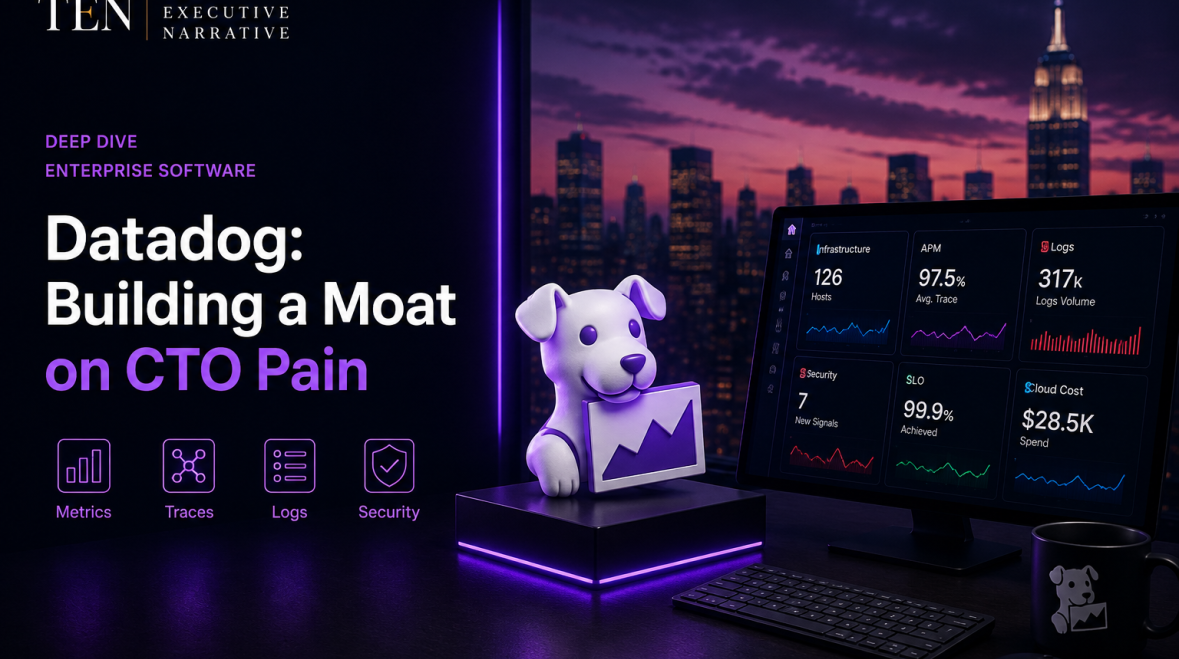
As enterprise infrastructure moved to complex multicloud environments, CTOs faced severe visibility gaps across fragmented microservices. Datadog recognized that infrastructure monitoring was fundamentally a data unification problem rather than a point-solution feature. By building a single-pane-of-glass observability platform, Datadog turned chaotic cloud operational telemetry into an unassailable data-stickiness moat.
The Strategic Challenge
Modern cloud architectures generate billions of fragmented metrics, logs, and traces every minute across isolated environments. Engineering teams traditionally bought siloed monitoring tools, creating operational silos, delayed incident response, and astronomical software overhead. The core challenge was unifying real-time telemetry into a single, actionable platform without slowing down developer velocity.
The Strategic Insight
Datadog understood that observability becomes exponentially more valuable when metrics, traces, and logs live inside a single database layer. By deploying lightweight, universal collection agents across customer servers, the platform gathered telemetry at the root infrastructure layer. Treating observability as an integrated data engine transformed monitoring from an operational expense into an indispensable technical nervous system.
The Competitive Mechanism
Datadog's competitive advantage operates through a powerful land-and-expand flywheel:
• Low-friction agent deployment captures initial infrastructure monitoring metrics.
• Unified telemetry data encourages seamless cross-selling of log management, APM, and security.
• Multi-product adoption drives massive switching costs and industry-leading net retention.
Operating Model
Datadog operates a unified multi-tenant SaaS platform built on a single codebase and database architecture. Instead of acquiring disconnected point tools, every product module—from application performance to cloud security—integrates natively. This allows engineering, ops, and security teams to collaborate around a single source of truth during critical outages.
Strategic Trade-offs
Building an all-in-one cloud observability engine required accepting extreme data ingestion costs and complex real-time indexing overhead. Datadog resisted building heavy on-premises enterprise software, focusing exclusively on native cloud architectures. This intentional choice sacrificed legacy enterprise migrations to capture the hyper-growth cloud-native market.
Why Competitors Struggle
Legacy monitoring vendors rely on stitched-together acquisitions that create fragmented user experiences and data silos. Replicating Datadog's unified data pipeline and frictionless multi-product cross-selling is technically difficult. Once an enterprise embeds Datadog agents across its server fleet, removing them introduces unacceptable operational risk during cloud outages.
Executive Lessons
Durable SaaS advantage stems from solving systemic operational complexity rather than selling isolated software features. Leaders must ask:
• Are we selling point-solution features or building a unified system of record?
• Does our product architecture create natural land-and-expand cross-selling opportunities?
TEN Perspective
Datadog proves that modern enterprise moats are defined by operational integration rather than aggressive sales tactics. As cloud infrastructure grows more complex, value belongs to platforms that reduce friction and unify critical operational telemetry. Datadog's greatest achievement is showing that solving a CTO's biggest headache builds a billion-dollar enterprise moat.











Recommended for you
Breaking Down the Elements of a Masterpiece Painting
The Revival of Classical Art in a Digital Age
Must-See Art Exhibitions Around the World This Year
The Revival of Classical Art in a Digital Age