Most leadership teams do not have an innovation problem.They have an execution problem.A strategy meeting can produce a dozen compelling ideas in an afternoon. New products, new markets, new technologies, new business models. The presentation looks convincing because the idea exists in its most attractive form: before customers reject it, before operations complicate it, and before reality starts charging for every assumption.
Then the difficult part begins.
Someone has to turn the idea into something customers will actually choose.
The Idea Is Only the Beginning
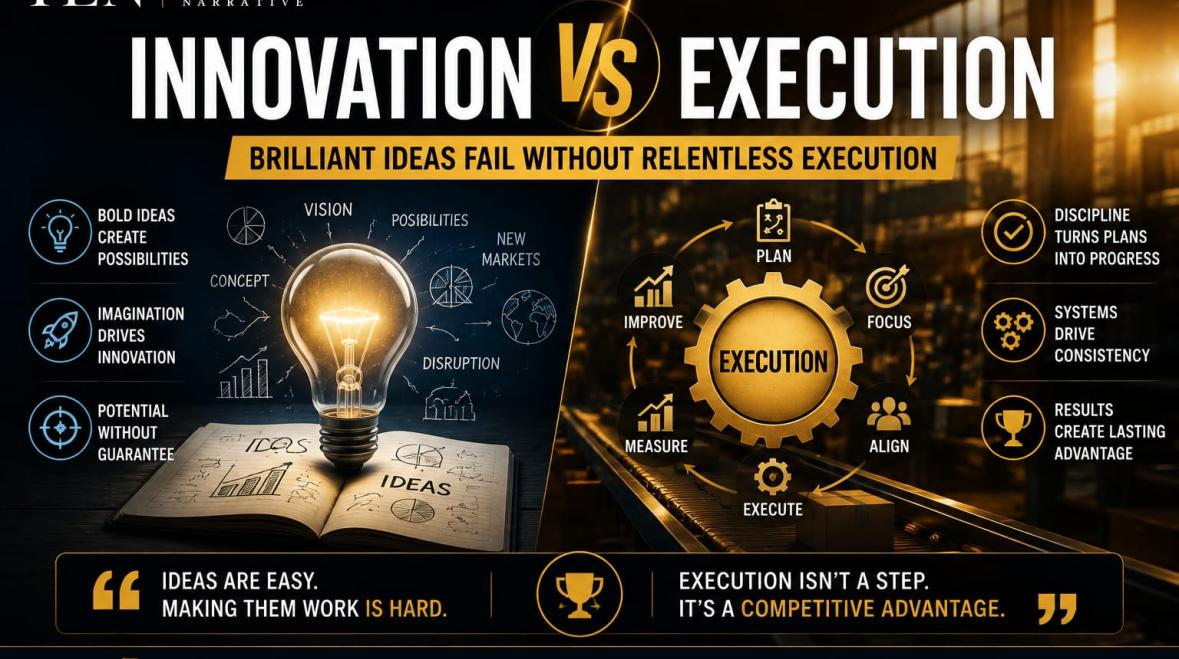
Innovation creates possibilities.Execution determines which possibilities become businesses.
A brilliant product can arrive too late. A powerful technology can remain trapped in a pilot. A promising market can be entered without the distribution needed to win it. None of these failures necessarily mean the original idea was wrong.
They mean the organization could not convert potential into performance.
This distinction matters because companies often celebrate innovation at the moment of creation. The harder competitive advantage comes later, when the organization repeatedly improves, scales, fixes, and delivers.Execution Is Where Strategy Becomes Real
Every strategy eventually meets an operating reality. Suppliers miss deadlines. Customers change their minds. Costs move. Employees interpret priorities differently. Competitors respond. The product that looked perfect in a presentation needs ten more iterations once thousands of customers start using it.
This is where execution separates companies.
The organization that learns faster, solves problems faster, and consistently closes the gap between intention and reality can outperform a company with a more impressive idea.Not because its idea was better.
Because it was better at making the idea matter.
The Advantage of Relentless Improvement
Execution is sometimes treated as the less glamorous side of business.
Innovation gets the keynote.
Execution gets the spreadsheet.
But enduring companies often build their advantage through thousands of small improvements that outsiders barely notice. A faster process. A better supply chain. Fewer defects. Better distribution. Shorter response times. More disciplined capital allocation.
Individually, none looks revolutionary.
Together, they can become extremely difficult to compete with.
That is why execution can become a moat even when the original idea is no longer unique.
The Wrong Question About Innovation
Executives often ask:
“Is this idea innovative enough?”
That matters.
But another question may matter more:
“Can this organization execute it better than everyone else?”
A company should know its tolerance for experimentation, but it should also know its capacity for turning experiments into repeatable economics.
Because innovation without execution creates possibilities.
Execution without innovation can create efficiency without direction.
The strongest companies connect the two.
They generate new ideas, then build the organizational muscle to make those ideas commercially useful.
TEN Perspective
Innovation determines what a company could become.Execution determines whether it ever gets there.The market does not reward the best presentation, the most ambitious strategy, or even the most original idea.
It rewards what customers can actually experience.
The competitive advantage is rarely the brilliance of the idea alone. It is the organization's ability to turn good ideas into reality—repeatedly, faster, and better than its competitors.
So the question for leadership is not simply:
“What should we innovate next?”
It is:
“What are we capable of executing so well that innovation becomes an advantage rather than another unfinished idea?”


















Recommended for you
Breaking Down the Elements of a Masterpiece Painting
The Revival of Classical Art in a Digital Age
Must-See Art Exhibitions Around the World This Year
The Revival of Classical Art in a Digital Age