

Is Owning Your Infrastructure Still Worth It?
August 09, 2026
- 5 mins read






2026 Copyright @ TEN.
All Rights Reserved
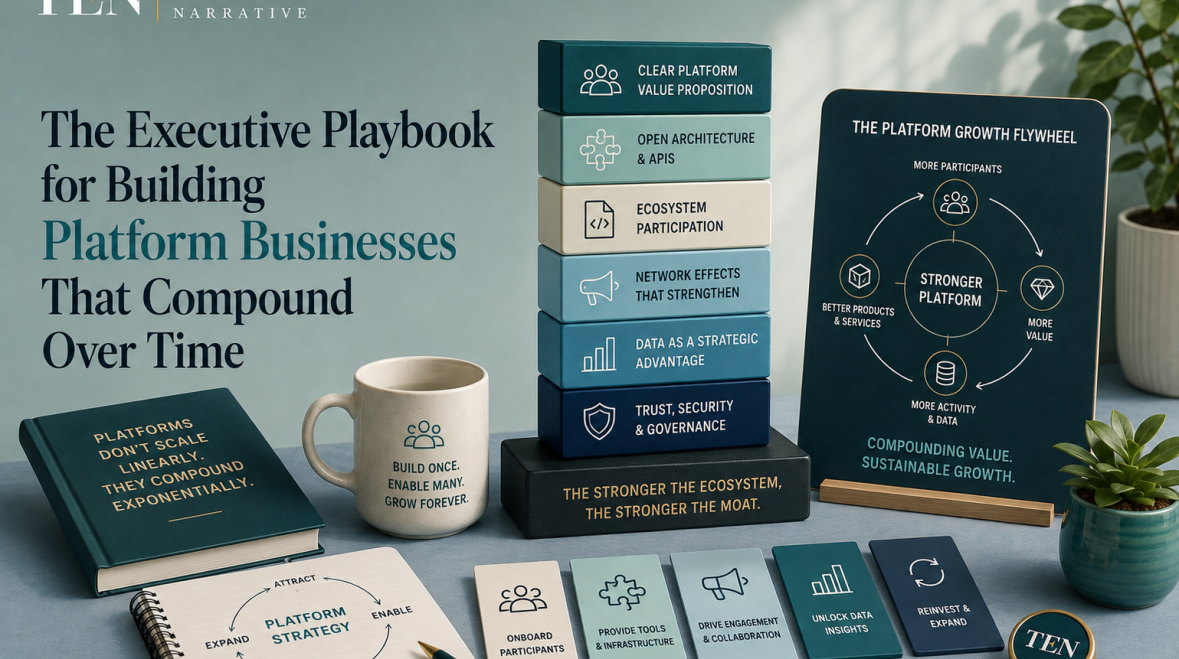
The strongest platform businesses do not simply sell more products.
They create systems that allow other businesses, developers, merchants or customers to create value on top of them.
AWS turned infrastructure into a platform. Shopify built an ecosystem around commerce. Stripe expanded payments into infrastructure for internet businesses. Mercado Libre connected commerce, payments and logistics. Razorpay has expanded from payments into a broader business-finance ecosystem.
The common principle is not "build more products."
It is:
Build infrastructure that makes other participants more valuable.
This Playbook identifies five operating principles executives can use to move from product-centric growth toward platform-driven growth.
Why This Strategy Exists
Product businesses scale by selling more of what they have built.
Platform businesses scale by enabling more participants to build, transact or operate through what they have built.
That distinction becomes increasingly important as organizations grow.
A product roadmap eventually faces limits. Every new feature requires additional investment. Every new customer creates additional demands. Growth can therefore increase complexity almost as quickly as it increases revenue.
Platforms approach the problem differently.
They create reusable infrastructure that allows customers, partners, developers or merchants to generate additional value without the company having to build every solution itself.
The strategic question therefore changes from:
"What else should we build?"
to:
"What can we build that allows others to build more?"
PLAY ONE — Build Infrastructure Others Can Depend On
Objective
Create a core capability that becomes increasingly valuable as more customers and partners use it.
Why This Play Exists
Products solve a defined customer problem.
Platforms provide infrastructure that can support many different problems.
AWS is a clear example. Instead of building individual technology solutions for every customer, AWS provides infrastructure and services that businesses can build on.
Stripe follows a similar principle in financial infrastructure. Its Connect product allows platforms and marketplaces to embed payments, onboarding and payouts into their own businesses. (Stripe)
The transferable lesson is simple:
The most powerful platform businesses make their infrastructure useful beyond their original product.
Implementation
Identify capabilities your organization repeatedly builds or operates for customers.
Ask:
Can this become reusable infrastructure?
Can other businesses build on it?
Can the same capability support multiple use cases?
If the answer is yes, prioritize infrastructure over one-off solutions.
PLAY TWO — Create Value for Multiple Participants
Objective
Design the platform so that success for one participant increases value for others.
Why This Play Exists
A platform becomes powerful when it connects different participants rather than simply serving one customer group.
Consider a marketplace.
More sellers create more selection.
More selection attracts more buyers.
More buyers create more demand for sellers.
The system begins reinforcing itself.
This creates a fundamentally different growth mechanism from a traditional product business.
Why It Works
Platforms can benefit from network effects.
As participation increases, the platform can become more useful, attractive and difficult to replace.
But network effects do not appear automatically.
The platform must first solve a meaningful problem for each participant.
Implementation
Map every important participant in your ecosystem.
For each one, identify:
What value do they receive?
What do they contribute?
Who benefits when their participation increases?
Then design the platform so that participant success reinforces ecosystem growth.
PLAY THREE — Make Integration Easier Than Building Alone
Objective
Reduce the effort required for customers and partners to adopt the platform.
Why This Play Exists
A platform can have excellent infrastructure and still fail if adoption is difficult.
Businesses have limited engineering capacity.
Developers have limited time.
Partners will avoid platforms that require excessive integration work.
Stripe's platform model demonstrates the importance of reducing this friction. Connect provides embedded components, onboarding and payment infrastructure so platforms can launch functionality without building every underlying capability themselves. (Stripe)
Why It Works
Every reduction in integration effort increases the probability that another organization will build on your platform.
This creates a powerful strategic advantage:
The easier your platform is to adopt, the more likely it becomes part of another company's operating infrastructure.
Implementation
Measure the time required for a new customer or partner to integrate.
Then systematically reduce:
Setup time
Engineering effort
Documentation complexity
Compliance requirements
Operational dependencies
Support requirements
Platform strategy is partly an engineering strategy.
But it is equally an adoption strategy.
PLAY FOUR — Expand the Platform Around the Customer's Workflow
Objective
Move beyond a single product by solving adjacent problems within the same customer journey.
Why This Play Exists
Once a company becomes deeply embedded in a customer's workflow, it gains an opportunity to solve additional problems.
But expansion should not mean randomly adding products.
It should follow the customer's existing workflow.
Stripe, for example, has expanded beyond basic payment processing into capabilities such as payouts, tax, financial accounts and other infrastructure that can be embedded into platform businesses. (Stripe)
The strategic principle is:
Expand where your existing position gives you an unfair advantage.
Implementation
Map the customer's workflow from beginning to end.
Identify:
What happens immediately before your product?
What happens immediately after it?
What adjacent problems require another provider?
Where does the customer repeatedly leave your ecosystem?
Prioritize adjacent capabilities where your existing infrastructure, data or relationships provide a structural advantage.
PLAY FIVE — Design the Platform to Compound
Objective
Ensure every new participant strengthens the platform rather than simply increasing revenue.
Why This Play Exists
Not all growth compounds.
A traditional business can acquire more customers while simultaneously increasing operational complexity.
A strong platform should become more valuable as participation increases.
More users can generate more data.
More merchants can increase selection.
More developers can increase functionality.
More transactions can improve infrastructure and economics.
More partners can expand distribution.
The goal is to create a reinforcing system.
Why It Works
Platform economics become powerful when growth improves the underlying system rather than simply increasing the size of the business.
This creates a compounding loop:
More Participants → More Activity → More Value → More Adoption → More Participants
The executive responsibility is to ensure the loop actually exists.
Implementation
Track whether every major growth initiative strengthens at least one platform flywheel.
Ask:
Does this attract more participants?
Does it increase engagement?
Does it improve the platform for existing users?
Does it create new capabilities?
Does it make the ecosystem harder to replicate?
If growth does none of these things, it may simply be adding scale—not creating a platform.
Common Implementation Mistakes
Organizations attempting to become platforms often make the same mistakes.
They build an ecosystem before solving a core customer problem.
They launch multiple products without a clear connection between them.
They focus on acquiring participants before creating value for them.
They make integration unnecessarily difficult.
They confuse a product suite with a platform.
They measure revenue growth without measuring ecosystem health.
The most important distinction is this:
A collection of products is not an ecosystem.
An ecosystem exists when different participants create value for one another through the infrastructure the company provides.
Executive Scorecard
Leadership teams should ask:
Is our core capability something other businesses can build on?
Does participation by one customer increase value for others?
How difficult is it for a new partner or developer to integrate?
Are we solving adjacent problems within the same customer workflow?
Does our growth strengthen the platform or simply increase operational complexity?
Do we have a measurable platform flywheel?
If the answer to these questions is unclear, the organization may still be operating as a product company rather than a platform business.
TEN Principle
The transition from product to platform is not about building more products.
It is about changing the source of growth.
Product companies create value primarily through what they build.
Platform companies create value through what they enable others to build, sell, connect or operate.
The strongest platforms therefore become more valuable as participation increases.
That is the real advantage.
Don't build everything customers need. Build the infrastructure that allows an ecosystem to build it with you.











Recommended for you
Breaking Down the Elements of a Masterpiece Painting
The Revival of Classical Art in a Digital Age
Must-See Art Exhibitions Around the World This Year
The Revival of Classical Art in a Digital Age