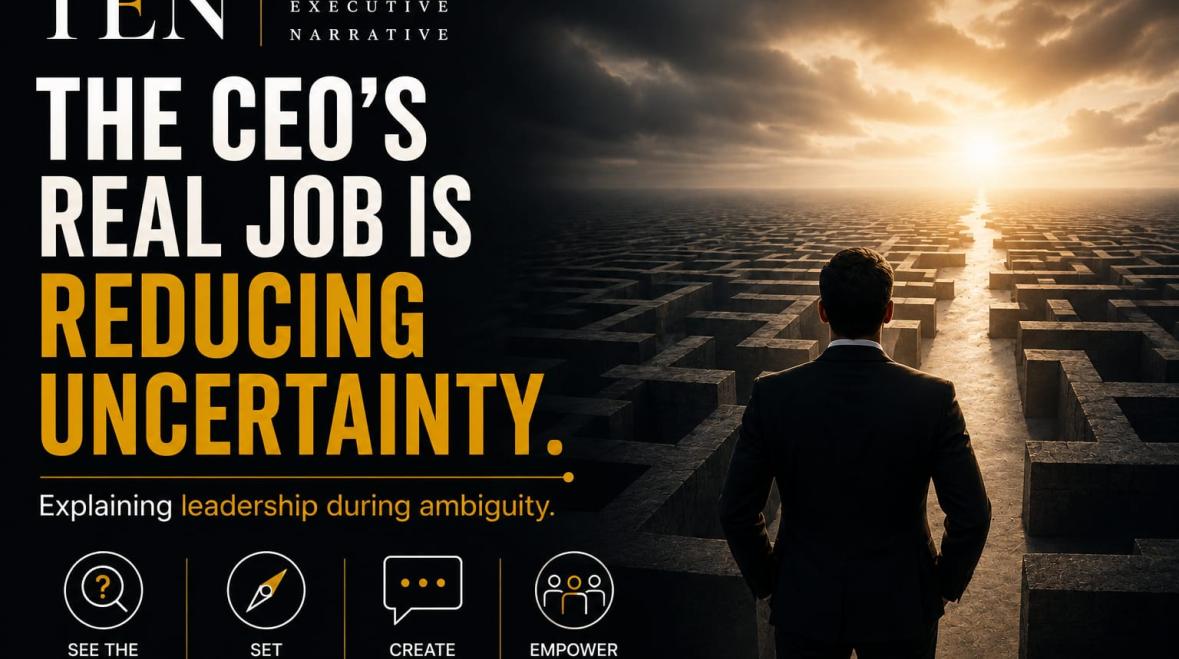
Leadership Begins Where Certainty EndsLeadership is often associated with setting direction, making difficult decisions and communicating a compelling vision. But in uncertain environments, the CEO has another critical responsibility: reducing uncertainty enough for the organization to move.
Markets change. Customers reconsider priorities. Competitors introduce unexpected moves. Technology disrupts established assumptions. Inside the company, employees are often trying to make decisions without knowing exactly what leadership sees coming next.
A CEO cannot remove uncertainty from the business. No leader can predict every market movement or guarantee every outcome. The real responsibility is to prevent uncertainty from becoming organizational paralysis.
Good leadership does not promise certainty. It creates enough clarity to act.
Uncertainty Becomes Expensive When It Spreads
Uncertainty at the top does not stay at the top.
When leadership is unclear about priorities, teams create their own interpretations. When decisions remain unresolved, employees delay action or seek additional approval. When strategy changes without explanation, people begin protecting themselves rather than moving confidently toward the objective.
The result is not always visible immediately. Projects continue. Meetings continue. People remain busy. But the organization begins losing speed because too much energy is being spent interpreting what leadership actually wants.
This is why ambiguity can become an execution problem.
The issue is not that employees lack information. It is that they lack confidence about what information matters most.
The CEO Cannot Know Everything
Reducing uncertainty does not mean having every answer.
In fact, pretending to have certainty when none exists can be more damaging than acknowledging what is unknown. Employees can usually recognize when leadership is overstating confidence, and false certainty creates fragile decisions that collapse when reality changes.
Strong leaders separate what is known from what is uncertain. They explain the assumptions behind important decisions, identify what could change the direction and make clear which decisions are temporary, reversible or still under evaluation.
That creates a different kind of confidence.
People do not need a CEO who claims to know exactly what will happen. They need a CEO who can explain what the organization knows, what it does not know and what it will do next.
Clarity Is a Leadership System
Reducing uncertainty is not achieved through one inspiring speech. It is reinforced through the way leadership communicates and makes decisions.
When priorities are clear, teams can make trade-offs without constantly escalating them. When decision rights are understood, employees know where authority sits. When leaders consistently explain why priorities are changing, organizations can adapt without interpreting every change as a crisis.
The objective is not to communicate more.
It is to communicate what matters most, what has changed and what has not changed.
A CEO who provides clarity allows the rest of the organization to spend less time interpreting leadership and more time executing the strategy.
The Cost of Leaving Questions Open
Some uncertainty is unavoidable. Some uncertainty is created by leadership.
A decision that could have been made today but remains unresolved for three weeks creates uncertainty. A strategic priority that changes every quarter creates uncertainty. A leadership team that gives different answers to the same question creates uncertainty.
Each individual example may appear small.
Together, they create organizational drag.
Employees begin waiting for more information. Managers avoid making commitments. Teams build parallel plans. Resources remain tied to initiatives that may no longer matter. The company becomes slower not because people are incapable of acting, but because they are unsure whether acting is safe or aligned.
The CEO's role is therefore partly about closing unnecessary uncertainty.
The Executive Responsibility
During ambiguity, CEOs should focus less on appearing certain and more on making the organization capable of navigating uncertainty. That means defining the few priorities that cannot be compromised, communicating the assumptions behind major decisions, identifying what is still unknown and establishing clear signals that would trigger a change in direction. It also means giving teams enough authority to act without waiting for leadership to resolve every detail. The strongest CEOs create confidence not by predicting the future perfectly, but by making the organization confident in how it will respond when the future changes.
Executive Lessons
Leadership during uncertainty is ultimately about creating clarity without pretending that uncertainty does not exist. CEOs should distinguish facts from assumptions, communicate priorities repeatedly, make decision ownership explicit and give teams clear boundaries within which they can act. The goal is not to eliminate ambiguity, because that is impossible. The goal is to ensure that ambiguity does not prevent the organization from moving.
TEN Perspective
Uncertainty is inevitable.
Confusion is not.
A company may operate in an unpredictable market and still move with remarkable clarity if its leadership knows what matters, communicates what has changed and gives people confidence to make decisions.
The CEO's real job is therefore not to provide every answer.
It is to create the conditions in which the organization can keep making good decisions even when the answers are incomplete.
The question leaders should ask is not:
“How certain are we about the future?”
It is:
“Have we given our people enough clarity to act while the future is still uncertain?”




















Recommended for you
Breaking Down the Elements of a Masterpiece Painting
The Revival of Classical Art in a Digital Age
Must-See Art Exhibitions Around the World This Year
The Revival of Classical Art in a Digital Age