

Building the Middle East's Logistics Backbone
August 04, 2026
- 3 mins read





2026 Copyright @ TEN.
All Rights Reserved
The Decision Is Only the Beginning
Business decisions are often judged by their immediate results. A company cuts prices and sales increase. It reduces costs and margins improve. It launches a new product and gains customers. These outcomes are easy to measure, which makes them easy to celebrate.
But the first result is rarely the complete story.
Every decision changes the conditions surrounding the next decision. A price reduction may increase demand but also change customer expectations. A cost reduction may improve margins while weakening service quality. A rapid hiring strategy may increase capacity while creating management complexity.
The strongest CEOs understand that a decision does not end when the outcome appears. That outcome becomes the starting point for what happens next.
First-Order Thinking Is Easy
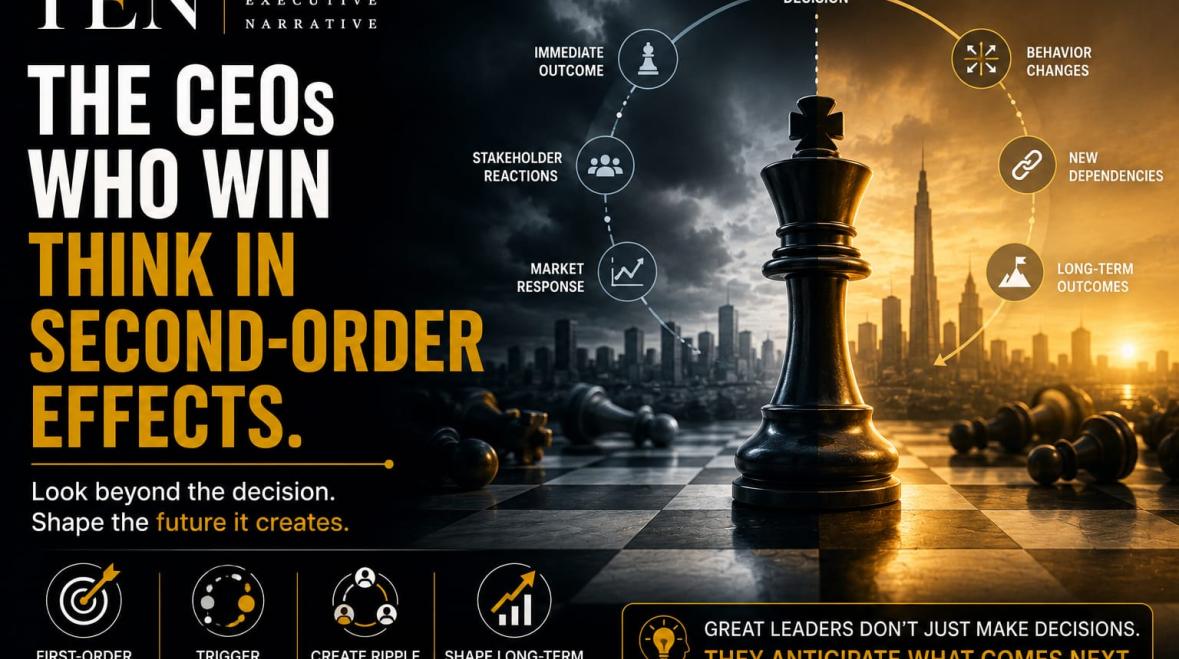
First-order thinking asks a simple question: “What happens if we do this?”
Second-order thinking asks: “And then what?”
That second question creates a different level of strategic discipline.
Imagine a company decides to offer significant discounts to acquire customers. The first-order effect may be higher sales and faster customer growth. But the second-order effects could include lower perceived value, customers becoming less willing to pay full price and competitors responding with their own discounts.
The decision may have solved an immediate growth problem while creating a more difficult pricing problem later.
This does not mean the discount was necessarily wrong.
It means the full decision cannot be evaluated without considering what it sets in motion.
The Best Decisions Consider Reactions
Business decisions rarely happen in isolation.
Customers respond. Competitors respond. Employees respond. Suppliers respond. Investors respond. Those reactions can create consequences that were not part of the original plan.
A company may automate a process to reduce costs. Employees may then change how they work around the system. Customers may experience a different level of service. Competitors may adopt similar technology and remove the company's advantage.
The original decision may still be economically sound.
But its strategic impact depends on the reactions it creates.Second-order thinking forces leaders to move beyond the internal view of a decision and consider how the wider system will respond.
Success Can Create New Problems
Second-order effects are not always negative.
A successful decision can create new opportunities while also creating new constraints.
A company that rapidly gains customers may achieve stronger market visibility, attract better talent and gain negotiating power with suppliers. But the same growth can create pressure on infrastructure, customer support and organizational structure.
Growth creates problems that did not exist before growth.
That is why successful CEOs do not only ask whether a decision is working. They ask what new problems success is creating.
This allows them to prepare before those problems become bottlenecks.
Think in Chains, Not Moments
Second-order thinking is essentially about understanding chains of consequences.A decision changes behavior. That behavior changes incentives. Those incentives influence future decisions. Over time, a single choice can reshape how an organization operates.
This is particularly important for decisions involving pricing, hiring, technology, acquisitions, organizational design and capital allocation because these decisions often create commitments that are difficult to reverse.
The objective is not to predict every consequence.That would be impossible.The objective is to identify the consequences that are most likely to materially change the strategic outcome.
The Executive Responsibility
CEOs should create a habit of asking what happens after the immediate result. Before major decisions, leadership teams should examine how customers, competitors, employees and the organization itself are likely to respond. They should identify which consequences could create new dependencies, constraints or opportunities and consider whether the company is prepared for them. This does not require endless analysis or perfect forecasting. It requires enough strategic imagination to recognize that the obvious outcome is often only the first move in a much longer chain.
The Advantage of Thinking Further
Most companies are competing on the quality of their immediate decisions.
Fewer are consistently thinking about what those decisions will cause next.That difference can become a competitive advantage.
When leaders anticipate second-order effects, they can design decisions that remain valuable beyond the initial outcome. They can avoid solving one problem while quietly creating another and prepare the organization for consequences before they become urgent.
The goal is not to become slower.
It is to become more deliberate about where decisions lead.
Executive Lessons
Second-order thinking helps leaders evaluate decisions beyond their immediate outcomes by considering reactions, dependencies, incentives and future constraints. A strong decision is not simply one that produces a positive result today; it is one that creates favorable conditions for the decisions that follow. CEOs who consistently ask “what happens next?” are better positioned to recognize hidden risks, prepare for emerging opportunities and avoid being surprised by consequences their own decisions created.
TEN Perspective
The best CEOs do not only think about the move they are making.They think about the moves that their decision will force everyone else to make.That is the difference between seeing a decision as an event and seeing it as a chain reaction.
The question is not simply:
“What will this decision achieve?”
It is:
“What will this decision cause?”
Because in business, the most important consequence of a decision is often the one that does not appear on the original plan.











Recommended for you
Breaking Down the Elements of a Masterpiece Painting
The Revival of Classical Art in a Digital Age
Must-See Art Exhibitions Around the World This Year
The Revival of Classical Art in a Digital Age