Modern enterprises have unprecedented access to data. Dashboards track customer behavior in real time, predictive models forecast demand, and AI identifies patterns that humans would struggle to detect. Yet many of the defining business decisions—from entering new markets to acquiring companies or launching breakthrough products—are still made under uncertainty. Data improves visibility, but it cannot eliminate ambiguity. The competitive advantage increasingly belongs to leaders who know when to trust the numbers and when to look beyond them.
The Strategic Challenge Organizations often assume that better data naturally leads to better decisions. As analytics capabilities mature, leadership teams risk treating measurable information as complete information. The challenge is that markets change before historical data can reflect them. Customer expectations evolve faster than dashboards update, and disruptive opportunities rarely arrive with statistical certainty. Executives must decide whether to follow evidence or move ahead of it.
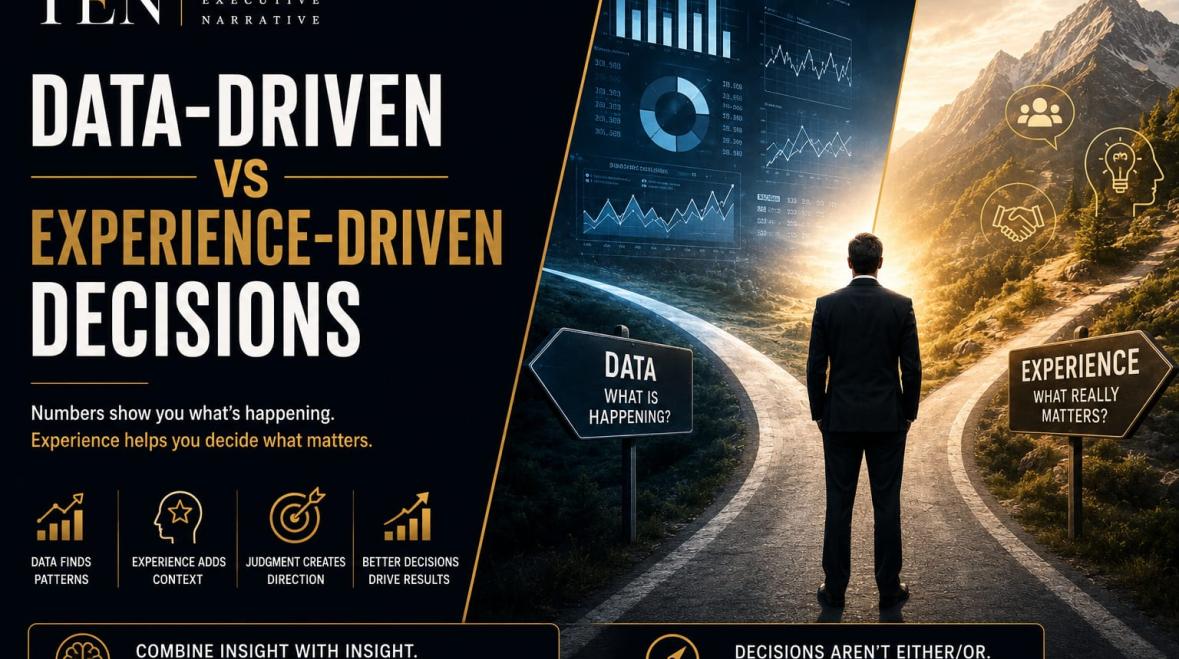
The Strategic InsightData is exceptionally effective at explaining what has happened and highlighting what is happening now. Executive judgment becomes essential when deciding what has never happened before. Every transformative decision contains variables that cannot be modeled with complete confidence. Strategy is not built by replacing intuition with analytics, but by combining evidence with experience where uncertainty is greatest.
The Competitive Mechanism
Organizations that outperform competitors rarely choose between data and judgment. They integrate both through a disciplined decision process.
•Analytics identify patterns, quantify risks, and reveal operational inefficiencies.
•Executive experience provides context, recognizes emerging shifts, and evaluates possibilities beyond historical trends.
•Together, they enable faster, more confident decisions without becoming trapped by either instinct or excessive analysis.
Operating Model
Leading organizations embed analytics into everyday operational decisions while reserving executive judgment for strategic inflection points. Pricing optimization, inventory planning, and resource allocation benefit from data-driven precision. Decisions involving innovation, market positioning, acquisitions, or long-term capital allocation require leaders to interpret signals that algorithms cannot fully understand. Operational excellence depends on consistency; strategic advantage depends on judgment.
Strategic Trade-offs
Relying too heavily on data can delay action until opportunities disappear. Relying only on instinct increases the risk of bias and inconsistent decision-making. Neither extreme creates durable advantage. The strongest leadership teams recognize that analytics reduce uncertainty, but they do not eliminate the responsibility of making difficult choices when certainty remains impossible.
Why Competitors Struggle
Many organizations mistake analytical maturity for strategic maturity. They invest heavily in dashboards and predictive models yet hesitate when the available data cannot produce a definitive answer. Others dismiss analytics entirely in favor of executive instinct. Both approaches weaken decision quality. Sustainable advantage belongs to organizations that understand where measurement ends and leadership begins.
Executive Lessons
Executives should continually ask:
•Are we using data to inform our judgment or to avoid making difficult decisions?
•If historical data disappeared tomorrow, what conviction would remain?
•Does our competitive advantage come from better information or better interpretation?
TEN Perspective
Data has become one of the most valuable assets in modern business.Judgment remains one of the rarest.
Every competitor can purchase similar analytics platforms, access comparable market intelligence, and build increasingly sophisticated AI capabilities. The harder capability to replicate is leadership that knows when evidence is sufficient—and when conviction must lead.
The question is no longer whether data can improve decisions.
The real question is whether executives still know how to decide when the data cannot.



















Recommended for you
Breaking Down the Elements of a Masterpiece Painting
The Revival of Classical Art in a Digital Age
Must-See Art Exhibitions Around the World This Year
The Revival of Classical Art in a Digital Age